In summary:
- Transform “mess” into “data” by reframing messy play as a way to understand cause and effect.
- Use simple items like paper or pasta to teach fundamental engineering principles like structural integrity.
- Compare baking and salad-making to reveal the hidden chemistry in irreversible and reversible reactions.
- Teach the basics of computer algorithms by “debugging” a recipe or sorting pasta shapes.
* Connect physical actions, like holding and counting objects, to abstract concepts like numbers and fractions.
The rain is drumming against the windowpane, and the familiar chorus of “I’m bored!” echoes through the house. The easy answer is to turn on a screen, but you’re looking for something more engaging, something that sparks curiosity without requiring a trip to the store for special supplies. The solution is likely already sitting in your pantry. Your kitchen is a treasure trove of scientific wonders waiting to be discovered, but many parents hesitate, fearing the inevitable mess or feeling they aren’t “science experts.”
Most online guides present kitchen science as a series of magic tricks: mix this and that to create a fizzing volcano. While exciting, these often miss the most crucial part of learning—understanding the “why” behind the “wow.” They prioritize a clean outcome over the chaotic, hands-on process where real discovery happens. The fear of a spill often prevents a child from truly experimenting and seeing the direct consequences of their actions.
But what if the key wasn’t to avoid the mess, but to embrace it as data? What if making a sandwich could become a lesson in computer programming? This guide is designed to shift your perspective. We’re moving beyond simple recipes to transform your kitchen into a legitimate laboratory. You don’t need to be a scientist; you just need to be a co-discoverer, ready to ask “What do you think will happen if…?”
Together, we’ll explore how to turn the fear of mess into a lesson on cause and effect, build engineering marvels with pantry staples, decode the complex chemistry of cooking, and even use a deck of cards to explain the logic of algorithms. Get ready to put on your lab coats (or aprons) and turn a dreary afternoon into a vibrant session of exploration and learning.
This article provides a complete roadmap for parents to facilitate genuine STEM learning using everyday kitchen items. Explore the sections below to find activities and strategies tailored to different scientific concepts.
Summary: Your Guide to Kitchen Science Adventures
- Why fear of the mess stops kids from understanding cause and effect?
- How to build a weight-bearing bridge using only paper and tape?
- Baking Bread or Making Salad: Which teaches more chemistry concepts?
- The “Let Me Do It” mistake that ruins the discovery moment
- How to teach algorithms using a deck of cards?
- How to boost memory retention using only household items?
- Why holding the numbers helps them understand the concept?
- How Does Bilingualism or Music Learning Boost Cognitive Development?
Why fear of the mess stops kids from understanding cause and effect?
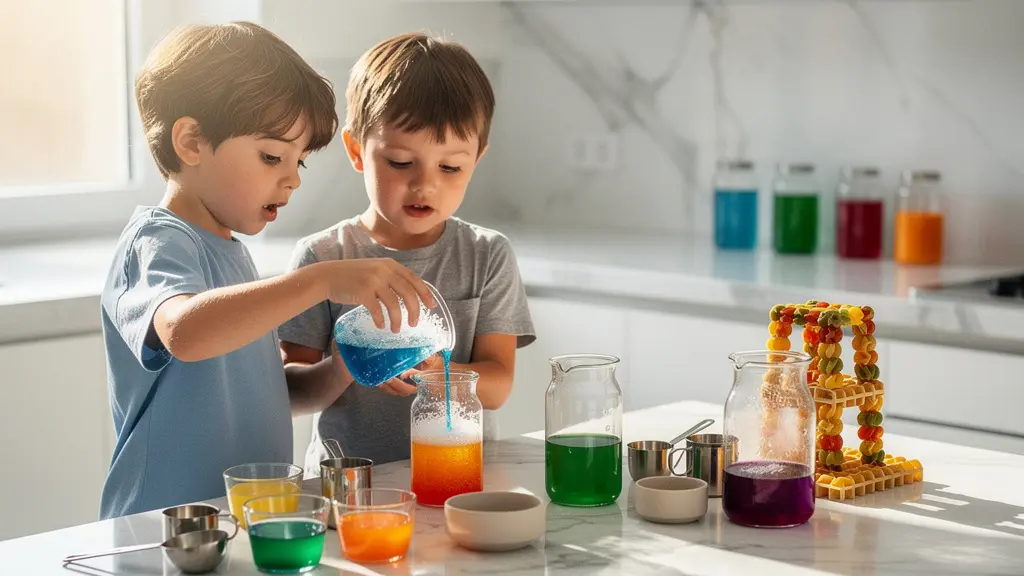
For many parents, the word “experiment” is synonymous with “mess.” The instinct is to control the environment, lay down newspapers, and hover with a sponge, ready to wipe away any spill. While well-intentioned, this “mess anxiety” can inadvertently short-circuit a child’s learning process. True understanding of cause and effect doesn’t come from a tidy demonstration; it comes from direct, hands-on, and often messy, interaction. When a child is free to pour, mix, and even spill, they are collecting raw data about the physical world.
A splash of vinegar isn’t just a mess; it’s evidence of the force they used. A sticky dough on their hands is a tangible lesson in viscosity. When we sanitize the process, we remove these critical sensory feedback loops. A child who has only ever seen a perfectly measured experiment unfold misses the chance to learn what happens when you add “too much” or “too little.” They learn the correct outcome but not the principles that govern it. Research on messy play confirms that children who engage in messy play show enhanced resilience, well-being, and a stronger foundation in early STEM learning.
The solution isn’t to let chaos reign but to reframe the concept of mess. Instead of a problem to be cleaned, view it as data to be analyzed. Create a “controlled mess zone” using a large baking sheet or a plastic tub. This designated “lab space” gives them the freedom to explore within boundaries. Afterward, the cleanup itself can become a follow-up experiment: Which works better on this oily stain, soap or just water? This teaches them about emulsification and turns a chore into another moment of discovery. By embracing the mess, you give your child permission to be a true scientist: one who pokes, prods, and learns from every outcome, tidy or not.
How to build a weight-bearing bridge using only paper and tape?
Engineering is, at its core, the art of solving problems with constraints. Asking a child to build a bridge strong enough to hold a toy car using only a few sheets of paper and some tape is a perfect introduction to this mindset. At first, they might just lay a flat sheet of paper across two books, only to see it collapse instantly. This “failure” is the first and most important data point: a flat shape is weak. This is where real engineering begins.
The next step is to guide their thinking. Don’t give them the answer. Ask, “What other shapes can we make with paper?” They might try rolling it into a tube or folding it like an accordion. Each attempt teaches them about how shape affects structural integrity. The accordion fold (corrugation) introduces pleats that distribute weight, a principle used in cardboard boxes. Rolling paper into columns demonstrates how cylinders can support heavy loads, just like the pillars of a real bridge. The triangle is the strongest shape in construction, and by taping paper triangles together, they can create a surprisingly strong truss bridge.
This paragraph introduces the concept of using simple materials for engineering. To visualize these principles in action, the image below shows a classic challenge using spaghetti and marshmallows.
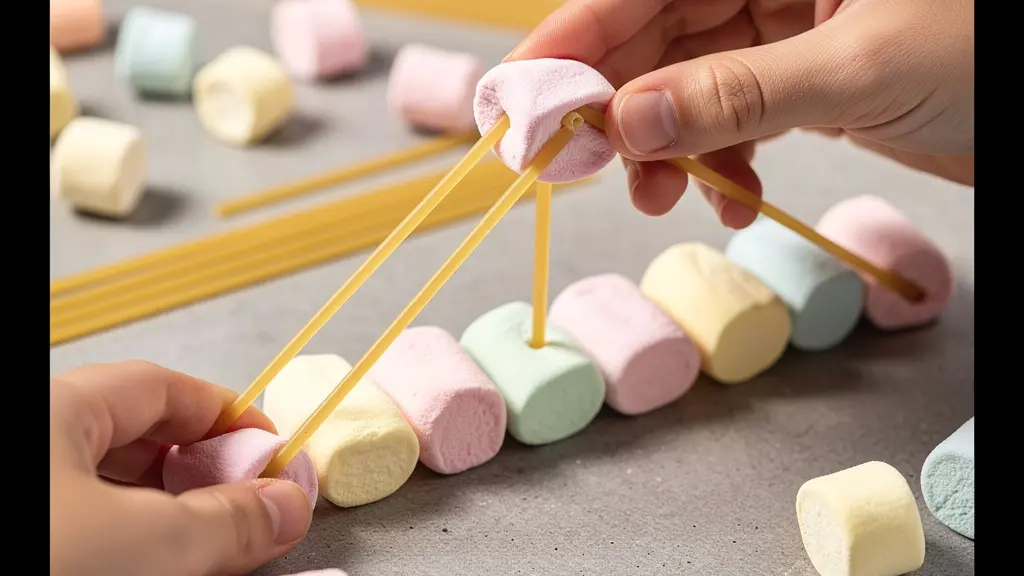
As this image of a spaghetti bridge shows, the same principles of triangulation and load distribution apply whether you’re using pasta or paper. These activities aren’t just about building; they are about discovering the physical laws that make structures strong. According to an overview of preschool engineering activities, these challenges enhance spatial awareness, boost fine motor skills, and introduce the foundational concepts of tension and compression in a way a textbook never could. The goal isn’t to build a perfect bridge, but to understand why one design works and another doesn’t.
Baking Bread or Making Salad: Which teaches more chemistry concepts?
At first glance, baking bread seems like the clear winner for a chemistry lesson. It involves yeast, heat, and a magical transformation from sticky dough to a fluffy loaf. It’s a fantastic showcase of irreversible chemical changes. As the I’m the Chef Too Educational Team notes, “Fermentation introduces the concept of living organisms transforming ingredients, producing gas that makes dough light and airy.” This is a profound biological and chemical event. You then have the Maillard reaction and caramelization, which create the golden-brown crust and complex flavors. These are changes you can’t undo; you can’t turn bread back into flour.
Fermentation introduces the concept of living organisms transforming ingredients, producing gas that makes dough light and airy.
– I’m the Chef Too Educational Team, Spark Curiosity: Delicious STEM Food Activities for Kids
However, dismissing the humble salad is a mistake. Making a salad is a masterclass in physical changes and solution chemistry. Chopping vegetables is a physical change—the lettuce is still lettuce, just in smaller pieces. The real science happens in the dressing. Mixing oil and vinegar is a perfect demonstration of immiscible liquids. Shaking them together creates a temporary mixture called an emulsion. Adding mustard or egg yolk introduces an emulsifier, a molecule that helps the oil and vinegar stay mixed longer. This is the same principle behind mayonnaise. A salad also teaches about enzymatic browning (why an apple turns brown after you cut it) and osmosis (why a cucumber gets watery when you salt it). As a comparative analysis of kitchen science shows, the two activities simply teach different things.
| Aspect | Baking Bread | Making Salad |
|---|---|---|
| Chemical Changes | Irreversible (Maillard reaction, gluten formation) | Mostly reversible physical changes |
| Key Reactions | Yeast fermentation, caramelization | Emulsification in dressing, enzymatic browning |
| Temperature Role | Critical for chemical reactions | Minimal temperature dependence |
| Biology Concepts | Living yeast organisms | Plant structures and osmosis |
So, which teaches more? Neither. They simply open different chapters of the chemistry textbook. Baking is about dramatic, heat-driven transformations, while salad-making is about the subtle physics and chemistry of mixtures and plant biology. The best approach is to do both, highlighting the different scientific principles at play in each delicious experiment.
The “Let Me Do It” mistake that ruins the discovery moment
It’s a moment every parent recognizes. Your child is struggling to pour the vinegar without spilling, and your hand reflexively reaches out with a “Here, let me do it.” In that instant, an experiment transforms into a demonstration, and a moment of potential discovery is lost. When a parent takes over, the child becomes a passive observer rather than an active participant. They see the outcome but are disconnected from the process that created it. The learning isn’t in seeing the volcano erupt; it’s in feeling the right amount of baking soda to add and seeing the consequences of their own actions.
The role of the parent in kitchen STEM isn’t to be the expert with all the answers, but the lead researcher who asks the right questions. Your job is to facilitate their thinking, not do the thinking for them. This approach is backed by research; studies on guided play show that responsive adults significantly improve children’s learning through exploration by providing prompts and encouragement rather than direct intervention. Instead of taking the measuring cup, try asking a question that guides them.
This shift from director to facilitator is powered by discovery-driven questions. These are open-ended prompts that encourage prediction, observation, and critical thinking. Instead of correcting their “mistake,” you create an opportunity for them to self-correct based on their own observations. This builds problem-solving skills and resilience, teaching them that “failed” experiments are just as valuable as successful ones because they provide new information. Here is a practical checklist to help you guide the discovery process without taking over.
Your Action Plan: Fostering Discovery with Probing Questions
- Before the Experiment: Ask them to predict the outcome. Use prompts like, “What do you think will happen when we mix the oil and water?” This establishes a hypothesis.
- During the Experiment: Encourage sensory observation. Ask, “What do you see, hear, or smell right now?” This focuses their attention on collecting data.
- After the Experiment: Prompt reflection and iteration. Ask, “If we did this again, what one thing would you change to get a different result?” This introduces the concept of changing variables.
- For “Failed” Experiments: Frame it as a discovery. Ask, “That didn’t do what we expected! What did we learn about these ingredients?” This normalizes failure as part of the scientific method.
- Connecting to the Real World: Ask them where else they’ve seen something similar. “Does this fizzy reaction remind you of anything else, like a can of soda?” This helps them generalize the concept.
How to teach algorithms using a deck of cards?
The word “algorithm” sounds intimidatingly technical, often associated with complex computer code. But at its heart, an algorithm is simply a set of step-by-step instructions for completing a task. A card game like “War” or “Go Fish” is a perfect example of an unplugged algorithm: there’s a clear sequence of actions (deal, flip, compare, collect) that you follow to reach a goal. While cards are a great tool, you can find even more intuitive examples right in your kitchen, turning everyday chores into lessons in algorithmic thinking.
A recipe is one of the most accessible algorithms for a child. It has a list of ingredients (variables) and a sequence of instructions that must be followed in a specific order. A fantastic activity is “Recipe Debugging.” Present your child with a simple recipe, like for a smoothie, but with the steps jumbled up. “Blend the fruit” might be listed before “Wash the fruit.” Their job is to “debug” the recipe by putting the steps in the correct logical order. This teaches the critical concept of sequencing in a fun, low-stakes context. As one educational resource points out, cooking requires precision, helping children understand that both science and coding require exact sequences.
You can take this a step further with other kitchen-based activities. The “Sandwich Bot” game is a hilarious and effective way to teach the need for precise instructions. The parent acts as a robot that can only follow literal commands. If the child says, “Put the peanut butter on the bread,” the parent might place the entire jar on top of the loaf. The child quickly learns they need to be more specific: “Unscrew the lid. Pick up the knife. Dip the knife in the jar…” Another great activity is using different pasta shapes to teach sorting algorithms. Give them a mixed bowl of penne, fusilli, and shells and ask them to sort them into separate piles. This physical act of sorting is a tangible representation of how computers organize data.
How to boost memory retention using only household items?
How do we help children remember the scientific principles they discover during a fun kitchen experiment? The key is to move from passive experience to active documentation. Simply doing an activity is fun, but to make the learning stick, a child needs to process and record their observations. This doesn’t require a fancy lab notebook; some of the most effective tools are already in your kitchen drawers.
The very act of drawing or writing about an experiment engages different parts of the brain, reinforcing the memory. The connection between physical action and mental recall is strong; research consistently shows that early visual and motor skills are directly related to later math and language skills. When a child draws the “before” and “after” of their baking soda and vinegar reaction, they are solidifying the concept of a chemical change in their mind. This act of documentation is a powerful memory-boosting tool.
Encourage them to create a “lab notebook” out of anything on hand. A roll of paper towels is perfect for this. Each sheet can represent one step of the experiment. They can draw the ingredients, the setup, and the final result. This visual sequence tells a story that is far more memorable than a verbal explanation from a parent.
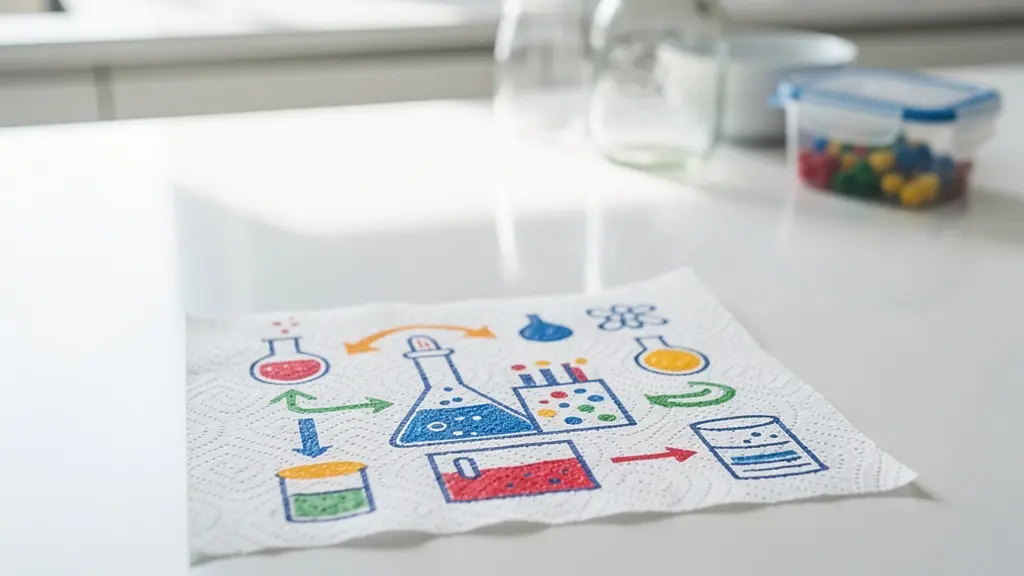
As seen here, a simple paper towel can become a canvas for scientific storytelling. This process also encourages them to identify the most important parts of the experiment. What was the key action that caused the change? What were the key results? This process of summarizing and visualizing is a critical skill for memory retention. Other household items can serve as memory aids too. Use different colored beads or pasta shapes to represent different molecules in a reaction, creating a physical model they can manipulate and remember.
Why holding the numbers helps them understand the concept?
For young children, numbers can be a strange and abstract concept. They can recite “one, two, three,” but the idea that the symbol “3” represents a specific quantity can be elusive. The kitchen provides the perfect laboratory for making numbers concrete, tangible, and “holdable.” When a child can physically interact with numbers, the abstract concept clicks into place. This is the foundation of number sense—an intuitive understanding of what numbers mean.
A kitchen scale is a magical tool for this. As a child adds spoonfuls of flour to a bowl on the scale, they see the numbers physically increase with each addition. This creates a direct, one-to-one correspondence between their action and the numerical representation of weight. They are literally “making the number go up.” You can ask them to predict, “What number do you think we’ll get if we add one more scoop?” This turns a simple measurement into an experiment in estimation and quantity.
This principle of tangibility can be applied to many mathematical concepts. Fractions, for example, are notoriously difficult. But when you give a child a chocolate bar and ask them to break it in “half,” and then into “quarters,” the concept becomes immediately clear. They can hold a “quarter” in their hand. It’s not an abstract `1/4`; it’s a delicious piece of chocolate. The same works for segmenting an orange or cutting a pizza. These activities provide a physical, sensory anchor for the abstract mathematical idea. Here are a few simple ways to make math tangible in the kitchen:
- Estimation Station: Fill a few clear jars with different items like beans, pasta, or marshmallows. Have your child first guess how many are in each jar (estimation), and then count them out to check their answer.
- Fraction Fruit: Use apples, bananas, or oranges to demonstrate fractions. Cutting an apple into halves, then quarters, then eighths provides a clear, visual, and holdable lesson.
- Counting & Grouping: Use cereal, raisins, or chocolate chips for simple counting, addition, and subtraction problems. Asking them to create “three groups of five raisins” is a hands-on introduction to multiplication.
Key takeaways
- Embrace the mess as valuable data; it’s where children learn about cause, effect, and physical properties firsthand.
- Your role isn’t to be the expert, but the lead facilitator who asks probing questions to guide discovery and critical thinking.
- Abstract concepts like algorithms and fractions become concrete and understandable when taught through tangible, hands-on kitchen activities.
How Does Bilingualism or Music Learning Boost Cognitive Development?
You might wonder what learning a second language or a musical instrument has to do with making a volcano out of baking soda. The answer is: everything. They are all forms of advanced brain training that build the same core cognitive muscles. Bilingualism and music learning are famous for enhancing cognitive flexibility—the brain’s ability to switch between different tasks, rules, or mental sets. A bilingual person constantly inhibits one language while speaking another, which is a powerful mental workout. Similarly, a musician reads notes, listens to pitch, and coordinates fine motor movements all at once.
STEM activities, especially the kind you can do in the kitchen, function in the same way. They are not just about learning facts; they are about training the brain to think in different modes. As one educational research team puts it, “Just as bilingualism improves cognitive flexibility by switching between rule sets, STEM activities train the brain to switch between creative modes (hypothesizing) and logical modes (testing).” When a child predicts what will happen in an experiment, they are in a creative, imaginative mode. When they measure the ingredients and observe the results, they switch to a logical, analytical mode. This constant switching is what builds a more agile and resilient brain.
The impact of this kind of thinking is not trivial. It’s a foundational skill for future academic success. A comprehensive meta-analysis has shown that STEM education shows a significant impact on cognitive ability, particularly in later school years. The hands-on, problem-solving nature of kitchen science provides the same kind of mental “cross-training” as learning an instrument or a new language. It teaches children how to approach a problem, form a plan, execute it, and analyze the results—a universal skill set that applies far beyond the kitchen.
Just as bilingualism improves cognitive flexibility by switching between rule sets, STEM activities train the brain to switch between creative modes (hypothesizing) and logical modes (testing).
– Educational Research Team, I’m the Chef Too STEM Education Blog
Therefore, when you’re doing these simple experiments, remember that you’re not just making a mess or a snack. You are providing a world-class cognitive workout, building the same mental pathways that lead to fluency in language, music, and critical thought. It’s one of the most powerful forms of brain development, and it’s accessible to everyone with a kitchen and a bit of curiosity.