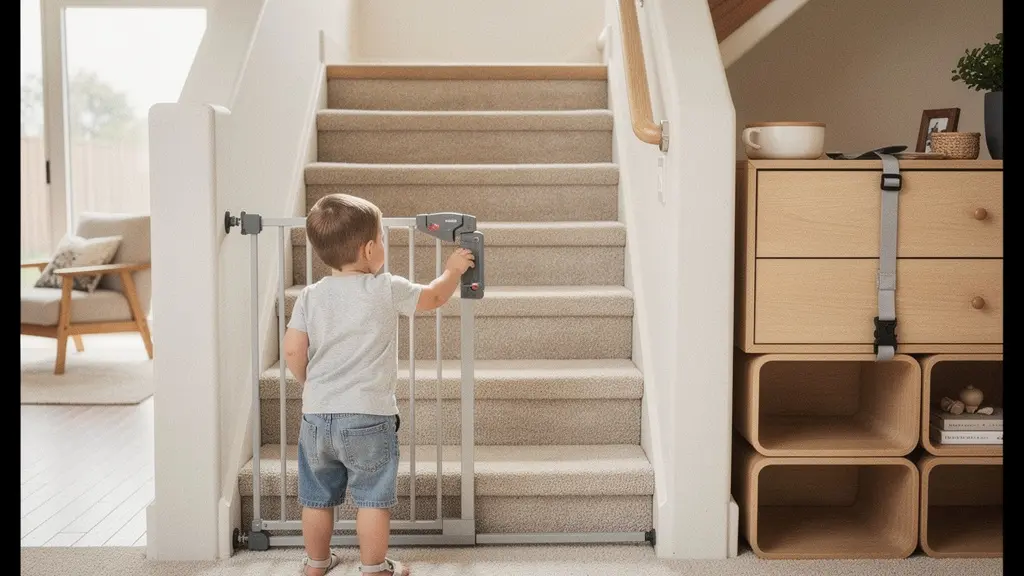
True home safety for toddlers isn’t about constant supervision; it’s about engineering a passive safety system that neutralizes hazards before an accident is possible.
- Verbal warnings fail because toddlers lack the brain development for impulse control. Environmental controls are the only reliable solution.
- Hardware-mounted gates are mandatory at the top of stairs. Pressure-mounted gates create a deadly failure point.
- Anchoring heavy furniture is non-negotiable, even in rentals, and can be done without losing your security deposit.
Recommendation: Shift your mindset from ‘watching your child’ to ‘engineering their environment.’ Analyze and eliminate every potential fall and tip-over hazard with physical barriers and anchors.
That heart-stopping moment is a universal rite of passage for parents: you turn your back for a second, and your newly mobile toddler is halfway up the stairs or pulling themselves up on a wobbly piece of furniture. The immediate instinct is to shout “No!” or “Be careful!” We believe that by teaching rules, we can instill caution. But as a professional childproofer, I can tell you this approach is fundamentally flawed and dangerously optimistic.
The common advice to “just watch your kids” or “teach them the boundaries” ignores the core reality of a toddler’s development. Their brains are not built for impulse control. They are wired for one primary mission: exploration. This unstoppable drive, which I call the exploration imperative, means they will climb, pull, and test every object in their path, regardless of your warnings. Relying on verbal commands to protect a child from the laws of physics is a losing battle.
The only effective strategy is to create a passive safety system—an environment so thoroughly engineered for safety that a child is protected even during the inevitable “supervision gaps” that occur throughout the day. This isn’t about restricting your child; it’s about creating a home where their freedom to explore doesn’t come with the risk of a life-altering injury. It requires a shift in mindset from reacting to danger to proactively eliminating it.
This guide will walk you through the non-negotiable, professional-grade rules for securing the two biggest hazards in any home: stairs and heavy furniture. We will move beyond generic tips to provide the specific, actionable knowledge you need to build a truly safe environment for your child to thrive.
Summary: A Professional’s Guide to Keeping Toddlers Safe from Stairs and Furniture Tip-Overs
- Why verbal warnings fail to protect kids under 3 from danger?
- How to anchor heavy dressers in a rental without losing your deposit?
- Pressure Gates or Hardware Mounted: Which is mandatory for top of stairs?
- The supervision gap that occurs when relying on a 6-year-old
- What are the 3 living room hazards most parents overlook?
- Why low shelves change behavior better than repeated verbal instructions?
- Why shoes and backpacks should never pass the entryway?
- Designing a Child-Friendly Environment That Promotes Independence
Why verbal warnings fail to protect kids under 3 from danger?
A toddler’s job is to explore. A parent’s job is to make that exploration safe. The fundamental conflict arises when we try to use adult logic—verbal instructions and warnings—to control a toddler’s innate, biological drive. Shouting “No, don’t climb that!” is often futile because a child under three operates primarily on impulse, not logic. Their prefrontal cortex, the brain’s center for judgment and impulse control, is years away from full development.

This developmental stage is defined by the exploration imperative. A toddler sees a set of stairs not as a hazard, but as a mountain to be conquered. A dresser is not a potential tip-over threat, but a fascinating ladder. Their curiosity is a powerful, non-negotiable force. Expecting them to remember and obey a rule in the face of such a compelling urge is unrealistic. Research into the development of inhibitory control shows this ability grows throughout early childhood but is incredibly fragile in the toddler years. They are not being defiant; they are being toddlers.
Therefore, safety cannot be based on a child’s behavior. It must be built into the environment itself. A passive safety system removes the hazard, making the child’s behavior irrelevant to the outcome. A properly installed gate doesn’t ask a toddler to remember a rule; it physically prevents access to the stairs. An anchored dresser doesn’t rely on a child to resist climbing; it makes the climb harmless. This is the cornerstone of professional childproofing: control the environment, not the child’s impulses.
How to anchor heavy dressers in a rental without losing your deposit?
For parents who rent their homes, the fear of losing a security deposit often creates a dangerous hesitation when it comes to anchoring furniture. The reality is that all tall, heavy, or unstable furniture—dressers, bookcases, TVs, and entertainment centers—must be anchored to a wall. A tip-over accident happens in seconds and can be fatal. The risk of losing a deposit is trivial compared to the risk to your child’s life. Fortunately, you don’t have to choose between safety and your deposit.
The key is to use a method that creates minimal, easily repairable damage. While adhesive-based anchors exist, their reliability can be questionable, especially on textured walls or with heavier furniture. The professional standard involves screwing an anchor into a wall stud for maximum security. The resulting small holes are simple to patch perfectly before you move out, leaving no trace.
To help you choose the right method for your situation, this table compares common anchoring solutions suitable for rental properties. Notice how traditional wall anchors provide the highest weight capacity for a very low cost, with the only downside being easily repairable holes.
| Solution Type | Damage Level | Weight Capacity | Installation Time | Cost Range |
|---|---|---|---|---|
| Adhesive-based anchors | No damage | Up to 100 lbs | 5 minutes | $15-30 |
| Tension-based furniture straps | Minimal (small marks) | Up to 150 lbs | 10 minutes | $20-40 |
| Traditional wall anchors | Repairable holes | 200+ lbs | 20 minutes | $10-25 |
| Furniture replacement (low units) | No damage | N/A | Varies | $100+ |
When you are ready to move out, a simple “Perfect Patch Method” will make those screw holes disappear. It’s a small task that ensures you’ve met the most critical safety standard in your home without financial penalty. Taking 20 minutes to install a secure, traditional anchor is a non-negotiable investment in your child’s safety.
Pressure Gates or Hardware Mounted: Which is mandatory for top of stairs?
This is the single most important rule in childproofing: a pressure-mounted gate must never, under any circumstances, be used at the top of a staircase. This is not a suggestion; it is a life-or-death mandate. The risk is catastrophic. A toddler’s full body weight pushing or falling against a pressure-mounted gate can easily dislodge it, causing both the gate and the child to tumble down the stairs. Stairway-related injuries are a major source of emergency room visits, with data indicating nearly 89,000 ER visits yearly for kids under 5 from these incidents.
The only acceptable solution for the top of stairs is a hardware-mounted gate. As the team at Mom Loves Best states in their comprehensive guide, this is a critical distinction for ensuring safety:
Hardware-mounted gates screw directly into the wall studs or banister, providing a secure hold that won’t dislodge if a child pushes on it. Avoid pressure-mounted gates here.
– Mom Loves Best Editorial Team, How To Babyproof Stairs: Step-By-Step Guide
Pressure-mounted gates, which work by creating tension against walls, are only suitable for bottom-of-stair applications or for blocking off rooms on the same level. They are a convenience product, not a top-of-stair safety device. Once a hardware-mounted gate is installed, your work is not done. Safety is an ongoing process, and regular checks are essential to ensure the gate remains secure.
Quarterly Gate Safety Audit: Your 6-Point Checklist
- Check screw tightness with the appropriate screwdriver; tighten if any play is detected.
- Inspect wall plugs for integrity; replace them if they are cracked or loose.
- Test the latch mechanism function; it should require deliberate adult pressure to open.
- Examine the gate frame for warping or damage, especially at stress points.
- Verify the gate height remains adequate as the child grows (minimum 22 inches from the floor).
- Test the auto-close function if applicable; adjust spring tension if needed.
The supervision gap that occurs when relying on a 6-year-old
In busy households, it’s tempting to ask an older child to “watch your little brother for a minute.” While well-intentioned, relying on a young sibling for supervision is a critical safety error. A 6-year-old, despite seeming responsible, lacks the cognitive abilities, attention span, and understanding of risk required to be an effective supervisor for a toddler. This creates a dangerous supervision gap—the period where a toddler is assumed to be watched but is effectively unsupervised.
A 6-year-old is easily distracted by a TV show, a toy, or their own thoughts. They cannot anticipate a toddler’s sudden, impulsive actions. They do not comprehend that a toddler pulling on a lamp cord could bring the heavy object crashing down, or that climbing onto a sofa arm places them at risk of a serious fall. Assigning this responsibility to a young child is not only ineffective but also unfair to them, placing them in a position to fail with potentially tragic consequences.
The only solution for managing supervision gaps is active containment. When you know you will be distracted—whether by cooking, taking a work call, or using the restroom—the toddler must be placed in a 100% safe, pre-approved area. This could be their crib, a playpen, or a room that has been meticulously childproofed with all hazards removed and the door securely latched.
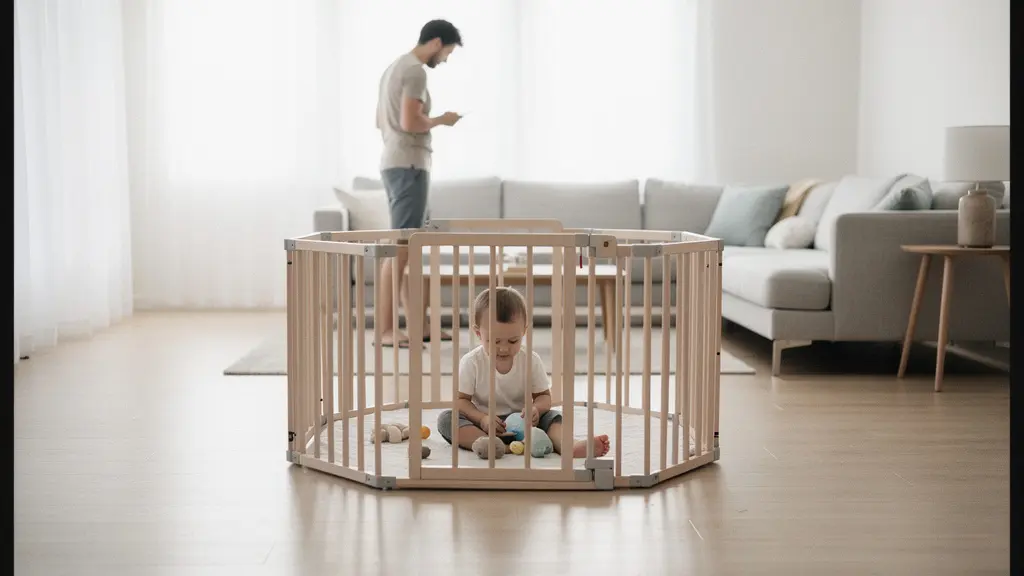
This strategy is part of a passive safety system. It acknowledges that no parent can provide constant, undivided attention 100% of the time. Instead of relying on a fallible human supervisor (whether an adult or another child), you rely on an infallible physical environment. Active containment isn’t a punishment; it’s a proactive safety measure that protects your toddler during the most vulnerable moments of the day.
What are the 3 living room hazards most parents overlook?
While stairs and dressers are well-known dangers, the living room often contains subtle but serious hazards that are easy to overlook. The speed at which these situations can escalate is alarming; as the Center for Injury Research and Policy at Nationwide Children’s Hospital reports, a child under five is treated in an emergency room for a stair-related injury every six minutes. Many similar accidents originate with common living room objects. A professional assessment focuses on identifying and neutralizing these less obvious threats.
Parents are often so accustomed to their own living space that they develop “hazard blindness,” failing to see the room from a toddler’s curious and climbing-focused perspective. From a childproofer’s viewpoint, here are the three most critical categories of overlooked hazards that must be addressed immediately.
1. Pull-Down Dangers
Toddlers use their hands to explore and pull themselves up. Anything that dangles is an invitation to pull. This includes tablecloths (which can bring hot food or heavy objects down with them), charging cords for laptops and phones, and, most notoriously, the pull-cords on window blinds, which pose a severe strangulation risk. The rule is simple: if it dangles, it’s a danger. Secure all cords, replace blinds with cordless versions, and remove tablecloths from accessible tables.
2. Unstable Decorative Items
That tall, stylish floor lamp in the corner can be easily pulled over. A large potted plant can be tipped, spilling heavy soil. Even a stack of magazines or a decorative ladder leaning against a wall can become an accident waiting to happen. You must walk through your living room and test the stability of every single item. Anchor tall lamps and shelving to the wall, move heavy plants to inaccessible areas, and remove any decorative items that are not completely stable.
3. Furniture as Launch Points
The most overlooked hazard is the relationship between pieces of furniture. A sofa pushed up against a low windowsill effectively becomes a step-stool to an open window. A chair placed near a countertop gives a toddler access to everything on that surface, from knives to medications. You must analyze your furniture layout not for aesthetics, but for a toddler’s climbing trajectory. Reposition furniture to create “buffer zones” around windows, railings, and kitchen counters, blocking potential climbing routes to more dangerous areas.
Why low shelves change behavior better than repeated verbal instructions?
A common source of frustration for both parents and toddlers is the constant battle over “off-limits” items. When a toddler repeatedly tries to grab a TV remote or pull books off a high shelf, our instinct is to say “No!” and take the item away. This cycle of restriction and frustration is exhausting and ineffective because it works against the child’s developmental needs. A more effective strategy, rooted in Montessori principles, is to design an environment that makes the desired behavior the easiest option.
Low, open shelving stocked with age-appropriate toys and books creates a “Yes Space.” In this space, the child is empowered to make their own choices, touch, and explore freely without hearing “no.” This simple environmental change does more to shape behavior than a thousand verbal commands. It redirects their exploration imperative toward safe and approved activities. It respects their need for autonomy and removes the source of conflict, fostering a more peaceful home environment.
This approach directly supports a toddler’s developing brain. As researchers note, a predictable and accessible environment is a key factor in developing self-regulation. In their paper on cognitive development, one team of experts highlights this connection:
Predictable routines can support children’s emerging self-control capacities
– Tarullo, A.R., Obradovic, J., & Gunnar, M.R., Self-Control and the Developing Brain
By making their own toys and books accessible on low shelves, you create a predictable routine: “These are my things, and I can access them myself.” This fosters independence, builds confidence, and drastically reduces the frustrating power struggles over forbidden objects. You are not just organizing toys; you are engineering a more cooperative and developmentally supportive environment.
Why shoes and backpacks should never pass the entryway?
The entryway of your home is more than just a place to hang coats; it is a critical transition point that should function as a “buffer zone” between the uncontrolled outside world and the safe, controlled environment inside. Establishing a strict rule that shoes, backpacks, and other outdoor items are removed immediately upon entry is a simple but powerful safety protocol. This isn’t just about cleanliness; it’s about preventing hidden hazards from migrating into your child’s living space.
Shoes can track in small, sharp objects like pebbles or glass shards, which pose a serious choking risk to a crawling baby or toddler. They can also carry residues of lawn chemicals, road salt, or other toxic substances. Backpacks and purses often contain small items like coins, pen caps, or loose hardware that can easily fall out and become choking hazards. By containing these items in the entryway, you physically prevent these dangers from ever reaching the areas where your child plays.
The following table details some of the hidden dangers that can be brought into the home and how a simple entryway protocol can mitigate the risk.
| Item Type | Hidden Hazard | Risk Level | Prevention Method |
|---|---|---|---|
| Shoes | Small pebbles, glass shards | High (choking) | Shoe rack at entrance |
| Backpacks | Loose hardware, small items | Medium | Designated hooks |
| Winter boots | Road salt, chemical residue | High (toxic) | Boot tray with mat |
| Sports equipment | Dirt clumps, sharp objects | Medium | Garage storage |
To make this rule effective, the entryway must be designed for success. Install low hooks that older children can reach for their own backpacks. Place a shoe rack or a series of open bins at floor level. A boot tray is essential for wet or snowy weather. By creating a designated, easy-to-use spot for everything, you transform a rule from a chore into an automatic habit for the whole family, reinforcing the boundary of your home’s passive safety system.
Key Takeaways
- Any gate used at the top of a staircase must be hardware-mounted directly into the wall studs. No exceptions.
- All heavy or tall furniture (dressers, bookcases, TVs) must be anchored to the wall, even in rental properties.
- Create “safe zones” for active containment (like a playpen or childproofed room) for the inevitable moments when you cannot provide 100% direct supervision.
Designing a Child-Friendly Environment That Promotes Independence
Ultimately, the goal of professional childproofing is not to create a sterile, restrictive bubble. It is to design a home that intelligently manages risk so that a child can safely develop autonomy and independence. A passive safety system liberates both the parent and the child: the parent is freed from constant anxiety, and the child is freed to explore, learn, and grow within secure boundaries. The daily toll of fall-related injuries, with approximately 8,000 children treated daily in U.S. emergency rooms, underscores the urgent need for this proactive approach.
Thinking of your home in terms of safety zones is a powerful framework. A “Green Zone” (like a child’s bedroom) is an area so thoroughly secured that it allows for unsupervised play. A “Yellow Zone” (like the living room) is safe for exploration but requires adult supervision. A “Red Zone” (like a garage or laundry room) is always off-limits. This mental model helps you assess risk and manage supervision levels effectively throughout the day.
This philosophy extends beyond just preventing injury. When you install low hooks for coats, place their favorite cups on an accessible shelf, or create a reading nook with books at their level, you are sending a powerful message: “You are capable. This is your home, too.” Every element that empowers them to do something for themselves builds confidence and reduces frustration. True safety design fosters independence, not dependence. It is the foundation upon which a child can build confidence and explore their world securely.
Zoned Home Safety Framework: Your Action Plan
- Green Zone Setup: Designate the child’s bedroom as a “Green Zone.” Remove all hazards, ensure all furniture is anchored, and provide only age-appropriate toys. This is your go-to space for safe, unsupervised play.
- Yellow Zone Rules: Identify shared spaces like the kitchen and living room as “Yellow Zones.” Install safety latches, corner guards, and outlet covers. Constant supervision is required here, but the environment is pre-secured to minimize risk.
- Red Zone Barriers: Areas like the garage, laundry room, and home office are “Red Zones.” They must be secured with locked doors or high latches, making them completely inaccessible to a toddler without an adult.
- Transition Planning: As your child’s skills and understanding grow, you can gradually introduce more supervised exploration in Yellow Zones, teaching them how to navigate these spaces safely.
- Weekly Safety Walk: Once a week, walk through your home from a toddler’s perspective. Check the integrity of your zones and update your safety measures based on your child’s new mobility skills.
By adopting this engineering mindset, you move from a state of constant, reactive fear to one of proactive, confident management. You create a home that is not just free from danger, but rich with opportunities for safe, independent growth.
Start today. Take a systematic walk through your home, not as a parent, but as a safety engineer. Identify every potential fall, tip-over, and pull-down hazard, and implement the physical solutions outlined in this guide. Your child’s safety depends not on your constant vigilance, but on the integrity of the safe environment you build for them.