Activities & Leisure
The hours children spend outside of formal instruction—in play, exploration, creative pursuits, and physical challenges—shape their cognitive, emotional, and social development as profoundly as any classroom lesson. Yet modern families often struggle with a paradox: children have access to more toys, programs, and entertainment options than ever before, while simultaneously experiencing less self-directed play, unstructured outdoor time, and opportunities to discover their genuine interests through trial and experimentation.
This tension between abundance and authentic engagement lies at the heart of thoughtful parenting around activities and leisure. The goal isn’t to fill every hour with enrichment or to achieve a perfect balance between screen time and nature connection. Instead, it’s about understanding how different types of play serve different developmental purposes, how to create environments that invite exploration rather than passive consumption, and when to step back so children can build the resilience, creativity, and self-knowledge that emerge only through unmediated experience.
The following exploration examines the foundational principles that transform leisure time from mere distraction into genuine development—covering everything from the neuroscience of boredom to the social dynamics of the bench, from selecting toys that grow with your child to knowing when a hobby should remain just that.
The Foundation: Why Boredom and Unstructured Time Matter
Perhaps the most counterintuitive principle in child development is that boredom serves as a catalyst for creativity rather than a problem to solve. When children complain they have “nothing to do,” their brains are actually in a fertile state—scanning their environment for novelty, making unexpected connections between existing knowledge, and rehearsing scenarios that prepare them for future challenges.
Unstructured activity allows children to practice executive function skills without adult scaffolding. They must generate their own goals, sustain attention without external rewards, shift strategies when initial attempts fail, and regulate the frustration that accompanies genuine problem-solving. A child building an imaginary restaurant with cushions and kitchen utensils is simultaneously developing planning capacity, symbolic thinking, and emotional regulation—skills that structured activities rarely demand in combination.
The common mistake lies in intervening too early when children appear stuck or aimless. Adults often interpret the transitional state between activities as distress rather than the necessary precursor to self-initiated engagement. Research on creative problem-solving consistently demonstrates that breakthrough insights emerge after periods of diffuse attention rather than focused effort. The fidgeting ten-year-old staring out the window may be consolidating learning, processing social interactions, or incubating the next phase of their elaborate imaginary world.
Creating space for this unstructured time requires resisting cultural pressure to fill schedules with programmed enrichment. It means tolerating the discomfort of a child’s complaint that they’re bored without immediately offering entertainment solutions, and trusting that the human brain naturally seeks engagement when given freedom and appropriate constraints.
Choosing and Organizing Materials That Invite Engagement
The distinction between open-ended and specific-purpose items fundamentally shapes how children interact with their environment. A set of blocks can become a castle, a road system, a balance scale, or an abstract sculpture. A battery-operated toy that performs a predetermined sequence offers entertainment but rarely invites the kind of manipulation that builds spatial reasoning or hypothesis testing.
Parents frequently make purchasing decisions based on age labels, assuming manufacturers have optimized developmental appropriateness. In reality, these labels primarily serve marketing purposes and liability concerns. A well-designed wooden puzzle marketed for ages three to five may engage a seven-year-old in geometry exploration, while a “STEM toy” with flashing lights may provide less cognitive challenge than a cardboard box and tape.
The Problem With Excessive Stimulation
Electronic features—particularly lights, sounds, and automated movements—often interrupt rather than enhance the learning process. When a toy provides immediate sensory reward without requiring the child to generate the action, it positions the child as audience rather than agent. The neural pathways that develop through cause-and-effect experimentation need the child to be the source of causation, observing how their specific actions produce specific results.
Selecting Items That Grow With Your Child
The most economically and developmentally valuable materials adapt to increasing sophistication. Simple wooden blocks serve a one-year-old practicing grasp and release, a three-year-old building towers and testing gravity, a six-year-old creating symmetrical patterns, and a ten-year-old engineering load-bearing structures. This longevity occurs because the material itself has no predetermined “correct” use—the child’s developing cognition brings new possibilities to the same object.
Organization to Reduce Decision Fatigue
Paradoxically, too many visible options create overwhelm rather than opportunity. Children faced with bins overflowing with mixed toys often default to familiar patterns or claim nothing interests them. A rotation system—where most items remain stored and a curated selection appears periodically—restores novelty without requiring new purchases. Items that haven’t been seen for six weeks trigger the same exploratory interest as new acquisitions, particularly when children have developed new capabilities in the interim that allow fresh approaches to familiar materials.
Hands-On Learning Through STEM Exploration
Science, technology, engineering, and mathematics learning happens most powerfully through direct physical manipulation rather than explanation or demonstration. A child who helps bake bread develops intuitive understanding of ratios, chemical reactions, and temperature effects that no video or textbook can replicate. The sensory feedback—dough that’s too sticky or too dry, the yeast smell that indicates fermentation, the visual transformation in the oven—creates embodied knowledge that becomes the foundation for later abstract reasoning.
Messy play proves crucial for scientific understanding because variables become tangible. When children mix cornstarch and water, they’re conducting polymer science experiments. The “magic” of a substance that behaves as solid under pressure and liquid under gentle touch invites hypothesis formation: What happens if I add more water? Less? What if I refrigerate it? This iterative experimentation—the core of the scientific method—emerges naturally from materials that respond variably to manipulation.
Engineering Challenges in Everyday Spaces
Formal engineering principles become accessible through household challenges. Building a bridge between two chairs using only paper and tape introduces concepts of tension, compression, and load distribution. The goal isn’t correct terminology but rather the physical experience of failure modes: bridges that collapse in the middle versus those that disconnect at anchor points require different design solutions, teaching through immediate feedback what engineering textbooks struggle to convey.
When Adult Involvement Undermines Learning
The instinct to prevent failure or accelerate success—taking over an experiment that’s going slowly or correcting an approach that seems inefficient—robs children of the most valuable learning moment. The child who successfully launches a vinegar-and-baking-soda rocket after twelve failed attempts develops persistence, troubleshooting skills, and genuine ownership of the knowledge. The child whose parent “helps” by doing the tricky parts learns that adults solve problems while children watch.
Effective support involves asking open-ended questions rather than providing answers: “What do you notice about the trials that went furthest?” or “Which variable do you want to change next?” This positions the adult as interested collaborator rather than expert authority.
Movement as Play Rather Than Exercise
The word “exercise” carries connotations of obligation and body optimization that can create resistance, particularly in children who don’t identify as athletic. Reframing physical activity as exploration, challenge, or play removes the performance pressure while maintaining the developmental benefits of gross motor skill development.
An obstacle course created from couch cushions, painter’s tape, and laundry baskets provides the same cardiovascular and coordination work as formal sports, but with the added cognitive demand of route planning and the creative satisfaction of environmental design. Children who help design the course develop spatial reasoning and executive function while naturally engaging in the physical challenges they’ve created.
Solo Activities Versus Team Sports: Finding Individual Fit
The temperamental match between child and activity format matters more than the activity itself. Some children thrive on the social dynamics and shared goals of team environments, while others experience team settings as socially overwhelming, finding their optimal challenge state in individual pursuits where pacing and intensity remain under personal control. Neither preference indicates future athletic potential or social capability—they reflect how an individual nervous system processes stimulation and finds engagement.
The Risk of Pushing Too Hard Too Soon
Early childhood represents a sensitive period for developing positive associations with physical movement. Children who experience movement as joyful exploration tend to maintain active lifestyles into adulthood, while those who associate physical activity with adult pressure, performance anxiety, or body criticism often develop lasting aversion. The long-term goal isn’t elite skill development at age seven—it’s building the intrinsic motivation that sustains lifetime engagement.
Creative Expression for Emotional Development
Art-making serves purposes far beyond the finished product. The process of selecting colors, manipulating materials, and translating internal experience into external form helps children understand and regulate their emotional states. A child who’s experienced a frustrating day may find that pounding playdough provides socially acceptable aggression release, while watercolor’s unpredictable bleeding might appeal to a child who needs to practice accepting imperfect outcomes.
The distinction between process art and product art illuminates different purposes. Process art prioritizes the experience—exploring how materials behave, experimenting with techniques, following curiosity without predetermined goals. Product art aims toward a specific result, often with adult-defined criteria for success. Both have value, but children experiencing anxiety or perfectionism particularly benefit from process approaches that remove the possibility of failure.
Setting Up a “Yes Space” for Art
Environmental design determines whether art-making feels accessible or burdensome. A designated area where spills don’t matter, materials remain accessible at child height, and cleanup tools are integrated into the space removes the friction that prevents spontaneous creativity. This doesn’t require dedicated rooms—a washable mat, a low shelf with basic supplies, and clear expectations about boundaries can transform a kitchen corner into an invitation for daily creative practice.
Common Mistakes That Undermine Confidence
Correcting the realism of children’s drawings applies adult aesthetic standards to developmental stages where symbolic representation serves different purposes. A six-year-old’s purple horse with three legs isn’t a mistake requiring correction—it’s visual problem-solving about how to represent a four-legged creature on two-dimensional space, or a narrative choice about a magical creature, or simply an exploration of color preferences. Critique at this stage teaches children that art serves adult approval rather than personal expression.
Alternatively, thoughtfully displaying children’s artwork—rotating pieces on a designated wall, using frames that make work feel valued, or creating portfolios that show progression—builds self-esteem through tangible evidence that their efforts and ideas matter enough for preservation.
Sports as a Laboratory for Life Skills
Organized sports offer a unique environment for learning resilience, social dynamics, and character—when adults frame the experience appropriately. The developmental value lies not in winning or skill mastery but in navigating disappointment, inequity, and sustained commitment under real-world conditions that can’t be perfectly controlled.
The benchwarmer role, while painful, teaches lessons about systems larger than individual effort, the reality of unequal opportunity, and the choice to maintain commitment even when recognition doesn’t follow. These experiences, processed with empathetic adult support, build psychological flexibility that transfers to academic setbacks, workplace hierarchies, and relationship challenges throughout life.
When to Honor the Desire to Quit
The balance between teaching commitment and respecting genuine misfit remains one of parenting’s more nuanced challenges. Finishing the current season honors agreements made to teammates and develops follow-through, but forcing participation in subsequent seasons when a child has thoroughly explored an activity and found it genuinely unsuitable teaches that their self-knowledge matters less than adult expectations. The key distinguishing factor often lies in whether the child wants to quit all similar activities or is specifically trying to exit one team, coach, or format while remaining interested in the broader pursuit.
What Not to Do on the Ride Home
The post-game analysis—dissecting plays, correcting decisions, or expressing disappointment about performance—transforms what might have been self-contained experience into an extended evaluation that makes children feel perpetually observed and assessed. The child who already knows they missed the critical shot doesn’t need the drive home to reinforce the failure. They need a parent who can hold space for disappointment without amplifying it, and who communicates that their worth isn’t contingent on athletic performance.
Cultivating Interests Beyond Structured Programming
True leisure—time spent on self-directed interests pursued for intrinsic satisfaction rather than external goals—becomes increasingly rare as schedules fill with optimized enrichment. Yet the capacity to engage deeply with a subject purely because it fascinates represents one of life’s most reliable sources of meaning and resilience.
Hobby sampling without expensive commitments allows children to explore potential interests through low-stakes exposure. A child curious about astronomy doesn’t initially need a telescope—they need a star map, a flashlight, and a parent willing to sit outside on clear evenings. The interest either deepens naturally, in which case equipment investment becomes worthwhile, or it fades after curiosity has been satisfied, in which case minimal resources have been spent.
The Error of Monetizing Children’s Hobbies
When adults identify marketable potential in a child’s hobby—suggesting they sell artwork, monetize a YouTube channel, or charge for tutoring peers—they risk transforming intrinsic motivation into extrinsic reward. The twelve-year-old who draws prolifically because the activity itself provides satisfaction may find that introducing payment and customer expectations drains the very quality that made the activity restorative. Protecting some pursuits as purely personal becomes increasingly important in cultures that frame all skills as potential income streams.
Family Activities That Bridge Age Gaps
Identifying pursuits that engage a six-year-old and a fourteen-year-old simultaneously requires focusing on activities where individual capacity determines challenge level. Hiking allows each person to move at their pace while sharing the destination and conversation. Cooking together assigns tasks matching different skill levels. Board games with variable strategy depths engage different cognitive stages. These shared experiences build family culture and create contexts for conversation that don’t emerge during side-by-side screen time.
Nature Play and Healthy Risk-Taking
Outdoor unstructured time provides a combination of benefits difficult to replicate in controlled environments: sensory variety, appropriate physical risk, solitude or small-group dynamics, and the cognitive flexibility required to adapt to changing conditions. Nature doesn’t provide instructions or level up—children must bring their own goals and generate their own engagement.
Tree climbing offers a masterclass in risk assessment when adults provide principles rather than prohibitions. Teaching children to test branch stability—checking diameter, looking for cracks, testing with partial weight before full commitment—develops transferable evaluation skills. This approach contrasts sharply with blanket “be careful” warnings that fail to specify what to be careful about, leaving children either paralyzed by vague anxiety or dismissive of non-specific caution.
Stick Play: Distinguishing Tools From Weapons
The automatic prohibition of stick play eliminates opportunities to practice impulse control, spatial awareness, and negotiated rule-making. Children who establish their own guidelines—no aiming at faces, checking surroundings before swinging, stopping immediately when someone says stop—develop self-regulation through peer enforcement rather than adult surveillance. This requires adult tolerance for play that looks riskier than it is, distinguishing between genuine danger and the productive challenge that builds competence.
Safety Knowledge Versus Safety Anxiety
The “Hug a Tree” protocol for children who become separated—stopping movement rather than trying to find the way back, making oneself visible, staying warm—provides concrete actions that reduce panic. This factual preparation differs fundamentally from fearful warnings that create generalized outdoor anxiety. Similarly, teaching children to identify poison ivy, recognize tick habitat, and understand local hazards builds capability rather than dependence. The goal is confident navigation of real environments, not risk elimination through constant adult proximity.
The transformation of leisure time from passive consumption to active engagement, from adult-directed programming to child-initiated exploration, requires patience with processes that look inefficient and tolerance for outcomes that don’t photograph well. But the long-term returns—children who know how to occupy themselves, who pursue interests for intrinsic satisfaction, who assess risks thoughtfully, and who approach new challenges with curiosity rather than anxiety—justify the restraint required to let development unfold at its own pace.
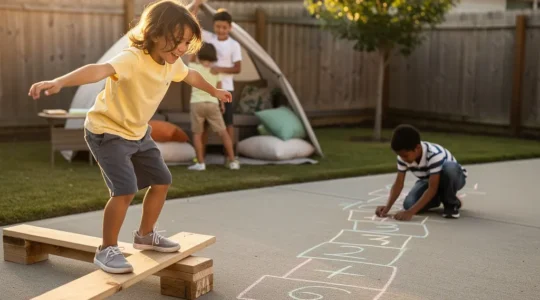
Daily Physical Activity Ideas for Kids Who Hate Organized Sports
In summary: Reframe “exercise” as fun, low-pressure “challenges” to tap into your child’s intrinsic motivation. Use everyday household items like cushions and tape to build engaging indoor cardio courses. Focus your language on building capability and strength, rather than mentioning…
Read more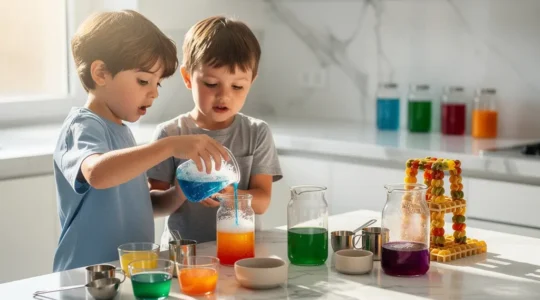
5 STEM Activities Using Kitchen Ingredients for Rainy Afternoons
In summary: Transform “mess” into “data” by reframing messy play as a way to understand cause and effect. Use simple items like paper or pasta to teach fundamental engineering principles like structural integrity. Compare baking and salad-making to reveal the…
Read more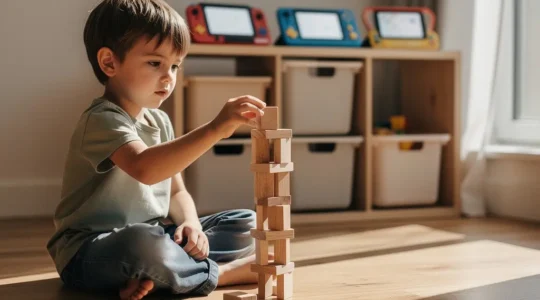
Wooden vs. Electronic Educational Toys: Which Is Better for Focus?
The true value of a toy is not in its material, but in the cognitive work it demands from the child. Toys that “do everything” for a child actively reduce their cognitive effort and long-term engagement. A superior toy follows…
Read more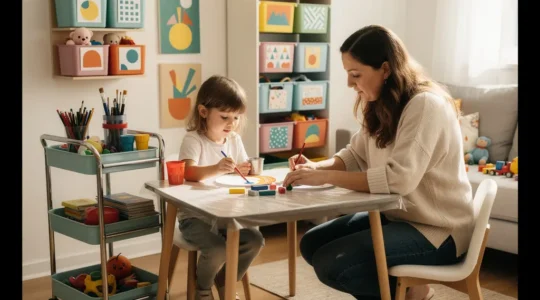
How to Encourage Creative Play in Small Apartments Without Mess?
The secret to mess-free creative play isn’t buying more washable products; it’s adopting a minimalist mindset that values process over product. Constant entertainment and cluttered supplies actively hinder a child’s ability to enter deep, imaginative states. Curating a small selection…
Read more