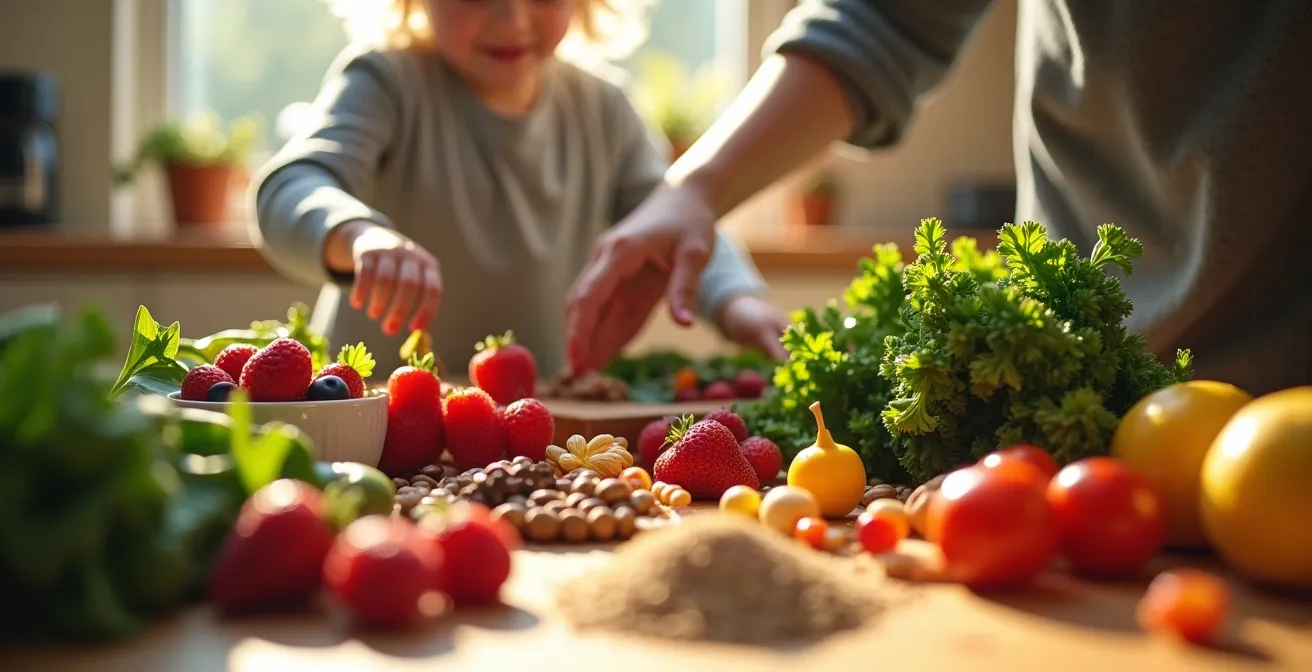
Maximizing your toddler’s brain health isn’t about buying everything organic; it’s about a smart nutritional strategy to minimize risk where it counts most.
- A toddler’s high metabolic rate and developing brain make them uniquely vulnerable to pesticide exposure.
- Focusing your organic budget on a few key items like the “Dirty Dozen” and dairy provides the greatest protective benefit.
- Simple, evidence-based methods like a baking soda wash can drastically reduce pesticide residues on conventional produce.
Recommendation: Adopt a risk-mitigation approach. Prioritize organic for high-risk foods and learn to effectively clean conventional produce to make your grocery dollars work harder for your child’s health.
As a parent, navigating the grocery store can feel like a high-stakes exam. Every aisle presents a choice, and the “organic” label often looms largest, promising superior health for your toddler but at a significantly higher price. You want the absolute best for your child’s developing brain, but you also have a budget to manage. The constant question—is the extra cost for organic really justified?—can be a source of significant stress and guilt for budget-conscious parents.
The common advice is a simple, often-repeated mantra: “buy organic to avoid pesticides” or “stick to the Dirty Dozen list.” While not incorrect, this advice barely scratches the surface. It often ignores the nuances of your child’s unique physiology, the trade-offs between local conventional and long-distance organic produce, and the marketing traps that lead you to believe an “organic cookie” is a health food. This black-and-white thinking overlooks the most powerful tool you have: strategic decision-making.
But what if the key wasn’t simply choosing organic versus conventional, but rather understanding where to invest your food budget for the highest possible return on your child’s neurological health? This guide moves beyond the simplistic debate. We will explore the specific reasons a toddler’s body is more susceptible to toxins and provide a clear, evidence-based framework for making intelligent choices. It’s about becoming a savvy nutritional strategist, not just a worried shopper.
This article will provide you with a practical, science-backed roadmap. We’ll examine why a toddler’s metabolism matters, how to prioritize your organic purchases strategically, and how to effectively reduce contaminants from conventional foods. You’ll also learn to see through marketing gimmicks and find truly brain-boosting nutrients, even for the pickiest eaters. Let’s transform your grocery shopping from an exercise in anxiety to an act of empowered, informed care.
Summary: A Strategic Parent’s Guide to Toddler Nutrition
- Why a toddler’s metabolic rate makes them more vulnerable to toxins?
- How to choose which 5 items must be organic if you can’t buy everything?
- Local Conventional or Supermarket Organic: Which is nutrient-superior?
- The “Organic Cookie” trap: Why sugar is still sugar?
- How to remove 70% of residues from non-organic fruit?
- Algal Oil or Fish Oil: Which has less “fishy burps” for kids?
- The toxicity risk: Can you get too much Vitamin A from fortified foods?
- Getting Essential Fatty Acids Into Kids Who Refuse to Eat Fish
Why a toddler’s metabolic rate makes them more vulnerable to toxins?
To understand why the organic debate is so critical for young children, we must first recognize that a toddler is not a miniature adult. Their small bodies are in a state of rapid development, and this creates a unique situation of metabolic vulnerability. A toddler’s metabolic rate is significantly higher than an adult’s, meaning they breathe more air, drink more water, and consume more food relative to their body weight. This increased intake proportionally increases their exposure to any environmental contaminants present, including pesticides.
Furthermore, a child’s detoxification systems—the liver, kidneys, and immune system—are still immature and less efficient at processing and eliminating harmful substances. When a toddler is exposed to neurotoxins, such as organophosphate pesticides commonly found on conventional produce, these chemicals can circulate for longer and at higher concentrations in their system. This is particularly concerning during the first few years of life, a critical window for brain development where billions of neural connections are being formed. Exposure to neurotoxic substances during this period can interfere with these intricate processes.
The link between diet and pesticide load is not theoretical. Compelling evidence from research in Environmental Health Perspectives demonstrates that children who switch to a diet of organic fruits, vegetables, and juices can see a significant and rapid reduction in the levels of organophosphate pesticides in their bodies. This shows a direct and measurable benefit of choosing organic, effectively lowering the toxic burden on a child’s developing system. This isn’t about fear, but about a clear-eyed understanding of risk and the power of nutritional strategy to mitigate it.
How to choose which 5 items must be organic if you can’t buy everything?
Accepting that reducing pesticide exposure is beneficial doesn’t mean your entire grocery cart must be organic. For budget-conscious parents, the key is a targeted approach: a nutrient-per-dollar strategy that focuses spending where it has the most significant impact. Rather than feeling overwhelmed, you can prioritize by focusing on foods most likely to carry high pesticide loads and those your child consumes most frequently.
The Environmental Working Group (EWG) provides an invaluable tool for this strategy with its annual “Dirty Dozen” and “Clean Fifteen” lists. These guides analyze data from the U.S. Department of Agriculture to rank produce based on pesticide residue levels. The “Dirty Dozen” are the items that consistently test highest for pesticides, making them the top priority for organic purchase. For example, just over 75% of non-organic fruits and vegetables sampled had pesticide residues, but the concentration varies wildly. Strawberries, spinach, and peaches are almost always on the high-residue list.
Conversely, the “Clean Fifteen” list identifies produce with the least contamination. Avocados and sweet corn, for instance, are rarely found with detectable pesticide residues, making them safer conventional choices. This data empowers you to make informed trade-offs. This issue is especially pressing for prepared foods, as recent testing by Friends of the Earth revealed 29 different pesticides in baby food samples, highlighting the hidden exposures in processed goods.
Your Priority Shopping Checklist: The Strategic 5
- Focus on the “Dirty Dozen”: Prioritize buying organic versions of produce with the highest pesticide residues. Strawberries, spinach, and peaches consistently show high levels and are toddler favorites.
- Prioritize Daily Foods: If your toddler eats a particular fruit or vegetable every single day, like apples or bananas, choosing organic for that specific item significantly reduces their cumulative exposure over time.
- Choose Organic Dairy: Many pesticides are fat-soluble, meaning they can accumulate in the fatty tissues and milk of animals. Opting for organic milk, yogurt, and cheese minimizes this risk.
- Buy Organic Oats: Oats are a staple in many toddlers’ diets, but conventional oats are frequently treated with glyphosate as a drying agent before harvest. Choosing organic oats is a key step to avoid this common herbicide.
- Lean on the “Clean Fifteen”: For your remaining produce purchases, consult the “Clean Fifteen” list. Foods like avocados, sweet corn, and pineapples have very low pesticide residues, making them safer conventional buys. Almost 60% of these samples had no detectable pesticides.
Local Conventional or Supermarket Organic: Which is nutrient-superior?
The “organic” label is a powerful indicator of reduced pesticide use, but it isn’t the only factor determining a food’s nutritional quality. A common dilemma for conscientious parents is choosing between produce that is certified organic but has traveled thousands of miles to a supermarket, and produce that is grown conventionally by a local farmer just a few miles away. The answer lies in understanding the trade-offs between pesticide load and nutrient degradation over time.
Organic produce often boasts a higher concentration of certain nutrients, like antioxidants, at the moment of harvest. Research has even linked organic food consumption in children with higher fluid intelligence and working memory. However, nutrients, particularly delicate ones like Vitamin C, begin to degrade as soon as the food is picked. The long transit times for supermarket produce—often a week or more—can significantly diminish its nutritional value by the time it reaches your kitchen.

Local, freshly picked produce, even if conventional, has the distinct advantage of freshness. It goes from farm to table in a matter of days, preserving much of its peak nutrient content. The best approach involves direct communication. Many small-scale local farmers use low-spray or integrated pest management practices but cannot afford the costly organic certification. A simple conversation at the farmers’ market can reveal their methods, often showing they are far cleaner than large-scale conventional agriculture.
| Factor | Local Conventional | Supermarket Organic |
|---|---|---|
| Nutrient Density at Harvest | Variable based on soil health | Often higher in certain nutrients |
| Post-Harvest Nutrient Loss | Minimal (1-3 days farm to table) | Higher (7-14 days transit time) |
| Pesticide Residues | Present unless specified | Minimal to none |
| Vitamin C Retention | Better due to freshness | Degrades during transport |
| Cognitive Development Impact | Unknown | Linked with higher fluid intelligence and working memory in children |
The “Organic Cookie” trap: Why sugar is still sugar?
As consumer awareness around organic food has grown, so has the food industry’s savvy in marketing to health-conscious parents. This has led to the rise of the “health halo” trap: the assumption that a product is healthy simply because it carries an organic label. Supermarket shelves are now filled with organic cookies, crackers, fruit snacks, and cereals that, while made with organic ingredients, are often just as high in sugar, refined flours, and unhealthy fats as their conventional counterparts.
Give the body junk food, and the brain is certainly going to suffer.
– Bethany Thayer, MS, RD, WebMD interview on brain foods for children
For a toddler’s developing brain, the source of the ingredients matters, but the nutritional composition of the food is paramount. Organic cane sugar affects the body and brain in the same way as conventional sugar. It causes a rapid spike in blood glucose, followed by a crash, which can impact a child’s mood, focus, and energy levels. Furthermore, studies show that excess sugar consumption can trigger reward pathways in the brain similar to addictive substances and has been linked to impaired learning and memory. Falling into the organic cookie trap means you may be avoiding pesticides but are still feeding your child a product that undermines their cognitive health.
The solution is to become a label detective. Look beyond the front-of-package claims and turn the box over to the ingredient list and nutrition facts panel. A truly healthy snack is defined by its wholeness, not just its organic certification. Prioritize snacks made from whole foods like fruits, vegetables, nuts, and seeds, which provide fiber, healthy fats, and micronutrients that support stable energy and brain function.
Action Plan: How to Identify Truly Healthy Organic Snacks
- Check Ingredient List Length: A shorter list is almost always better. Aim for snacks with five or fewer recognizable ingredients.
- Look for Whole Foods First: The first ingredient should be a whole food, such as “organic apples” or “organic whole wheat flour,” not a sugar or refined starch.
- Verify Sugar Content: Scrutinize the “Added Sugars” line. Aim to keep added sugars under 5 grams per serving for a toddler’s snack.
- Check for Fiber: A good snack should have at least 2 grams of fiber, which helps slow down sugar absorption and promotes stable blood sugar.
- Look for Healthy Fats: Ingredients like nuts, seeds, or avocado provide healthy fats that aid in glucose absorption and provide building blocks for the brain.
How to remove 70% of residues from non-organic fruit?
While prioritizing organic purchases is a key strategy, it’s not always financially feasible or practical to buy everything organic. Fortunately, you are not powerless when it comes to conventional produce. A simple, inexpensive, and science-backed kitchen practice can dramatically reduce your child’s exposure to surface-level pesticides: washing produce in a baking soda solution. Many people believe a quick rinse under tap water is sufficient, but research shows this is largely ineffective at removing anything more than dust.
The effectiveness of baking soda (sodium bicarbonate) lies in its alkalinity, which helps to break down common pesticides like thiabendazole and phosmet, which cannot be removed by water alone. A landmark University of Massachusetts study found that a 12-15 minute soak in a simple baking soda and water solution was significantly more effective than both tap water and a commercial bleach solution at removing pesticide residues from the surface of apples.

This method provides a powerful tool for risk mitigation. By adopting this as a standard practice for all your conventional produce, you can bridge the gap between your budget and your desire for safer food. It’s important to note a key limitation: this method is highly effective for surface pesticides but cannot remove systemic pesticides, which are absorbed into the flesh of the fruit or vegetable. This is why a combined strategy—using the baking soda wash for “Clean Fifteen” and lower-risk items while still prioritizing organic for the “Dirty Dozen”—is the most comprehensive approach.
Your Guide: The Evidence-Based Pesticide Removal Method
- Prepare the Solution: In a clean sink or large bowl, mix 1 teaspoon of baking soda for every 2 cups of cool water. Swirl to dissolve.
- Soak the Produce: Submerge your non-organic fruits and vegetables in the solution. For firm items like apples or peppers, a soak of 12 to 15 minutes is ideal for maximum surface pesticide removal.
- Rinse Thoroughly: After soaking, rinse the produce under cool, clean running water to wash away any remaining residue and the baking soda solution.
- Handle Delicate Produce: For delicate items like berries or leafy greens that can’t withstand a long soak, a vigorous rinse under running water for at least 30 seconds while gently rubbing is the next best alternative.
- Understand the Limits: Remember that this method cleans the surface effectively but does not remove pesticides that have penetrated deeper into the produce.
Algal Oil or Fish Oil: Which has less “fishy burps” for kids?
Essential fatty acids, particularly DHA (docosahexaenoic acid), are critical building blocks for a toddler’s brain, which is composed of nearly 60% fat. Fish and fish oil have long been touted as the gold standard for DHA. However, many parents struggle with two major issues: their child’s refusal to eat fish and the dreaded “fishy burps” that often come with fish oil supplements. This can turn a health-promoting effort into a daily battle. Fortunately, there is an excellent alternative that solves both problems: algal oil.
What many people don’t realize is that fish do not produce DHA themselves; they accumulate it by eating microalgae. Algal oil is a supplement made directly from these microalgae, cutting out the “middle fish.” This provides a concentrated, pure source of DHA that is naturally free from the fishy taste and smell that causes aversion and unpleasant after-effects in children. For a picky eater, a flavorless algal oil supplement can be easily hidden in a smoothie, yogurt, or applesauce, making it a stress-free way to ensure they get this vital nutrient.
Beyond the taste, algal oil offers significant advantages in terms of purity and sustainability. Fish can accumulate heavy metals like mercury and other environmental toxins (PCBs) from the ocean. While reputable fish oil brands filter their products, the risk, though small, still exists. The American Academy of Pediatrics specifically advises against feeding toddlers high-mercury fish like tuna and swordfish. Algal oil, on the other hand, is grown in controlled, purified water, completely eliminating the risk of ocean-borne contaminants. It’s also a more sustainable and vegetarian/vegan-friendly option.
| Factor | Algal Oil | Fish Oil |
|---|---|---|
| Fishy Taste/Burps | None – plant-based source | Common, especially if rancid |
| DHA Content | High – original source | High – from consuming algae |
| Mercury/PCB Risk | None – grown in controlled environment | Potential contamination risk |
| Sustainability | Highly sustainable | Depends on fishing practices |
| Vegetarian/Vegan | Yes | No |
| Absorption Rate | Similar to fish oil | Well absorbed with fat |
Key Takeaways
- A toddler’s high metabolism and immature detoxification systems make them more susceptible to the neurotoxic effects of pesticides.
- A strategic, budget-conscious approach involves prioritizing organic for the “Dirty Dozen,” dairy, and oats, while opting for conventional “Clean Fifteen” produce.
- A simple 15-minute soak in a baking soda solution can effectively remove most surface-level pesticides from non-organic fruits and vegetables.
The toxicity risk: Can you get too much Vitamin A from fortified foods?
Vitamin A is an essential nutrient for vision, immune function, and cellular growth, but it’s a classic case of where more is not necessarily better. It’s crucial for parents to understand that Vitamin A comes in two main forms: carotenoids (like beta-carotene) found in fruits and vegetables, and preformed Vitamin A (retinol) found in animal products and fortified foods. While the body can safely process and excrete excess carotenoids, preformed Vitamin A can be toxic in high doses, a condition known as hypervitaminosis A.
The risk for toddlers comes from the cumulative intake from multiple sources, particularly fortified foods. Many breakfast cereals, milks, and snack bars are fortified with preformed Vitamin A. If a child consumes several of these products throughout the day, in addition to a multivitamin containing retinol, their intake can quickly approach or exceed the Tolerable Upper Intake Level (UL). According to the NIH Office of Dietary Supplements, the UL for children aged 1-3 years is 600 mcg RAE/day. Acute toxicity can cause symptoms like nausea, dizziness, and blurred vision, while chronic overdose can lead to more severe issues, including liver damage and pressure on the brain.
While reaching toxic levels from a normal, varied diet is unlikely for most children, it’s a risk that parents should be aware of, especially if their child is a picky eater who relies heavily on a few specific fortified “kid-friendly” foods. It is also critical to be cautious with certain animal products. For example, just three ounces of beef liver can contain over 6,500 mcg RAE of preformed Vitamin A, more than ten times the daily upper limit for a toddler. The key is awareness: read labels on fortified foods and be mindful of total intake, especially if also giving a multivitamin supplement.
Getting Essential Fatty Acids Into Kids Who Refuse to Eat Fish
Ensuring your toddler gets enough essential fatty acids (EFAs) like omega-3s is a top priority for brain development, but what do you do when your child gags at the mere sight of fish? This is a common frustration for parents who know the benefits but can’t get past the picky-eater blockade. The solution is to think creatively and strategically, incorporating EFA-rich foods into meals in ways that are virtually undetectable. You don’t need to force salmon onto their plate to support their cognitive health.
The plant kingdom offers several powerful sources of ALA (alpha-linolenic acid), a type of omega-3 that the body can convert into the all-important DHA and EPA. Ground flaxseeds and chia seeds are nutritional powerhouses that can be stirred into yogurt, oatmeal, or smoothies. Their gelatinous texture when mixed with liquid can even be used to create a “power pudding.” Hemp seeds are another excellent choice, offering a great balance of omega-3 and omega-6 fats, plus protein. They have a mild, nutty flavor and can be sprinkled on almost anything, from pasta to avocado toast. For direct sources of DHA, flavorless algal oil remains the champion for picky eaters, disappearing completely into beverages or soft foods.
Don’t overlook other nutrient-dense foods that support brain health in tandem with EFAs. Eggs, particularly omega-3 fortified ones, are a fantastic source of choline, a nutrient vital for memory development. In a compelling example of nutrient synergy, a 2020 review of 54 studies suggested that adding choline to a child’s diet during their first 1,000 days could significantly support brain development and protect against nerve cell damage. Just two whole eggs can provide all the choline a child needs for the day. This demonstrates that a holistic approach, combining various brain-boosting foods, is often more effective than focusing on a single nutrient source.
Case Study: The Brain-Boosting Power of Eggs
A comprehensive 2020 review analyzing 54 different studies highlighted the critical role of choline during the first 1,000 days of a child’s life. The research concluded that adequate choline intake could support overall brain development, help protect nerve cells from damage, and improve long-term cognitive functioning. The practical application is simple and powerful: two whole eggs provide 294 grams of choline, which completely covers 100% of the recommended daily intake for children between the ages of 1 and 8, making it an easy and effective way to deliver this essential brain-building nutrient.
Frequently Asked Questions about Are Organic Meals Worth the Extra Cost for Toddler Brain Development?
What’s the difference between preformed vitamin A and carotenoids?
You can’t overdose on vitamin A by eating fruits and vegetables because the body processes carotenoids safely, converting only what it needs. However, preformed vitamin A from animal sources, fortified foods, and supplements can be stored in the body and cause toxicity if consumed in excess.
Which foods are highest in preformed vitamin A?
Organ meats are by far the most concentrated source. For instance, just 3 ounces of beef liver contains 6,582 mcg RAE of preformed vitamin A—more than twice the maximum recommended daily intake for children under 8. Dairy products and fish are also significant sources.
Is reaching toxic levels from food alone likely?
For most children with a varied diet, it is not a common risk. However, data from the US shows that the 95th percentile of intake from a combination of foods and supplements does exceed the upper limit, though it remains below the level where adverse effects are typically observed. Caution is warranted, especially with heavy reliance on fortified foods and supplements.