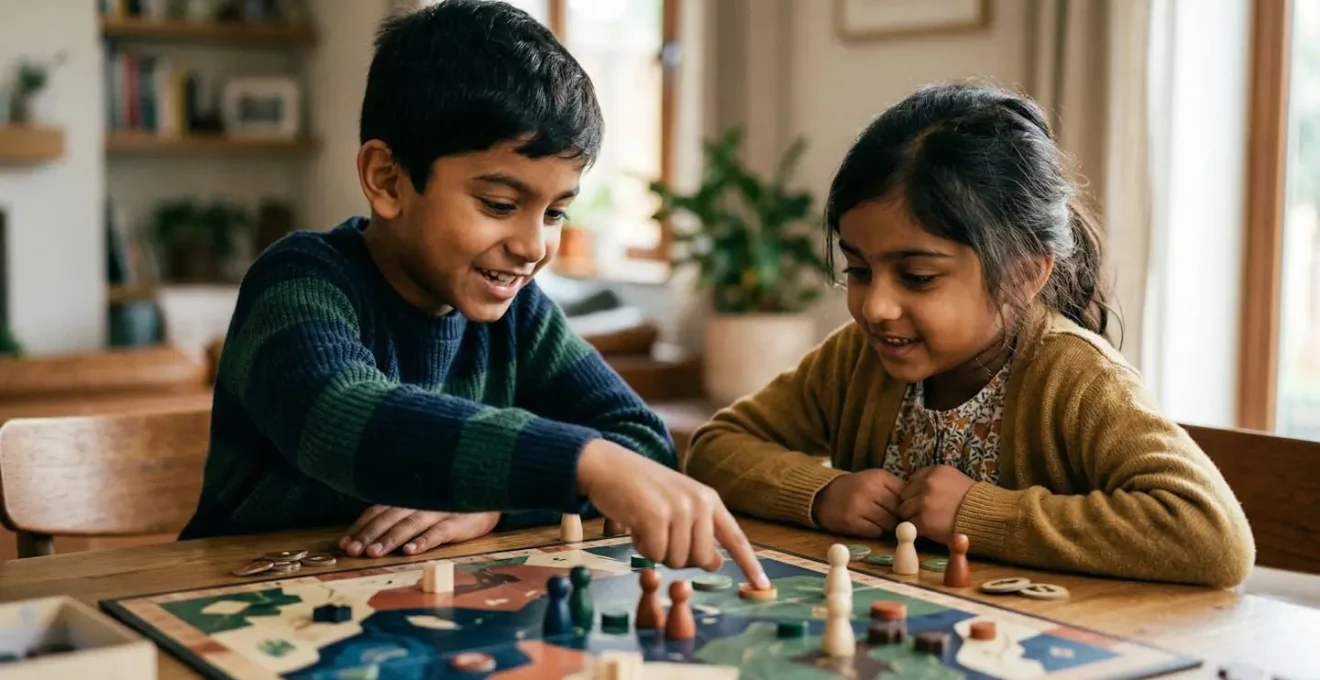
The constant competition between your children isn’t a behavior to be eliminated, but a family dynamic to be redesigned.
- Shifting focus from “who won” to “how did you grow” is the foundation for turning rivalry into resilience.
- Common parenting tactics like forced sharing and direct comparisons often backfire, unintentionally fueling resentment and a fixed mindset.
Recommendation: Transition your role from a referee of conflicts to an architect of cooperative “games” where shared success is the only way to win.
The sound is familiar in many homes: the race to the car, the argument over who got the bigger slice of cake, the constant tallying of wins and losses in a board game. For parents managing siblings where everything feels like a competition, the noise can be exhausting. The common instinct is to try and stop the rivalry, to enforce peace, or to declare that “everyone’s a winner.” But what if this approach misses the point entirely?
Competition itself isn’t the enemy. It’s a natural part of life that can build resilience, drive, and character. The real challenge lies in the *framing* of that competition. The line between a healthy drive to improve and a toxic, stress-inducing battle for parental approval is incredibly thin. Many well-intentioned strategies, from celebrating every child’s “unique talents” to insisting on fairness, can inadvertently create a zero-sum game where one child’s success feels like another’s failure.
The crucial shift is to move beyond simply managing the surface-level conflicts. Instead, the goal is to become a conscious architect of your family’s dynamics. This guide will not offer simple tricks to quell arguments. It will provide a therapeutic framework for understanding the underlying psychological forces at play. We will explore how to re-engineer the “rules of the game” at home, transforming the environment from a competitive arena into a training ground for healthy ambition, cooperation, and genuine self-worth.
This article provides a structured approach for parents to guide their children from toxic rivalry to healthy ambition. The following sections break down key psychological principles and offer practical strategies to reshape your family’s competitive landscape.
Summary: From Sibling Rivalry to Resilient Ambition: A Parent’s Guide
- How to teach a child to compete against themselves?
- Why kids cheat and how to address it without shaming?
- Do trophies for everyone ruin the drive to win?
- The “Why can’t you be like your brother” mistake
- When to switch from racing to escaping a room together?
- The “Forced Sharing” mistake that actually increases selfishness
- What can a child learn from not being the star player?
- Helping Siblings Learn Cooperation Through Structured Play Conflicts
How to teach a child to compete against themselves?
The first and most fundamental shift in redesigning your family’s competitive dynamic is to change the opponent. When siblings are constantly pitted against each other, the game is finite, with a clear winner and loser. The alternative is to introduce the concept of competing against one’s past self—an infinite game focused on personal growth. This reframes “winning” not as beating a sibling, but as achieving a new personal best.
This approach is rooted in the principles of a “growth mindset,” the belief that abilities can be developed through dedication and hard work. Fostering this mindset has tangible benefits. For instance, a landmark national study on students demonstrated that growth mindset interventions can lead to a significant improvement in academic performance, proving that focusing on process and improvement yields real results. The goal is to make the child’s own progress the most exciting scoreboard in the house.
To do this, you must change the language you use around activities. After a soccer game, instead of asking “Did you win?” ask, “What’s one thing you did better than in practice?” or “Did you try that new move we talked about?” This directs their attention inward, toward their own effort and skill development. It teaches them that the true victory lies in continuous improvement, a far more sustainable and fulfilling source of motivation than external validation.
Your Action Plan: Fostering Self-Competition
- Reframe Questions: Consciously shift post-activity questions from ‘Did you win?’ to ‘What was one thing you improved on today?’ or ‘What did you learn?’. This immediately moves the focus from external comparison to internal progress.
- Track Personal Bests: Create a simple chart or “Personal Best Dashboard” for specific, measurable skills (e.g., time to complete a puzzle, number of successful basketball shots). This makes their own progress the visible ‘opponent’ to beat.
- Praise the Process: Use specific praise that highlights effort, strategy, and perseverance. Instead of “You’re so smart,” say “I saw how you kept trying different ways to solve that problem. That was impressive focus!”
- Use the Brain-as-Muscle Metaphor: Explain that struggling with a challenge is like a workout for their brain, making it stronger. This turns difficulty into a positive sign of growth, not a signal of failure.
- Model Your Own Growth: Talk openly about a skill you are trying to improve. Let them see you struggle, practice, and celebrate your own small improvements. This normalizes the process of self-competition.
By consistently applying this framework, you begin to change the entire game. The source of validation shifts from an external, often fickle source (beating a sibling) to an internal, empowering one (beating your old self).
Why kids cheat and how to address it without shaming?
Discovering that your child has cheated during a game can be disheartening, often triggering worries about their moral character. However, from a therapeutic perspective, cheating is rarely a sign of inherent dishonesty. More often, it is a symptom of unbearable pressure. When the perceived stakes of losing—disappointing a parent, feeling inferior to a sibling, or failing to live up to an expectation—become too high, a child’s brain may seek the shortest path to avoid that pain.
This isn’t just about board games. Academic research from the University of Wollongong reveals that students report cheating primarily due to intense pressure to perform and a disinterest in the material. This directly translates to the family room floor. If a child feels their worth is tied to winning, they may bend the rules to secure that feeling of worth. The act of cheating is a distress signal that the “game” has stopped being fun and has become a high-stakes test of their value.
The crucial first step in addressing cheating is to regulate your own reaction. A response rooted in anger or shame will only reinforce the child’s fear of failure and make them more likely to hide their behavior in the future. Instead, the goal is to create an environment of psychological safety where they can be honest about their feelings.
This requires a calm, private conversation that separates the behavior from the child’s identity. Instead of “You are a cheater,” try an observation and a question: “I noticed the rules got a bit mixed up there. It seems really important to you to win this game. Can you tell me what that feels like?” This opens the door to understanding the underlying fear or pressure. It’s an opportunity to reinforce that your love is unconditional and not dependent on their performance, and to discuss why fair play makes the game more fun for everyone in the long run.
As this image illustrates, the most effective response is one of connection. By sitting with your child and creating a supportive space, you can address the root cause of the behavior—the pressure—rather than just punishing the symptom. This builds trust and teaches them that they can come to you with their struggles, which is a far greater victory than any board game win.
Ultimately, addressing cheating without shame is a powerful way to redesign the game. It sends a clear message: “Your honesty is more important to me than your victory.”
Do trophies for everyone ruin the drive to win?
The participation trophy debate is a flashpoint for many parents. One side argues that rewarding everyone diminishes the value of real achievement and creates a generation that expects rewards for simply showing up. The other side contends that it encourages involvement and protects the self-esteem of young children. As a therapist, I see that the answer isn’t a simple “yes” or “no”—it’s a matter of developmental appropriateness.
Before we even discuss trophies, it’s vital to consider the larger context of youth sports. A staggering 70% of kids quit organized sports by age 13. The number one reason they report for quitting is that “it’s not fun anymore.” This suggests the core problem isn’t the trophy, but the pressure and lack of enjoyment that can creep into competitive activities. The real question for parents should be: What system of rewards and recognition keeps my child engaged and feeling positive about this activity?
The effectiveness of a participation trophy is directly tied to a child’s cognitive development and their understanding of competition. A young child doesn’t process a trophy the same way a teenager does. This is clearly demonstrated in a case study from the Highlights 2015 State of the Kid research report. It found that while 6 to 10-year-olds largely appreciated trophies just for playing, the majority of 11 to 12-year-olds preferred them to be awarded only for winning, viewing them as more meaningful tokens of actual success. This shows a clear developmental shift where the meaning of the award changes dramatically.
This developmental progression is essential for parents to understand when deciding on an approach to rewards and recognition. The following table, based on common findings in youth development, breaks down the effects by age.
| Age Group | Benefits | Potential Drawbacks | Recommendation |
|---|---|---|---|
| Under 7 | Builds initial confidence; associates sports with positive experiences; encourages continued participation | Minimal at this age due to limited understanding of competition | Highly beneficial – use participation trophies |
| Ages 8-12 | Still provides some motivation; recognizes effort and commitment | Children begin understanding competition; may feel frustrated seeing everyone receive trophies | Transition period – shift toward effort-based awards like ‘Most Improved’ or ‘Best Sportsmanship’ |
| Ages 13+ | Limited benefit; teenagers understand merit-based recognition | May be perceived as patronizing; can diminish drive for improvement | Phase out – replace with honest discussion about growth and specific skill achievements |
The key takeaway is to see rewards not as a one-size-fits-all solution, but as a tool that needs to evolve with your child. For young kids, a participation trophy is a celebration of effort. For older kids, the real reward is the feeling of competence and the recognition of genuine achievement.
The “Why can’t you be like your brother” mistake
Of all the phrases that can fuel toxic sibling rivalry, few are as corrosive as the direct comparison. Whether said in a moment of frustration or as a misguided attempt at motivation, statements like “Why can’t you be neat like your sister?” or “Your brother never had trouble with math” are devastating. As family therapists, we see this as one of the most common and damaging errors in parenting. As Utah State University researchers bluntly state in their study on the topic, “Explicit and implicit comparisons to siblings can foster resentment and competition.”
Explicit and implicit comparisons to siblings can foster resentment and competition.
– Utah State University researchers, Ask an Expert: Navigating Sibling Rivalry study
This isn’t just about hurt feelings. Comparison actively shapes a child’s identity and limits their potential through a powerful psychological phenomenon known as the Pygmalion Effect. This effect demonstrates that our expectations of others can become self-fulfilling prophecies. When a parent consistently compares siblings, they are assigning fixed labels: one is “the athletic one,” the other is “the smart one.” These labels, even if seemingly positive, create rigid boxes that can be incredibly difficult to escape.
Case Study: The Pygmalion Effect in the Family
The Pygmalion Effect, famously demonstrated in schools by researchers Rosenthal and Jacobson, showed that student performance was directly influenced by teacher expectations. This same dynamic plays out at home. When parents compare siblings, they create fixed roles (“the smart one,” “the artistic one”). The child labeled “the smart one” may become afraid to try sports for fear of not being good enough, while “the artistic one” might give up on a challenging math problem because they believe they aren’t “wired for it.” The parents, in turn, unconsciously reinforce these roles, creating a feedback loop that limits each child’s potential to explore the full spectrum of their identity.
The antidote to comparison is a conscious focus on individual strengths and growth. This means celebrating each child for who they are and where they are on their unique developmental path. It involves creating a family culture where different talents are not ranked, but equally valued. One child’s ability to build an intricate Lego city is just as worthy of praise as another’s ability to score a goal in soccer.
The goal is to cultivate an environment, like the one pictured, where each child feels seen and valued for their individual interests and efforts. This requires parents to actively notice and name strengths in all areas—not just academics or athletics, but kindness, creativity, humor, and perseverance. By doing so, you’re not just avoiding a parenting mistake; you’re giving your children the freedom to build a robust and multifaceted sense of self, independent of their sibling’s achievements.
Ultimately, by removing the yardstick of comparison, you allow each child to run their own race, on their own track, at their own pace.
When to switch from racing to escaping a room together?
Healthy competition can build character, but there is a clear tipping point where it becomes destructive. As the architect of your family’s dynamics, one of your most critical jobs is to recognize the warning signs that the “game” is no longer serving your children’s well-being. Unchecked, severe sibling rivalry can cross the line into sibling bullying, which has serious and lasting consequences. The stakes are incredibly high; startling research published by Harvard Health reveals that being bullied by a sibling can double the risk of developing depression and engaging in self-harm in early adulthood.
This data underscores the urgent need for parents to be vigilant. It’s not about eliminating all conflict but about identifying when the dynamic has become chronically negative and one-sided. The goal is to intervene before the patterns become entrenched. When you see these signs, it’s time to consciously change the game from a competitive one (racing) to a cooperative one (escaping a room together).
Look for these clear warning signs that indicate the competitive environment has turned toxic and a shift toward mandatory cooperation is needed:
- Pre-Game Anxiety: A child consistently shows visible anxiety, stress, or stomach aches before a competitive activity with a sibling. This is a clear sign the pressure has become unhealthy.
- Disproportionate Reactions: Excessive, prolonged gloating after a win or inconsolable distress after a loss that extends long after the game is over. The emotional stakes have become too high.
- Constant Conflict Over Rules: The game itself is lost amid endless arguments over rules, accusations of cheating, or attempts to change the rules mid-game to gain an advantage.
- Withdrawal and Avoidance: One child consistently loses, is victimized, or seems unable to defend themselves, leading them to avoid family activities or refuse to play altogether.
When these patterns emerge, it’s a signal to temporarily shelve the competitive board games and activities. Instead, deliberately introduce activities where the only path to success is teamwork. This can include cooperative board games (like Forbidden Island or The Crew), building a large, complex Lego set together with a single set of instructions, or working on a shared project like gardening or cooking a meal. The key is that the objective is shared, and one child cannot succeed at the expense of the other.
This strategic shift isn’t a punishment. It’s a necessary recalibration of the family system, teaching your children in a practical, hands-on way that their greatest strength can often be found in working together.
The “Forced Sharing” mistake that actually increases selfishness
“You have to share with your sister.” It’s a phrase uttered by parents everywhere with the best of intentions: to teach generosity and fairness. Yet, paradoxically, forcing a child to share, especially a prized possession, often has the opposite effect. It can increase possessiveness, trigger more conflict, and undermine the very spirit of generosity you hope to instill. This happens because forced sharing ignores a crucial psychological concept: psychological ownership.
For a young child, their toys are not just objects; they are extensions of themselves. When a parent forces them to give up a special toy, it can feel like a violation. The child doesn’t learn “it’s good to share”; they learn “my possessions are not safe” and “adults will take my things away for the benefit of my sibling.” This creates a scarcity mindset and a zero-sum dynamic, where a sibling’s gain is perceived as a personal loss, leading to more hoarding and conflict, not less.
The Power of Secure Ownership
Child development experts emphasize that allowing children to have secure ownership over certain special items and their own personal space is key to reducing conflict. As explained in resources from Nemours KidsHealth, when a child feels their most treasured items are safe and respected, they feel less threatened overall. This security actually makes them more relaxed and genuinely willing to share other, non-special items. Forced sharing short-circuits this process, creating constant anxiety over resources and paradoxically increasing selfishness as a defensive measure.
The alternative to forced sharing isn’t a free-for-all where one child keeps everything. The alternative is to architect a system that teaches negotiation, patience, and respect for property. This moves the parent from the role of enforcer to that of a facilitator, empowering children with the tools to solve sharing dilemmas themselves. By implementing fair, predictable systems, you teach valuable life skills that extend far beyond the playroom.
Consider implementing these practical, fair sharing systems that teach valuable problem-solving skills:
- The ‘Toy Timer’: For a high-demand, shared toy, use a neutral kitchen timer. Each child gets a set amount of time. The timer, not the parent, is the objective arbiter, which dramatically reduces arguments about fairness.
- ‘You Cut, I Choose’: When dividing something like a snack or craft supplies, have one child do the dividing and the other get the first choice. This simple rule ingeniously ensures the first child will make the portions as equal as possible.
- ‘Personal Ownership Zones’: Designate a special box or shelf for each child where their most treasured items reside. These items are exempt from the general sharing rule. This respects their need for psychological ownership and reduces anxiety.
- Model Negotiation Language: Actively teach them phrases like, “Can I trade you for that?” or “Can I use that when you’re done?” This builds a vocabulary for collaborative problem-solving instead of snatching and crying.
By replacing forced sharing with a system that respects ownership and teaches negotiation, you are not just solving a squabble over a toy. You are laying the groundwork for a lifetime of successful conflict resolution.
What can a child learn from not being the star player?
In a culture that often glorifies the winner, it can be painful for a parent to watch their child sit on the bench, get a smaller part in the play, or consistently be outshone by a sibling. The natural protective instinct is to want to shield them from the disappointment of not being the “star.” However, these supporting roles, while less glamorous, are often where some of life’s most critical skills are forged. Reframing this experience is essential for both the child and the parent.
Not being the star player provides an unparalleled opportunity to develop a different, and arguably more valuable, set of competencies. When a child isn’t consumed with being the center of attention, they have the mental space to observe, analyze, and understand the bigger picture. They learn to see the game, not just their role in it. They develop empathy for their teammates, understanding what it feels like to struggle and what kind of support is most helpful. They learn that success is a team effort and that their contribution—encouraging from the sidelines, executing a crucial defensive play, or supporting the star—is integral to the group’s achievement.
Developing Leadership from a Supporting Role
Sports psychology research consistently shows that children who are not always the star player develop crucial leadership qualities that are often overlooked in high-achievers. These skills, sometimes called ‘supporting role’ competencies, include a high degree of strategic observation (seeing patterns in the game that the star player might miss), a deep understanding of team dynamics, and the ability to motivate others. These are precisely the skills of a great manager or team leader in the adult world. This experience teaches them that true leadership is not always about being in the spotlight, but about making everyone around you better, a concept that is foundational to modern workplace collaboration.
The parent’s role in this is crucial. It requires resisting the urge to complain about the coach or downplay the importance of the activity. Instead, it’s about asking questions that highlight the value of their position: “What did you notice about the other team’s strategy from the bench?” or “It was great how you encouraged Sarah after she missed that shot. That really helped the team’s spirit.” This validates their contribution and helps them build an identity that is not solely dependent on individual accolades.
By framing the supporting role as a position of strategic importance and skill-building, you teach your child a profound lesson: you don’t have to be the star to be essential to the team’s success.
Key Takeaways
- The parent’s primary role is not to be a referee who punishes infractions, but an architect who designs a healthier family system.
- Focusing on a child’s competition with their own past performance is the most effective way to build intrinsic motivation and resilience.
- Toxic competition is often driven by external pressures and a fear of losing parental approval; addressing the root cause is more effective than punishing symptoms like cheating.
Helping Siblings Learn Cooperation Through Structured Play Conflicts
Throughout this guide, we have explored ways to reframe competition and mitigate its negative effects. The final and most proactive step in your role as a family architect is to move beyond managing conflict and start actively teaching cooperation. This can be achieved through what I call “structured play conflicts”—activities intentionally designed with a shared goal and limited resources, which force siblings to negotiate, collaborate, and problem-solve together.
This isn’t about simply telling them to “work together.” It’s about creating a scenario where they have no other choice. For example, challenge them to build the tallest possible tower with a limited set of Lego blocks, but with a shortage of a key piece (e.g., long flat bases). This scarcity forces them to negotiate, trade, and plan together. The parent’s role in this is critical: you are not the referee who solves disputes, but the “Game Master” who upholds the pre-agreed rules and asks guiding questions like, “That’s a tough problem. How can you both get what you need to make the tower stable?”
The power of this approach lies in the debrief that follows. Once the activity is over, whether they succeed or fail, sit down with them for a two-minute reflection. Ask three simple questions: 1. What was the hardest part? 2. What strategy worked well for you as a team? 3. If we did this again, what would you do differently? This metacognitive step is where the learning is solidified. It helps them analyze their own social dynamics and internalize the lessons of collaboration.
By designing these structured conflicts, you provide a safe and controlled environment for your children to practice the essential life skills of negotiation, compromise, and shared victory. You are giving them a collaboration “flight simulator.” They learn, through direct experience, that by combining their strengths, they can achieve something greater than either of them could alone. This is the ultimate shift from a zero-sum to a positive-sum game dynamic.
Begin architecting a more cooperative and growth-oriented dynamic in your family today. By implementing these structured experiences, you are not just hoping for cooperation; you are actively building the neural pathways and emotional skills that will make it their default mode for solving problems together for a lifetime.