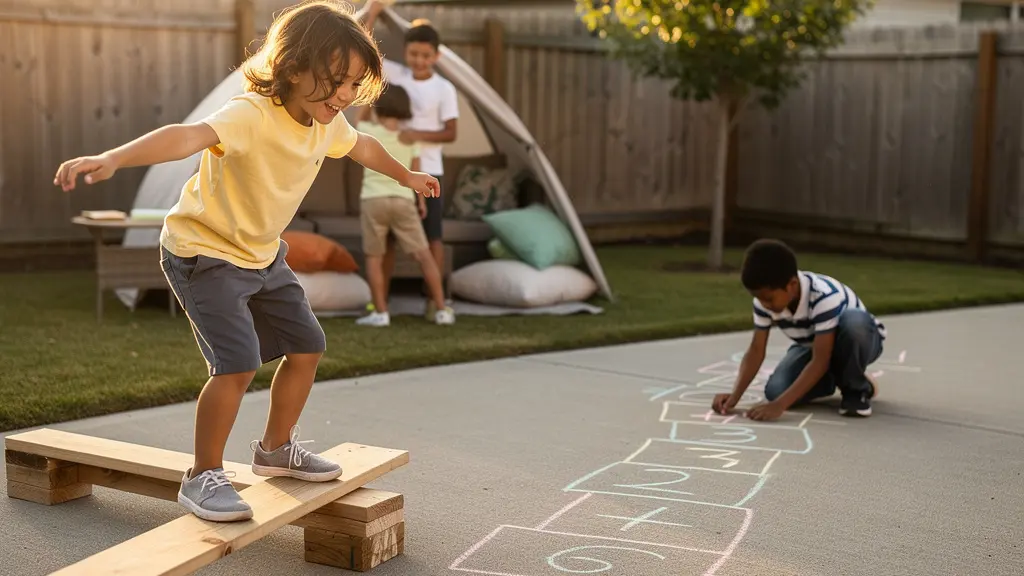
In summary:
- Reframe “exercise” as fun, low-pressure “challenges” to tap into your child’s intrinsic motivation.
- Use everyday household items like cushions and tape to build engaging indoor cardio courses.
- Focus your language on building capability and strength, rather than mentioning weight, shape, or “being fit.”
- Prioritize variety and enjoyment over early intensity to prevent the burnout that causes kids to quit sports.
The official guidelines often feel like a looming deadline: 60 minutes of physical activity per day. For parents of kids who love running, jumping, and team sports, this is a background hum. But if your child resists every suggestion of soccer practice or a family jog, that number can be a source of daily anxiety. You’ve likely tried all the common advice—signing them up for different teams, encouraging them to “just go play outside,” or bargaining screen time for active time—only to be met with disinterest or outright refusal.
The frustration is real, but it often stems from a misunderstanding. For many children, especially those who are more introverted, creative, or less competitive, the structure and pressure of organized sports can extinguish the natural joy of movement. The problem isn’t a lack of energy or a desire to be sedentary; it’s that the “activity” on offer feels like a chore with a high risk of failure or social discomfort.
But what if the solution wasn’t finding another sport for them to tolerate, but fundamentally changing the definition of movement itself? The secret lies in shifting the framework from exercise-as-a-task to movement-as-a-game. It’s about creating low-pressure, intrinsically rewarding experiences that build confidence and physical literacy from the ground up. This guide provides a new playbook for parents, focusing on transforming your child’s mindset, your home environment, and your communication to foster a lifelong, positive relationship with being active.
text
Summary: Fun and Engaging Activity Ideas for Non-Athletic Kids
- Why reframing movement as “challenges” changes the mindset?
- How to build a cardio course using cushions and tape?
- Cycling or Soccer: Which suits the introverted child better?
- The “Burnout” mistake: When early intensity leads to quitting at age 10
- How to encourage activity without mentioning weight or shape?
- What can a child learn from not being the star player?
- How to teach a child to check a branch before trusting it?
- Constructing the Ideal Diet for Highly Active Kids With Fast Metabolisms
Why reframing movement as “challenges” changes the mindset?
The word “exercise” can be a non-starter for many kids, loaded with connotations of difficult, repetitive, and boring work. Reframing movement as a “challenge” or a “quest” fundamentally alters the psychological stakes. It shifts the focus from an external goal (getting fit, burning energy) to an internal one: curiosity, problem-solving, and mastery. This taps directly into intrinsic motivation, the desire to do something because it is inherently interesting or enjoyable. In fact, research demonstrates that children with higher intrinsic motivation show 23% more moderate-to-vigorous physical activity than their peers driven by external rewards.
Instead of saying, “Let’s go for a run,” try, “I challenge you to a race to that big tree and back!” The goal isn’t just movement; it’s a game with a clear, achievable objective. This approach works by aligning the activity with your child’s innate interests. You become a game designer, creating movement puzzles that speak their language. A child who loves fantasy stories isn’t doing lunges; they are “crossing a treacherous canyon.” A science-minded kid isn’t just jumping; they are “testing the laws of gravity.”
This reframe has a powerful secondary effect: it removes the fear of failure. In a challenge, “failing” is just part of figuring out the puzzle. If you can’t make the jump, you adjust your strategy and try again. This builds resilience and a growth mindset, teaching kids that capability is something you build through trial and error, not something you either have or don’t. Tying activity to their own “spark” makes it a form of self-expression.
- For fantasy lovers: Frame activities as ‘quests’ with imaginary obstacles to overcome and treasures to find.
- For science enthusiasts: Present movements as ‘physics experiments’ testing gravity, momentum, and balance.
- For builders: Design activities as ‘engineering challenges’ constructing obstacle courses or movement puzzles.
- For artistic children: Create ‘movement art’ combining dance, shapes, and creative expression.
- For story lovers: Develop narrative-based activities where movements advance the plot of a co-created story.
By connecting movement to what already excites your child, you’re not forcing them to be active; you’re giving them a new, physical way to engage with their passions.
How to build a cardio course using cushions and tape?
One of the best ways to put the “challenge” mindset into practice is by turning your living room into a dynamic cardio course. This is more than just a rainy-day activity; for kids who find organized sports overwhelming, it’s a perfect environment. According to occupational therapists, these homemade courses can be rich in sensory input that is crucial for development. Incorporating vestibular stations (like log rolls) and proprioceptive activities (like jumping onto a cushion “crash pad”) helps children develop coordination, body awareness, and self-regulation in a fun, pressure-free setting.
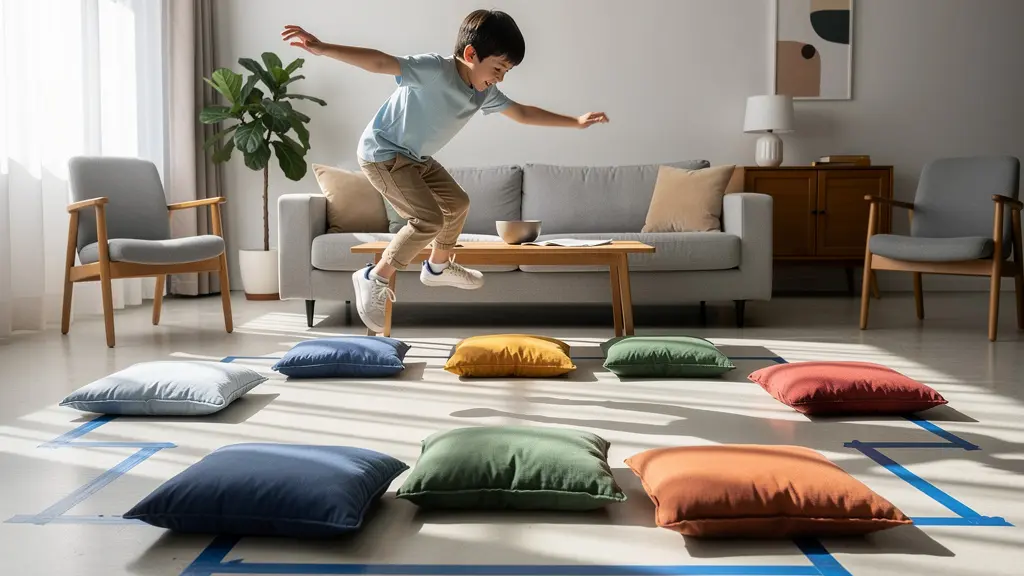
As you can see, everyday objects become the building blocks for adventure. The key is to think like a “play engineer.” Use painter’s tape on the floor to create balance beams, agility ladders, or “hot lava” boundaries. Arrange cushions, pillows, and couch seats as stepping stones, hurdles, or landing pads. The goal is to create a sequence of stations that challenges different types of movement.
Start simple and build complexity as your child gains confidence. Here is a progressive five-station course you can build in minutes:
- Station 1 – Tape Line Balance: Start with walking forward on a straight line of tape. Progress to walking backward, then sideways, and finally trying to balance a beanbag on their head.
- Station 2 – Cushion Crash Pad: Set up a pile of sturdy cushions or pillows. Have your child jump onto the “crash pad” from a standing position, then from a low step, gradually increasing the height for more proprioceptive input.
- Station 3 – Rolling Zone: Clear a space for log rolls. This is fantastic for vestibular input. Add complexity by having them change direction or roll toward a specific target.
- Station 4 – Cognitive Challenge: Before moving to the next station, they must perform a memory sequence of three movements (e.g., one jumping jack, one spin, one touch-your-toes).
- Station 5 – Problem-Solving Path: Create a “lava floor” where they can only step on cushion “stepping stones” to get from one side of the room to the other.
Let your child help design the course. Giving them ownership of the “engineering” process makes it their game, not your exercise routine.
Cycling or Soccer: Which suits the introverted child better?
Parents often push team sports with the best of intentions, hoping to build social skills and a sense of camaraderie. But for an introverted or shy child, the high-intensity social environment of a soccer field or basketball court can be overwhelming. The constant communication, physical proximity, and performance pressure can cause anxiety that overshadows any potential fun. In these cases, insisting on a team sport can backfire, creating a negative association with all physical activity.
Individual pursuits, on the other hand, offer a space for a child to connect with their own body and achieve a state of “flow” without social static. As one expert explains:
Children who are shy and introverted often don’t feel comfortable with the constant interaction required in team sports. Individual activities allow them to achieve flow states more easily.
– Kelly Theis, Ph.D., FamilyFirst Psychological Services
This isn’t about isolating your child; it’s about matching the environment to their temperament. Activities like cycling, swimming, martial arts, rock climbing, or even just running allow a child to focus on personal progress. The “competition” is with themselves: Can I ride my bike a little farther today? Can I hold that karate stance for three more seconds? Can I swim one more lap? This fosters self-reliance and internal validation, as success is measured by personal improvement, not by comparison to others or the team’s score.
Cycling, in particular, offers a unique blend of physical exertion and mental space. A child can explore their neighborhood, feel a sense of freedom and independence, and control the pace and intensity of their activity. It can be a solitary pursuit for quiet reflection or a small-group activity with one or two close friends, providing a more manageable social setting than a full team. For an introverted child, this control is key to making physical activity a source of energy, not a drain on it.
Ultimately, the goal is to find an activity where your child feels competent and comfortable. For many introverts, the quiet hum of a bicycle chain is far more inviting than the roar of a crowd.
The “Burnout” mistake: When early intensity leads to quitting at age 10
In a culture that often celebrates early achievement, it’s tempting to push a child who shows even a flicker of talent in a sport. We sign them up for travel teams, hire private coaches, and focus on year-round training, hoping to give them a competitive edge. But this “more is better” approach is often the very thing that drives kids away from sports for good. A staggering 70% of children quit organized sports by age 13, with burnout and excessive pressure cited as primary reasons.
Burnout happens when the fun is replaced by an overwhelming focus on performance. The activity stops being a source of joy and becomes a source of stress. The pressure to win, the fear of letting down parents or coaches, and the sheer physical and mental exhaustion from over-specialization can extinguish a child’s love for the game. This is especially true before the age of 12, when a child’s identity is still forming. Tying their self-worth to their performance in a single sport is a recipe for emotional fragility.
The antidote to burnout is variety and a focus on enjoyment. Encouraging a child to try three or four different activities throughout the year—like swimming in the summer, martial arts in the fall, and skiing in the winter—develops a wider range of motor skills and prevents repetitive use injuries. More importantly, it keeps things fresh and reminds them that movement is a broad, joyful part of life, not a single, high-stakes career path. As a parent, your role is to be a guardian of the fun.
Your Burnout Prevention Checklist
- Watch for signs: Be alert to chronic fatigue, increased anxiety before practice, or a sudden reluctance to go.
- Monitor their language: Notice if your child stops talking about the sport positively or focuses only on mistakes and pressure.
- Check for physical complaints: A pattern of recurring injuries or non-specific pains can be a sign of both physical and mental exhaustion.
- Observe the focus: Has the emphasis shifted entirely from fun and teamwork to winning and individual stats?
- Ensure variety and rest: Make sure your child tries multiple activities and has dedicated off-seasons for unstructured play and recovery.
Keep conversations centered on what they enjoyed, what they learned, and the effort they put in—not just the final score. This shifts the measure of success from winning to participating.
How to encourage activity without mentioning weight or shape?
In our health-conscious world, it’s easy to let language about “staying fit,” “being in shape,” or “burning calories” slip into our conversations about activity. While well-intentioned, this vocabulary can be harmful, teaching children to view their bodies as projects to be managed and judged. It connects movement to appearance rather than feeling, and can lay the groundwork for body image issues and disordered eating down the line. The most powerful way to foster a healthy relationship with activity is to banish body and weight talk entirely.
Instead, shift your language to be capability-focused. Celebrate what their bodies can *do*. Praise their strength, stamina, balance, and speed. When you focus on function over form, you empower your child to see their body as a tool for adventure and exploration, not an object for scrutiny. This builds a profound sense of physical confidence that has nothing to do with a number on a scale. As one health expert notes, the focus should always be on the feeling activity provides.
Frame activities as tools for mental and emotional health: ‘Let’s go for a walk to clear our heads’ focuses on the feeling, not appearance.
– Dr. Mary L. Gavin, Nemours KidsHealth
This requires a conscious effort to swap out old phrases for new, more empowering ones. Think of it as upgrading your parenting software. Instead of saying, “Exercise is good for you,” say, “Wow, look how powerful your legs are getting from all that biking!” This small change has a huge impact. It turns an abstract health concept into a tangible, personal achievement.
Here are some simple but powerful language swaps you can start using today:
- Instead of “Exercise is good for your body,” try → “Look how fast you can run now!”
- Replace “This will help you stay fit” with → “Your legs are getting so powerful!”
- Swap “You need to be active” for → “Let’s go on an adventure in the park!”
- Change “Time for your workout” to → “Ready for our fun movement game?”
- Avoid “You need to burn calories” and use → “Let’s build up energy for playing all afternoon!”
By making your praise specific and focused on capability, you teach your child to appreciate their body for its strength and resilience, building a foundation of self-esteem that will last a lifetime.
What can a child learn from not being the star player?
In youth sports, the spotlight inevitably falls on the “star player”—the one who scores the most goals or runs the fastest. For a child who isn’t a natural athlete, this can be disheartening. They might feel invisible, untalented, or unimportant to the team’s success. As a parent, it’s our job to help them reframe this experience, not as a failure, but as an opportunity to develop a different, and often more valuable, set of skills. The reality is, most adult workplaces function less like a showcase for individual stars and more like a complex team where collaboration and support are paramount.
The Value of the Supporting Role
Clinical psychologist Maria Kanakos has studied the dynamic of youth sports teams and found that children in non-star roles often develop superior life skills. These “invisible roles”—the strategist who sees the whole field, the encourager who boosts team morale after a mistake, or the “most-improved” player who demonstrates grit and perseverance—teach profound lessons. They learn about contributing to a collective goal, the importance of reliability, and how to support others. These are the exact skills that create successful professionals and community members.
The key is to help your child identify and value their unique contribution. Ask questions that shift the focus from scoring to other aspects of the game: “I noticed you made a great pass that set up that goal. That was smart thinking!” or “The team seemed to have more energy when you were cheering them on. You’re a great motivator.” This teaches them to find their worth in their effort, strategy, and sportsmanship, rather than just the final score. It’s also vital to ensure the team environment itself is healthy.
A good coach notices when a player does something well, even if it’s not a flashy play. A healthy team culture is one where teammates encourage each other after a mistake, not just praise the stars. If your child feels like an important part of the team and feels safe to make mistakes, they are in a positive environment for growth. They are learning resilience, empathy, and the quiet satisfaction of being a reliable part of something bigger than themselves—lessons far more enduring than any trophy.
By celebrating these “invisible” contributions, you arm your child with the understanding that success comes in many forms, and that being a great teammate is just as important as being a star player.
How to teach a child to check a branch before trusting it?
Encouraging unstructured outdoor play—climbing trees, exploring woods, and navigating natural landscapes—is fantastic for building confidence and gross motor skills. But it also comes with a new set of risks. Instead of simply laying down a list of rigid rules (“Don’t climb that!”), a more empowering approach is to teach your child the process of dynamic risk assessment. This is a life skill that involves observing, evaluating, and making an informed judgment in real-time. Teaching a child how to test a tree branch is a perfect, tangible way to introduce this concept.
The goal is to give them a mental framework they can apply to any new situation. Instead of you being the sole arbiter of safety, they become an active participant in their own well-being. This builds judgment and self-reliance. The “Look, Listen, Feel” framework is a simple, memorable method for assessing the safety of a branch or foothold.
- LOOK: First, use your eyes. Check the branch for visible signs of weakness. Are there cracks, splits, or peeling bark? Is there discoloration or fungus that could indicate decay? Compare its thickness to your arm—is it substantial enough?
- LISTEN: Next, use your ears. Gently shake the branch with your hands. Do you hear any creaking, cracking, or snapping sounds? A healthy branch will feel solid and silent.
- FEEL: Finally, test it with gradual weight. Hang from it with just your hands first. Bounce gently. Only after it has proven it can hold your partial weight should you commit your full body weight to it.
- POSITION: Choose branches that are growing at an upward or horizontal angle from the trunk. Downward-angled branches are more likely to break under stress.
- BACKUP: Always think one move ahead. Before you trust a new handhold or foothold, identify what your next move will be and make sure you have a stable position to return to if needed.
This thinking extends far beyond tree climbing. As outdoor education programs demonstrate, this same framework can be used to test the stability of a rock before scrambling over it, gauge the steepness of a hill on a bike, or check the thickness of ice. It transforms a child from a passive rule-follower into an active, thinking explorer.
By teaching them *how* to think about safety, you give them a tool that will keep them safer in countless situations, long after they’ve outgrown the climbing trees in your backyard.
Key Takeaways
- The goal is not to find a sport your child loves, but to build a love for movement itself through play and exploration.
- Your language is your most powerful tool. Praise capability, effort, and strength—never mention weight, shape, or calories.
- Variety trumps intensity. Exposing kids to many different activities prevents burnout and builds a more well-rounded, resilient athlete for life.
Constructing the Ideal Diet for Highly Active Kids With Fast Metabolisms
Once you’ve successfully transformed your child from sedentary to active, a new challenge often emerges: feeding them! Highly active kids, especially those with fast metabolisms, can seem like bottomless pits. They need a consistent supply of high-quality fuel to support their energy levels, muscle growth, and overall development. The key isn’t just providing more food, but providing the *right* kind of food at the right times. As the American Academy of Pediatrics points out, children are naturally quite good at regulating their intake if given the opportunity.
Children naturally start to understand hunger and fullness cues around age 6-7. Parents should honor fast metabolisms by having nutrient-dense foods readily available.
– American Academy of Pediatrics, Physical Activity Guidelines
Your role is to be the “gatekeeper of nutrition,” ensuring that when hunger strikes, healthy and satisfying options are the easiest ones to grab. Instead of thinking in terms of three large meals, it’s more effective to plan for three meals and two to three nutrient-dense snacks. An ideal snack or meal for an active child contains a winning combination of protein (for muscle repair), complex carbohydrates (for sustained energy), and healthy fats (for brain function and hormone regulation). This formula helps prevent the energy spikes and crashes that come from sugary, processed snacks.
Having a go-to list of “snack formulas” can make this much easier. The goal is to combine elements from each nutritional category into something delicious and easy to prepare, as shown in the following snack analysis.
| Snack Combination | Protein Source | Complex Carb | Healthy Fat |
|---|---|---|---|
| Greek Yogurt Bowl | Greek yogurt | Mixed berries | Pumpkin seeds |
| Apple Power Plate | Almond butter | Apple slices | In the nut butter |
| Trail Mix Energy | Mixed nuts | Dried fruit | From nuts |
| Hummus & Veggies | Chickpea hummus | Carrot sticks | Tahini in hummus |
| Cheese & Crackers | String cheese | Whole grain crackers | From cheese |
By keeping your pantry and fridge stocked with these components—like hard-boiled eggs, whole grain crackers, hummus, nut butters, fruits, and vegetables—you empower your child to make healthy choices. They get the fuel they need, and you get peace of mind knowing their active bodies are well-supported.
Start today by picking one small challenge or a new capability-focused phrase and see how your child responds. The goal is progress, not perfection, as you work together to build a joyful and lifelong relationship with movement.