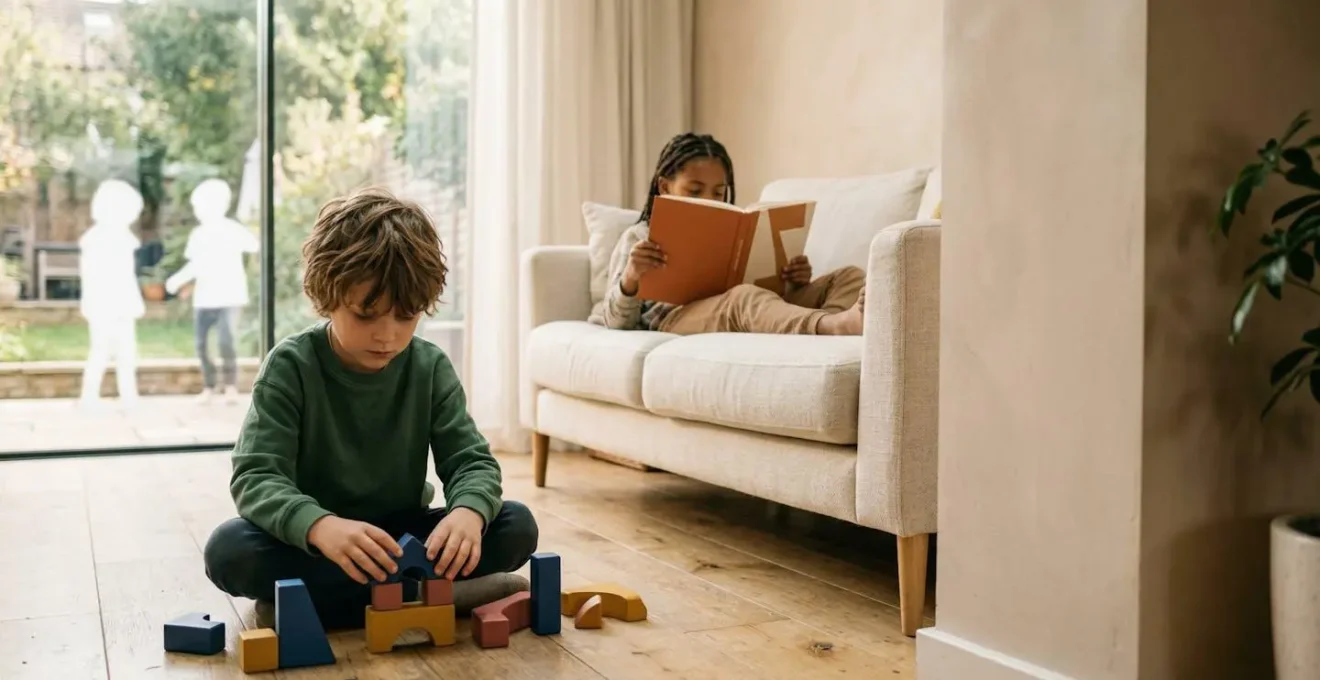
The solution to excessive screen time isn’t just finding more activities; it’s strategically creating the space for boredom.
- Passive screen use and active, creative play engage a child’s brain in fundamentally different ways.
- Unstructured, device-free time activates the brain’s “Default Mode Network,” the source of imagination and self-discovery.
Recommendation: Shift your focus from managing screen time to curating an environment where a rich and balanced “mental diet” of activities can naturally flourish.
That familiar glow. The sound of a video starting its autoplay countdown. For many parents, the constant presence of screens feels like an unwinnable battle. You worry your child has no interests outside of their tablet or console, and the quiet panic sets in: what happens when the battery dies? The common advice is to set limits, find new activities, and lead by example. While these are valid steps, they often treat the symptom, not the cause. They position parents as entertainment directors, constantly needing to provide an alternative that’s more dazzling than the last digital dopamine hit.
But what if the approach is backward? What if, instead of fighting a war against screens, the real strategy lies in cultivating the very thing digital devices are designed to eliminate: boredom? The key to unlocking your child’s genuine, self-driven interests isn’t about filling every moment with a scheduled hobby. It’s about re-engineering their environment to allow for empty space—for contemplation, for tinkering, and for the quiet, internal spark of an idea to finally catch fire. This is not about banning technology, but about understanding its place within a healthy, balanced “mental diet.”
This guide will walk you through a new framework. We’ll explore why passive viewing is different from active creation, how to foster exploration without pressure, and how to use the power of downtime to help your child discover what they truly love. It’s time to stop being an activity director and start being an environment curator.
Summary: A Parent’s Guide to Cultivating Hobbies Beyond the Screen
- Why Watching YouTube Is Different from Playing Lego?
- How to Let Them Try 5 Hobbies in a Month for Free?
- Why You Must Ban Devices to Find Out What They Actually Like?
- The Pressure Mistake: Why They Shouldn’t Have to “Be Good” at It?
- What Can a 5-Year-Old and a 12-Year-Old Enjoy Together?
- Blue Light Glasses: Do They Actually Protect Children’s Eyes?
- What Should They Do Exactly if They Can’t See You?
- How to Encourage Creative Play in Small Apartments Without Mess?
Why Watching YouTube Is Different from Playing Lego?
At first glance, both activities keep a child occupied. Yet, the neurological difference between passively consuming video content and actively building with blocks is profound. Watching a screen often puts the brain into a receptive, low-engagement state. The content flows in one direction, requiring little to no creative output, problem-solving, or physical manipulation. This is the “empty calories” portion of a child’s mental diet. It’s entertaining but offers minimal developmental nutrition. It’s a significant portion, too; according to recent American Academy of Pediatrics survey data, children ages 5-8 average 3 hours and 38 minutes of media use per day.
In contrast, activities like playing with Lego, drawing, or even sorting rocks demand active engagement. The child’s brain must plan, execute, adapt, and solve spatial or logical problems. Their hands are engaged, creating a powerful feedback loop between thought and physical action. This active process builds critical thinking skills, spatial reasoning, and resilience. As Los Angeles-based paediatrician Dr. Joel ‘Gator’ Warsh points out, the real issue is the opportunity cost. He expresses this concern in an interview with Today’s Parent:
My biggest concern as a paediatrician, even as a dad, is what the kids are not doing. So if we’re on this much, we’re on the iPad too much, then we’re not outside, we’re not playing, we’re not active, we’re not necessarily engaging with our family or friends.
– Dr. Joel ‘Gator’ Warsh, Today’s Parent
This isn’t to demonize screens, but to categorize them correctly. They are a part of modern life, but understanding their passive nature is the first step toward intentionally carving out time for the active, creative, and social “food groups” that are essential for a well-rounded developmental diet.
How to Let Them Try 5 Hobbies in a Month for Free?
The idea of finding a new hobby can feel overwhelming and expensive for parents. The pressure to sign up for classes or buy equipment can be a major barrier. The solution is to reframe it as a “hobby tasting menu”—a low-stakes, high-variety approach to exploration. The goal isn’t to find “the one” hobby immediately, but to expose your child to a range of experiences to see what sparks their curiosity. This method removes the financial burden and the pressure of long-term commitment. By leveraging household items, free apps, and a bit of creativity, you can offer a world of new activities.
Inspired by frameworks for screen-free engagement, here is a five-week plan you can adapt using things you likely already have. Each week introduces a different type of creative or analytical thinking, providing a varied “tasting” experience:
- Week 1: Nature Detective. Go for a walk in a park or your own backyard. Use a free app like Seek by iNaturalist to identify plants, insects, and birds. They can create a small nature journal with drawings or leaf rubbings.
- Week 2: Kitchen Chemist. Conduct simple, safe science experiments with kitchen staples. Build a baking soda and vinegar volcano, create a density tower with different liquids (oil, water, honey), or grow crystals from salt or sugar.
- Week 3: Stop-Motion Animator. All you need is a smartphone and some toys. Using a free stop-motion app, they can create short films, learning the basics of animation one frame at a time.
- Week 4: Audio Storyteller. Using a phone’s voice recorder or free software like Audacity, they can write and record their own radio play or podcast. Crinkling paper can be a fire, and tapping on a table can be footsteps.
- Week 5: Upcycled Artist. Gather cardboard boxes, plastic bottles, and other clean recyclables. Challenge them to build “junk bots,” a diorama of their room, or a marble run.
This approach has been successful in community programs, like those documented by Parent Club Scotland, where families created “skill swap” networks to teach everything from guitar chords to basic coding at no cost. The key principle is novelty and rotation. By introducing something new each week, you keep the process exciting and prevent the boredom that can set in when a child feels forced into a single, parent-chosen activity.
Why You Must Ban Devices to Find Out What They Actually Like?
The phrase “I’m bored” can trigger a parent’s instinct to immediately solve the problem. We offer suggestions, pull out a board game, or, in a moment of weakness, hand over a device. However, this is a critical misstep. Boredom is not a problem to be solved; it is a necessary state for creativity and self-discovery. When a child’s brain isn’t being fed a constant stream of external stimuli from a screen, it’s forced to generate its own. This is where the magic happens.
Neuroscience provides a clear explanation for this phenomenon. When we are bored, our brains switch into what’s known as the Default Mode Network (DMN). This is the same network that’s active during daydreaming, reminiscing, and imagining the future. It’s the brain’s internal sandbox, where it connects disparate ideas, works through social scenarios, and engages in autobiographical thinking. In short, it’s the biological foundation of creativity and identity formation. As neuroscience research explains, boredom activates the brain’s default mode network, the system responsible for imagination and reflection.
As researchers at Nodi Kids elaborate, this is an active, not a passive, state:
When a child says ‘I’m bored’ and starts daydreaming or tinkering, their brain is actually hard at work in a mode scientists call the default mode network. This is the brain state associated with mind-wandering, and it’s closely linked to creativity.
– Researchers at Nodi Kids, Child development research on creative thinking
Therefore, a “device ban” or a scheduled “digital detox” isn’t a punishment. It’s a strategic tool. It creates the vacuum that only your child’s own thoughts and interests can fill. It’s in those quiet, unstructured moments that a child might finally notice the cardboard box in the corner and see a spaceship, or pick up a pencil and start sketching the world outside their window. You’re not taking something away; you’re giving them the mental space to discover what’s already inside them.
The Pressure Mistake: Why They Shouldn’t Have to “Be Good” at It?
Once a child shows a flicker of interest in a new activity—whether it’s kicking a soccer ball or learning a new song on the piano—a parent’s natural instinct is to encourage them. But the *way* we encourage them matters profoundly. Often, we fall into the trap of praising ability (“You’re such a natural artist!”) or the final product (“That’s a perfect drawing!”). While well-intentioned, this type of praise can inadvertently create pressure and a fear of failure.
This is the core of the research by Stanford Professor Dr. Carol Dweck on “growth mindset” versus “fixed mindset.” When we praise innate talent, we promote a fixed mindset—the belief that ability is a static trait. Children praised this way become afraid of challenges that might expose them as not being “a natural” after all. As Dr. Dweck found in her research, “When we praised children for their ability after a success, they were more likely to reject challenges and fall apart or become defensive when they hit difficulty.” This is precisely how a budding hobby dies.
The alternative is to foster a growth mindset by praising the process, not the person or the product. This means focusing on effort, the strategies they used, the persistence they showed, and the learning that occurred. This approach teaches children that abilities can be developed through dedication and hard work. A mistake is no longer a sign of failure, but an opportunity to learn. The goal of a hobby shifts from “being good at it” to the joy of engagement, the satisfaction of improvement, and the fun of the process itself.
Your Action Plan: Shifting to Process-Oriented Praise
- Instead of Product Praise: Don’t say, “That’s a beautiful drawing!” Say, “You used so many different colors! Tell me about this part.” This focuses on choices and opens a conversation.
- Instead of Ability Praise: Don’t say, “You’re so smart at math!” Say, “You really practiced that method, and look how you’ve improved.” This connects effort to results.
- Instead of Praising Fixed Traits: Don’t say, “You’re a natural athlete!” Say, “I saw you try a few different ways to get past that obstacle, and you figured it out!” This highlights strategy and problem-solving.
- Instead of Focusing on Perfection: Don’t say, “This is perfect!” Say, “You stuck with this even when it was tricky, and now you really understand it.” This values persistence and learning.
- Avoid Empty Effort Praise: Don’t just say, “Good job trying!” Instead, specifically identify what worked: “I noticed when you slowed down and focused, you were able to solve it.” This makes the praise concrete and useful.
By consciously shifting your language, you remove the crippling pressure to perform. You give your child the freedom to explore, make messes, and be “bad” at something new—which is the only way anyone ever gets good at anything.
What Can a 5-Year-Old and a 12-Year-Old Enjoy Together?
Finding an activity that genuinely engages both a young child and a pre-teen can feel impossible. The vast difference in cognitive abilities, attention spans, and physical skills often leads to frustration, with one child bored and the other feeling held back. The key is to move away from activities that require symmetrical participation (where everyone does the same thing) and embrace the concept of asymmetrical collaboration.
Asymmetrical collaboration involves a single project where siblings can contribute in different but complementary ways, according to their skill level. The older child takes on roles requiring more complex planning, reading, or fine motor skills, while the younger child handles tasks that are simpler but still essential to the overall goal. This structure transforms the older sibling from a reluctant playmate into a mentor and leader, and the younger sibling from an annoyance into a valuable teammate. It builds confidence in both and fosters a genuine sense of teamwork.
Here are five asymmetrical collaboration projects that work well for wide age gaps:
- Collaborative Building (Lego/Blocks): The 12-year-old acts as the “architect,” reading complex instructions, planning the structure, and delegating tasks. The 5-year-old becomes the “supplier and builder,” finding the correct colored and shaped pieces and connecting them as directed.
- Cooking or Baking Together: The older child reads the recipe, measures ingredients, and handles any tasks involving heat or sharp utensils. The younger child can stir batters, wash vegetables, sprinkle toppings, or help with the final presentation.
- Large-Scale World-Building: Roll out a large piece of paper. The 12-year-old can design the map of a fantasy world, invent its lore, and write down names of cities and characters. The 5-year-old can draw the monsters, houses, trees, and rivers that populate that world.
- Mentor-Mentee Skill Sharing: The older child can formally teach the younger child a skill they have mastered. This could be a simple card trick, a basic drawing technique (like how to draw a star), or the rules of a simple video game. The act of teaching reinforces the older child’s own mastery.
- Co-written and Illustrated Story: The 12-year-old writes the narrative of a story, focusing on plot and dialogue. The 5-year-old’s job is to illustrate the scenes and create unique voices for each character during a dramatic read-aloud performance.
By structuring play this way, you’re not just finding a temporary solution to occupy them. You are actively building their relationship, teaching them about leveraging different strengths, and creating shared memories rooted in teamwork rather than conflict.
Blue Light Glasses: Do They Actually Protect Children’s Eyes?
As parents become more aware of screen time, a market for “solutions” has emerged, with blue light filtering glasses being one of the most popular. The marketing claims are compelling: reduce eye strain, prevent eye damage, and improve sleep. But does the science back up these claims for children? The short answer is: not in the way most people think. Eye strain from screens, often called “digital eye strain,” is primarily caused by focusing at a close distance for prolonged periods and reduced blinking, not by blue light itself.
The most comprehensive scientific evidence to date confirms this. A 2023 Cochrane systematic review analyzing 17 trials concluded that blue light filtering lenses offered no significant, short-term benefit for reducing visual fatigue, improving visual performance, or enhancing sleep quality. The American Academy of Ophthalmology does not recommend any special eyewear for computer use.
So, are they useless? Not entirely, but their role needs to be correctly understood. As pediatric ophthalmologist Dr. Rupa Wong clarifies, the one proven benefit is related to our sleep cycle. She advises reframing them as a “sleep-hygiene tool,” not an “eye-protection device.” Blue light, especially in the evening, can suppress the body’s production of melatonin, the hormone that signals it’s time to sleep. Blocking this light in the one to two hours before bed can help regulate the circadian rhythm.
However, glasses are an expensive solution to a problem that can be solved for free. Far more effective (and evidence-based) strategies exist to protect both eyes and sleep:
- Use Built-in Device Features: Enable “Night Shift” (iOS), “Eye Comfort Shield” (Android), or “Night Light” (Windows). These functions automatically warm the screen’s color temperature in the evening, reducing blue light emission at no cost.
- Follow the 20-20-20 Rule: This is the number one tool against eye strain. Every 20 minutes, have your child look at something 20 feet away for at least 20 seconds. This relaxes the focusing muscles in the eyes.
- Establish a “Digital Sunset”: The most effective method of all. Ban all screens for 1-2 hours before bedtime to allow melatonin to rise naturally.
- Increase Outdoor Time: Research has shown that spending more time outdoors in natural light can help reduce the progression of nearsightedness (myopia) in children.
Instead of investing in a quick fix, focusing on these behavioral habits provides more comprehensive and lasting benefits for your child’s overall digital wellness.
What Should They Do Exactly if They Can’t See You?
Fostering independence is a key part of curating a balanced mental diet. This means allowing for periods of unsupervised play, which is crucial for building autonomy and problem-solving skills. In today’s world, that “unsupervised” time can be either offline in their room or online exploring a digital space. Both scenarios require clear, simple safety frameworks so your child knows exactly what to do if they encounter something confusing, scary, or inappropriate when you’re not immediately there to supervise.
The goal is to create “Safe Sandboxes”—pre-vetted environments where children have the freedom to explore independently within safe boundaries. For offline play, this might be a “Yes Space,” a room or area where all accessible materials (art supplies, toys, books) are known to be safe. For digital play, it means using curated platforms like YouTube Kids with approved-only channels enabled, rather than the open internet. Research on child internet safety has shown this “Safe Sandbox” approach is highly effective.
Within these sandboxes, children still need a simple, memorable action plan. For online encounters, the ELSA Digital Safety Framework is an excellent tool to teach them. It’s an easy-to-remember acronym for immediate action:
- E – Exit: Exit the app or website immediately if they see something that feels weird, scary, or makes them uncomfortable.
- L – Log off: Log off or turn off the device completely. Don’t just switch to another app.
- S – Speak: Speak to a trusted adult about what they saw. It’s crucial to create an environment where they know they can tell you anything without fear of being punished or losing their device privileges.
- A – Ask: Always ask for help from an adult before sharing any personal information like their name, school, address, or photos online.
By establishing these clear boundaries and action plans, you empower your child with a sense of control and competence. You’re not just telling them “be safe”; you’re giving them the exact tools to manage their own safety. This builds trust and makes them more likely to come to you when they need help, fostering the very independence you aim to cultivate.
Key Takeaways
- A child’s “mental diet” requires a balance of passive consumption and active, creative engagement.
- Strategic boredom is not a problem to solve but a necessary catalyst for activating the brain’s imagination and self-discovery networks.
- Praising a child’s effort, strategy, and persistence (process) over their innate talent or results (product) builds resilience and a love for learning.
How to Encourage Creative Play in Small Apartments Without Mess?
One of the biggest practical barriers to encouraging creative, hands-on play is the perceived mess and lack of space, especially for families living in apartments. The thought of paint spills on the carpet or a thousand tiny beads scattered across the floor is enough to make any parent reach for the clean, contained world of a tablet. However, fostering imagination doesn’t have to mean sacrificing your living space. The solution lies in choosing low-mess, high-imagination activities and establishing clear containment systems.
The “Creation Station” concept, documented by pediatric researchers, is a highly effective strategy. This involves designating a specific, easy-to-clean zone for all messy activities. This could be a large plastic storage bin lid (a tuff tray), a washable mat in a corner of the room, or even just the bathtub for water-based play. Crucially, cleanup becomes part of the activity itself—a ritual that teaches responsibility while keeping the home organized. A “one-box-at-a-time” rule for activity kits also prevents overwhelm by ensuring one project is put away before the next one comes out.
Within this framework, there are countless activities that offer maximum creative output for minimal cleanup. Here are a few ideas perfect for small spaces:
- Fort Building: Using sheets, pillows, chairs, and clothespins, children can create entire worlds. It’s a fantastic exercise in engineering and imagination, and it disappears completely at the end of the day.
- Painter’s Tape Roadways: Easily removable painter’s tape can transform a floor into a sprawling city for toy cars, a hopscotch court, or a maze. It peels off cleanly with no residue.
- Shadow Puppet Theater: All you need is a dark room, a flashlight (or phone light), and your hands. This classic activity requires zero materials and zero cleanup, and it’s endlessly creative.
- Magnetic Creativity Wall: Dedicate a portion of your refrigerator or a magnetic whiteboard to play. Magnetic tiles, poetry kits, or gears offer a vertical play surface that saves precious floor space.
- Window Art Station: Tape a coloring page to a sunny window and place tracing paper over it. The light from behind makes tracing easy and fun. Using washable window crayons is another great, easily cleanable option.
By being strategic about the types of activities and the systems for containing them, you can make creative play an easy and welcome part of daily life, proving that a big imagination doesn’t require a big house.
Ultimately, shifting your child’s focus away from screens is not about adding more to your parental to-do list. It is about a fundamental change in perspective: from an activity director to an environment curator. By embracing strategic boredom, praising the process, and providing the time and space for exploration, you create the conditions for your child’s intrinsic interests to emerge. Your role is not to hand them a hobby, but to empower them to discover their own.