Education & Learning
The early years of a child’s life represent a remarkable window of opportunity for learning and development. During this period, the brain forms over one million neural connections every second, laying the groundwork for all future learning, behavior, and health. Yet many parents feel overwhelmed by conflicting advice about what their child should be learning, when, and how. The truth is that effective early education isn’t about pushing academic skills prematurely—it’s about understanding how young minds develop and creating environments where curiosity, confidence, and capability can flourish naturally.
This comprehensive resource explores the core pillars of early childhood education and learning, from establishing daily routines that support cognitive readiness to nurturing the social, emotional, and executive function skills that determine long-term success. Whether you’re navigating the toddler years or preparing your child for formal schooling, understanding these foundational principles will empower you to make informed decisions that align with your child’s unique developmental needs and learning style.
Building Effective Learning Routines From the Start
Consistency isn’t about rigidity—it’s about creating predictable patterns that help young brains know what to expect. Research shows that children with inconsistent learning times can experience delays in cognitive readiness of up to six months compared to peers with regular routines. This happens because the developing brain thrives on patterns, using them to build neural pathways that support attention, memory, and self-regulation.
The good news is that effective routines don’t require hours of structured time. A 15-minute morning focus session can be remarkably powerful when implemented consistently. This might involve looking at a picture book together, practicing letter sounds, or engaging in a simple counting game. The key is the regularity, not the duration. Think of it like watering a plant: brief, consistent attention yields better results than sporadic intensive sessions.
Parents often struggle with the balance between structured activities and child-led exploration. The answer isn’t choosing one approach exclusively but rather understanding when each serves your child best:
- Structured routines work well for building specific skills, establishing transitions, and providing security for anxious children
- Child-led time fosters creativity, problem-solving, intrinsic motivation, and allows children to process new information at their own pace
- Hybrid approaches offer structure with flexibility—setting a time for “learning play” but letting your child choose the activity within appropriate boundaries
One critical mistake parents make is over-scheduling, which frequently manifests as increased tantrums and resistance. When every moment is programmed, children lose the downtime necessary for integration and self-directed play. If your child consistently melts down after activities or resists previously enjoyed routines, consider whether they’re simply overstimulated rather than defiant. Adjusting routines when boredom or resistance appears isn’t admitting defeat—it’s responsive parenting that acknowledges changing developmental needs.
Understanding and Supporting Cognitive Development
Brain development in early childhood isn’t a passive process—it’s actively shaped by the quality and type of interactions children experience daily. Specific interactions that involve back-and-forth communication, problem-solving, and emotional attunement literally build the architecture of the developing brain, strengthening connections in areas responsible for language, executive function, and emotional regulation.
Understanding typical developmental milestones helps parents recognize both progress and potential concerns. By age four, most children demonstrate these memory and attention capabilities:
- Following two- to three-step instructions without reminders
- Recalling events from earlier in the day with some detail
- Focusing on a preferred activity for 10-15 minutes
- Recognizing and naming familiar letters, numbers, or shapes
- Remembering and singing simple songs or rhymes
If your child isn’t quite there yet, don’t panic—development varies widely. Instead, focus on activities that strengthen these skills naturally. Simple games like memory matching, “I Spy,” sequencing cards, or hiding objects and asking your child to recall their locations all boost memory retention without requiring screens or expensive materials. A deck of cards and some household items provide endless opportunities for brain-building play.
The distinction between passive learning and active engagement cannot be overstated. A child watching an educational video is passively receiving information; a child building a block tower and narrating their process is actively constructing knowledge. Active engagement requires the brain to predict, test, adjust, and integrate—processes that strengthen neural pathways far more effectively than passive observation.
Many well-intentioned parents fall into the trap of emphasizing academic skills—letter recognition, counting, shape identification—while neglecting problem-solving and critical thinking. But a child who can recite the alphabet yet cannot figure out how to reach a toy on a high shelf has memorized sequences without developing the reasoning skills that underpin all future learning. Balance factual knowledge with opportunities to experiment, fail, adjust, and try again. For children with naturally short attention spans, this means breaking activities into smaller chunks, incorporating movement, and celebrating small wins to build confidence and stamina gradually.
Nurturing Social Skills Through Interaction and Play
Social competence—the ability to cooperate, negotiate, share space and resources, and navigate conflict—is as crucial to lifelong success as any academic skill. Yet these capabilities don’t develop through instruction alone; they emerge through practice in real social situations, including the uncomfortable ones.
Counter to what many parents believe, conflict is actually a necessary tool for social learning. When children disagree about who gets the red crayon or how to build the fort, they’re learning negotiation, perspective-taking, emotional regulation, and problem-solving in real time. The adult’s role isn’t to prevent these moments but to provide the scaffolding that helps children navigate them constructively.
Setting up collaborative games where everyone contributes to a shared goal—building a pillow fort together, creating a group art project, or working as a team to complete a puzzle—builds a teamwork mindset that differs fundamentally from individual achievement. Consider these approaches:
- Shared tasks require cooperation toward a common outcome (baking cookies together, setting the table as a team)
- Individual chores build personal responsibility and autonomy (putting away one’s own toys, choosing tomorrow’s outfit)
- Alternating between both types helps children understand different social contexts and expectations
The phrase “you have to share” is ubiquitous in parenting, yet always forcing children to share can actually undermine the development of genuine generosity and respect for ownership. A more nuanced approach acknowledges that sometimes children need time with their own things, while also teaching turn-taking and the pleasure of giving. For impulsive preschoolers, teaching turn-taking works best with visual aids—timers, tokens, or simple “you have it, then I have it” songs that make the abstract concept of waiting concrete and predictable.
Developing Critical Thinking and Reasoning Skills
The ability to analyze, question, and reason develops gradually throughout childhood, but the foundation is established in the earliest years through how adults respond to children’s natural curiosity. One of the most powerful phrases you can use is “I don’t know, what do you think?” Instead of always providing answers, this response communicates that thinking through problems is valuable, that multiple perspectives exist, and that your child’s ideas matter.
Storybooks offer rich opportunities for developing reasoning skills beyond simple comprehension. Rather than just reading the words, pause to question character motivations: “Why do you think the fox said that? How do you think the rabbit felt? What would you do differently?” These questions require children to infer, predict, and evaluate—higher-order thinking skills that transfer to all areas of learning.
Teaching the difference between fact and opinion early establishes critical thinking foundations that serve children throughout life. Start simple: “It’s raining” is a fact we can observe; “rainy days are boring” is an opinion that not everyone shares. As children grasp this distinction, they begin to question claims rather than accepting everything they hear as truth.
Many parents instinctively shield children from small failures—catching them before they fall, solving problems before frustration builds, removing all obstacles from their path. Yet these small failures are precisely where resilience and analytical thinking develop. When a block tower collapses, that’s a learning opportunity: What happened? What could we try differently? The process of analyzing what went wrong and generating solutions builds the cognitive flexibility that underlies adaptive intelligence.
A surprisingly effective activity is analyzing advertisements together as a game. Even young children can begin to recognize that commercials are trying to make them want something, that cartoon characters are used to appeal to kids, and that claims like “the best” are opinions, not facts. This playful media literacy lays groundwork for critical consumption of information in an increasingly complex media landscape.
Learning Styles and Brain-Healthy Lifestyle Choices
Not all children learn the same way, and understanding your child’s natural learning style can transform frustration into engagement. Recent neuroscience has revealed fascinating connections between lifestyle choices and long-term brain plasticity—the brain’s ability to form new connections and adapt throughout life.
Consider these evidence-based findings:
- Music practice shows measurable positive impacts on mathematical ability, likely because both involve pattern recognition, sequencing, and proportional reasoning
- Bilingualism, once thought to cause confusion, actually confers significant cognitive advantages including enhanced executive function, mental flexibility, and creative problem-solving
- Aerobic exercise directly stimulates growth in the hippocampus, the brain region critical for memory formation and learning—movement isn’t a break from learning; it’s fundamental to it
Understanding these connections helps parents make informed choices about activities and daily routines. For instance, timing complex tasks with circadian rhythms can optimize learning: most children show peak cognitive performance mid-morning, making this ideal for challenging new concepts, while creative activities often flow better in afternoon hours when the brain shifts toward more diffuse thinking.
The error of over-drilling flashcards illustrates a common misunderstanding about how memory works. Rote repetition without context or meaning creates fragile knowledge easily forgotten. More effective approaches embed information in stories, songs, physical activities, or practical applications where the brain creates multiple pathways to the same information.
Supporting Kinesthetic Intelligence
Approximately 30% of children are kinesthetic learners—they process information most effectively through movement and hands-on experience. For these “movers and shakers,” sitting still to complete worksheets isn’t just difficult; it’s neurologically inefficient. Homework hacks that incorporate movement—bouncing on a yoga ball while reading, walking while practicing spelling words, or using hand gestures to remember math facts—align the learning approach with the child’s neurological strengths.
Manipulatives for math concepts—counting beads, fraction blocks, measurement tools—make abstract ideas concrete and touchable. Children who struggle with number sense on paper often grasp the same concepts immediately when they can physically manipulate objects. Similarly, understanding the distinction between fidget tools and toys is crucial: a fidget tool occupies the hands to help the mind focus, while a toy captures attention itself. A smooth stone to rub or a textured band to stretch can be legitimate learning supports, not distractions.
The practice of taking away recess as punishment for incomplete work or behavior issues is counterproductive and potentially harmful. Children who most need movement breaks are often those most likely to lose them, creating a punitive cycle. Physical activity improves attention, mood, and cognitive function—removing it undermines the very capacities needed for better behavior and learning.
Fostering Independence and Self-Management Skills
True learning involves not just acquiring knowledge but developing the self-regulation and organizational skills to manage one’s own learning process. These executive function skills—planning, organization, time management, emotional regulation—predict academic and life success more reliably than IQ scores, yet they’re often overlooked in favor of academic content.
When your child asks for help, resist the urge to immediately provide solutions. The “Pause” technique involves taking a breath and responding with questions rather than answers: “What have you tried so far? What do you think might work? What’s the tricky part?” This brief pause shifts children from passive help-seeking to active problem-solving, building confidence and capability with each iteration.
Scaffolding represents the bridge between struggle and success—providing just enough support that children can accomplish what they couldn’t do independently, then gradually removing supports as competence grows. It’s the difference between doing the puzzle for them and pointing out where they might look for matching pieces. Effective scaffolding requires reading your child’s signals: too little support leads to overwhelm and shutdown; too much creates dependency and robs them of the satisfaction of genuine achievement.
A crucial but often overlooked prerequisite to logical thinking is emotional regulation. A dysregulated child cannot access the prefrontal cortex needed for reasoning, problem-solving, or learning. Before addressing the incomplete homework or the struggle with math facts, address the emotional state. Sometimes this means a hug, a glass of water, or five minutes outside before attempting the cognitive task.
Many parents shield children from natural consequences, but these consequences provide some of life’s most powerful learning opportunities. Forgetting lunch means being hungry until snack time; refusing a jacket means feeling cold at the park. When we constantly rescue children from the outcomes of their choices, we deprive them of the cause-and-effect learning that builds judgment and foresight. The key is ensuring consequences are safe and age-appropriate, then stepping back to let the learning happen. Afterward, reflecting on mistakes without blaming—”That was hard. What will you do differently next time?”—solidifies the lesson without shame.
Practical Systems for Organization
Executive function skills can be supported through external systems until internal capabilities develop. The “Sunday Reset” ritual—taking time each week to organize materials, review the upcoming schedule, and prepare what’s needed—creates predictability and reduces daily chaos. For younger children, this might involve choosing outfits for the week or organizing the toy shelf; for older ones, it includes checking the backpack, reviewing assignments, and planning activities.
Debates about pouch systems versus multi-pocket bags or the best labeling strategies might seem trivial, but the right organizational system can dramatically reduce daily friction. The best system is the one your child will actually use, which typically means simple, visual, and easy to maintain. Labeling strategies that actually stay on typically involve a combination of visual cues (colors, pictures) and text, and placement where children naturally look.
Paradoxically, the error of over-supplying often creates more chaos than under-supplying. When children have too many markers, too many worksheets, too many options, decision fatigue and disorganization result. Streamlined supplies that have designated homes and are replenished as needed create systems children can manage independently. The “homework folder” chaos familiar to so many families often stems not from the child’s disorganization but from a system too complex for their current executive function capacity.
Effective early education and learning isn’t about earlier academics or more intensive programming—it’s about understanding how young humans develop and creating the conditions where natural learning thrives. By building consistent routines, supporting cognitive development through active engagement, nurturing social competence, fostering critical thinking, honoring diverse learning styles, and teaching self-management, you provide your child with far more than knowledge. You give them the tools, confidence, and love of learning that will serve them throughout life.
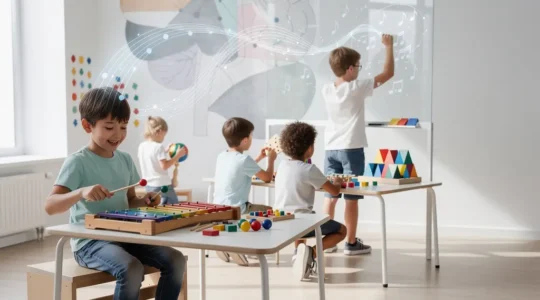
How Does Bilingualism or Music Learning Boost Cognitive Development?
Contrary to the belief that child development is about accumulating knowledge, the real key to boosting intelligence lies in building a superior ‘cognitive architecture’. This article reframes activities like music, bilingualism, and even physical play not as simple enrichment, but…
Read more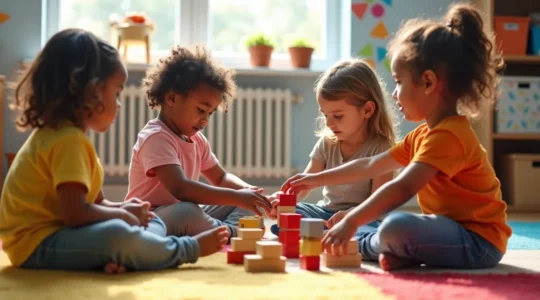
Why Group Learning Is Essential for Only Children Before School Starts?
Contrary to popular belief, preparing an only child for school isn’t about random exposure to other kids; it’s about strategically building a ‘social toolkit’ that a quiet home environment simply cannot provide. Peer correction is a faster and more effective…
Read more
How to Foster Critical Thinking in Kids Using Everyday Scenarios?
The secret to raising a critical thinker isn’t providing answers, but mastering the art of the ‘productive pause’ to let their reasoning grow. Most parents instinctively rush to solve problems for their children, accidentally stifling the development of independent thought….
Read more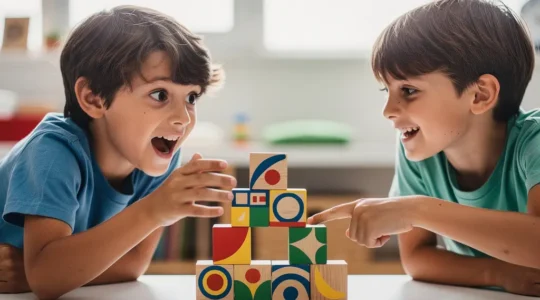
Helping Siblings Learn Cooperation Through Structured Play Conflicts
The constant fighting between your children isn’t a sign of parenting failure; it’s an untapped curriculum for teaching vital life skills. Most parental interventions, like immediately punishing or forcing a resolution, actually prevent children from learning to negotiate and self-regulate….
Read more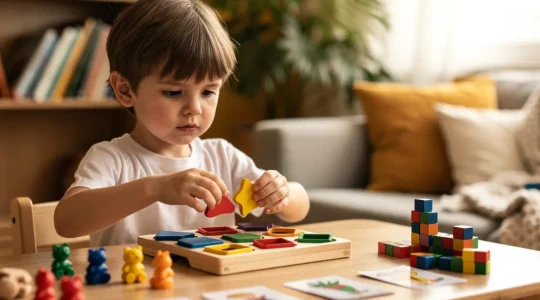
Which Cognitive Skills Matter Most Before Kindergarten Entry?
The most reliable indicator of kindergarten readiness isn’t a child’s ability to count to 20, but the strength of their underlying ‘cognitive engine’—the core skills of memory, attention, and flexible thinking. Everyday routines like sorting laundry or cooking are powerful…
Read more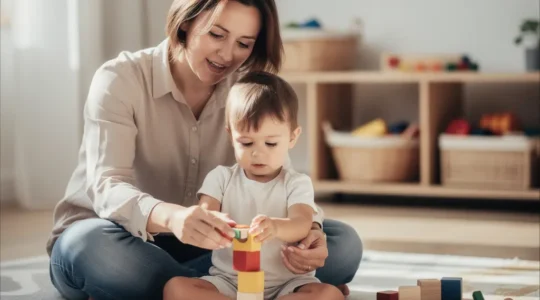
How to Build a Calm, Stress-Free Learning Routine for Your Toddler
The secret to a successful toddler learning routine isn’t about the right toys or forced fun; it’s about creating a neurologically safe environment that minimizes stress. Inconsistent routines can elevate a toddler’s stress hormone (cortisol), which directly hinders the development…
Read more