In summary:
- Your home’s entryway is the most critical checkpoint for stopping school-borne pathogens before they spread.
- Soap and water are non-negotiable for stomach bugs like norovirus, where alcohol-based sanitizers are ineffective.
- A balanced approach is key: target high-risk pathogens from school while allowing exposure to beneficial microbes to build natural immunity.
- Implementing a 15-minute “Sanitary Reset” each evening significantly reduces morning stress and illness.
The first sniffle of the school year often feels like an alarm bell. Suddenly, the house is a landscape of used tissues, coughs echo in the hallways, and the cycle of seasonal illness begins. Most parents rely on the usual advice: wash your hands, cover your mouth, and hope for the best. While well-intentioned, these general rules often lack the systematic rigor needed to truly disrupt the transmission of potent school-borne pathogens like influenza, strep, and norovirus.
The problem isn’t the advice itself, but the lack of a strategic framework. We treat hygiene as a series of isolated chores rather than a cohesive defense system. But what if the key wasn’t just reminding kids to wash their hands, but establishing a clinical-grade “Decontamination Protocol” at the threshold of your home? This isn’t about creating a sterile bubble; it’s about targeted, evidence-based vector control that neutralizes threats where they enter, protecting your family’s health without compromising the development of a robust immune system.
This guide will walk you through the science and practical steps of creating that protocol. We will analyze the primary germ vectors your child brings home, detail the correct methods and materials for neutralization, and provide behavioral strategies to ensure your children become active participants in the family’s health defense. Finally, we’ll balance this targeted approach by exploring how natural exposure plays a crucial role in building long-term immunity.
By understanding the “why” behind each hygienic step, you can transform your after-school routine from a daily battle into a powerful and efficient health strategy. The following sections break down this protocol into manageable, actionable components.
Table of contents: Establishing a Home Decontamination Protocol
- Why shoes and backpacks should never pass the entryway?
- How to teach the “under the nails” technique to impatient kids?
- Sanitizer or Soap: Which one fails against stomach bugs?
- The sharing habit that spreads mononucleosis and strep fast
- When to deep clean the backpack vs. just wiping it down?
- Why sterile environments might trigger allergies and asthma?
- How to get out the door by 8 AM with a baby and a toddler?
- Building Immunity Naturally: Does Playing in Dirt Actually Help?
Why shoes and backpacks should never pass the entryway?
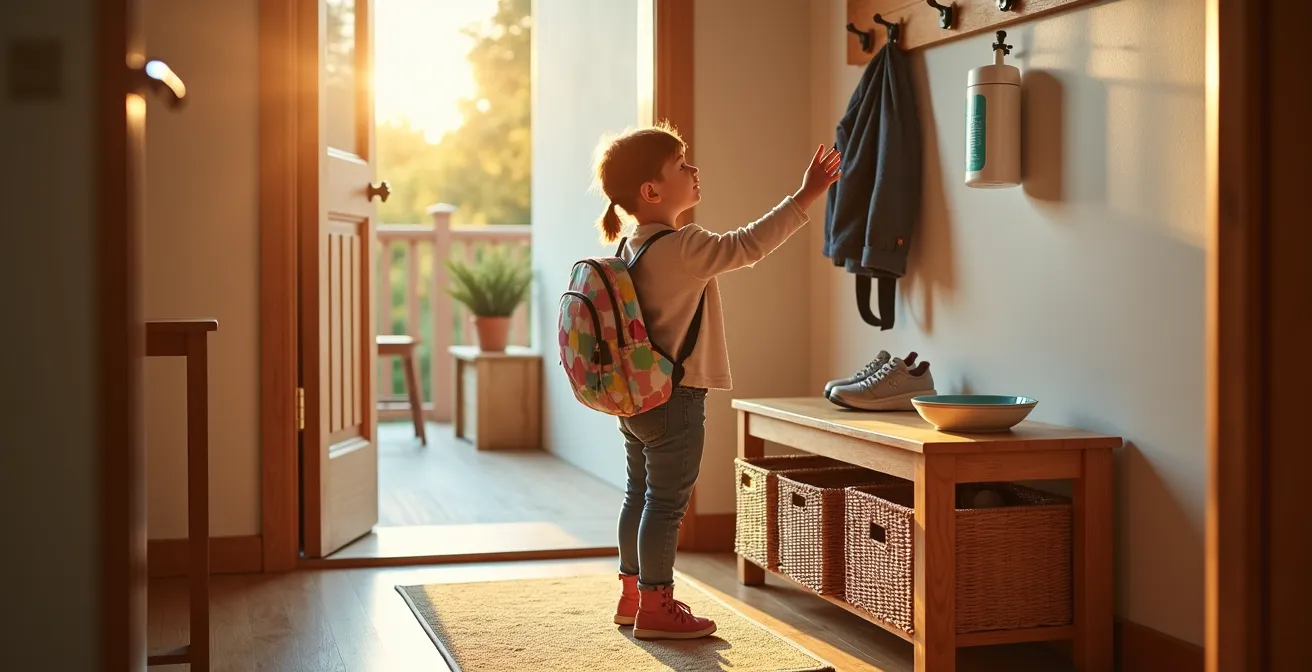
The front door of your home is the single most important checkpoint in your family’s defense against seasonal illness. The items that cross this threshold first—shoes and backpacks—are the primary vectors for introducing a high pathogen load into your living space. Thinking of them as simple accessories is a critical mistake; from a public health perspective, they are contaminated equipment. Research from the University of Arizona provides a startling context, finding an average of 421,000 units of bacteria on the exterior of shoes, including E. coli.
When shoes are worn throughout the house, they effectively stamp this cocktail of bacteria, viruses, and fecal matter onto every surface they touch, from carpets where toddlers crawl to kitchen floors. Backpacks, which are frequently placed on school floors, bathroom counters, and bus seats, carry a similar microbial load. Allowing them onto kitchen tables or beds creates a direct pathway for cross-contamination. Establishing a strict “landing zone” protocol at the entryway isn’t about obsessive cleanliness; it’s a fundamental principle of vector control. By containing these items at the point of entry, you prevent the widespread seeding of pathogens throughout your home, drastically reducing the overall exposure risk for the entire family.
Creating this landing zone requires a simple, dedicated system that makes the correct behavior the easiest option for everyone, including young children. The goal is to make stopping at the door an automatic, non-negotiable habit.
- Install low hooks: Place hooks at your child’s eye level so they can immediately hang their backpack without it ever touching the floor inside.
- Use a waterproof mat: A designated mat right inside the door serves as the clear “shoe zone.”
- Set up labeled cubbies: Baskets or cubbies for each family member provide a home for shoes, preventing a pile-up and reinforcing ownership.
- Position sanitizer: Keep a hand sanitizer dispenser at the entryway for immediate use after dropping off contaminated items.
- Post a visual chart: For younger children, a simple picture-based chart showing the sequence (shoes off, backpack on hook, wash hands) provides powerful behavioral scaffolding.
How to teach the “under the nails” technique to impatient kids?
Even with perfect 20-second handwashing, one area is consistently missed: the space under the fingernails. This small, protected environment is a haven for germs, trapping dirt, bacteria, and virus particles that regular washing can’t easily dislodge. For children, who are constantly digging in sandboxes, using shared art supplies, and touching countless surfaces, their fingernails can become a significant reservoir for pathogens. Teaching them to clean this area effectively is a crucial upgrade to their hygiene skills, but it requires a more engaging approach than simply issuing a command.
The key is to make this invisible threat visible and the cleaning process a rewarding activity. Traditional nagging is ineffective because children can’t see the germs they’re supposed to be fighting. Instead, a hands-on demonstration provides the “aha” moment that transforms their understanding. This is a classic example of behavioral scaffolding, where you provide a tangible tool or experience to build a new, abstract concept.
Case Study: The “Glitter Germs” Demonstration
To make the concept of germ spread tangible, educators have found immense success with a simple experiment. By putting a small amount of glitter on a child’s hands and calling it “glitter germs,” they ask the child to go about their normal activities. The child quickly sees the glitter transfer to toys, doorknobs, and friends. The final step is demonstrating that a quick rinse doesn’t remove the glitter; it requires thorough scrubbing with soap for at least 20 seconds, paying special attention to the areas where glitter gets trapped, like under the nails. Teachers leveraging this visual tool report that it can increase proper handwashing by up to 70% among students, as it connects the action of scrubbing to a visible result.
To translate this into a daily habit, introduce a fun tool like a soft, colorful nail brush. The tactile sensation and the novelty of the brush can turn a chore into a more focused, game-like activity. Frame it as “scrubbing out the secret hiding spots” for germs.
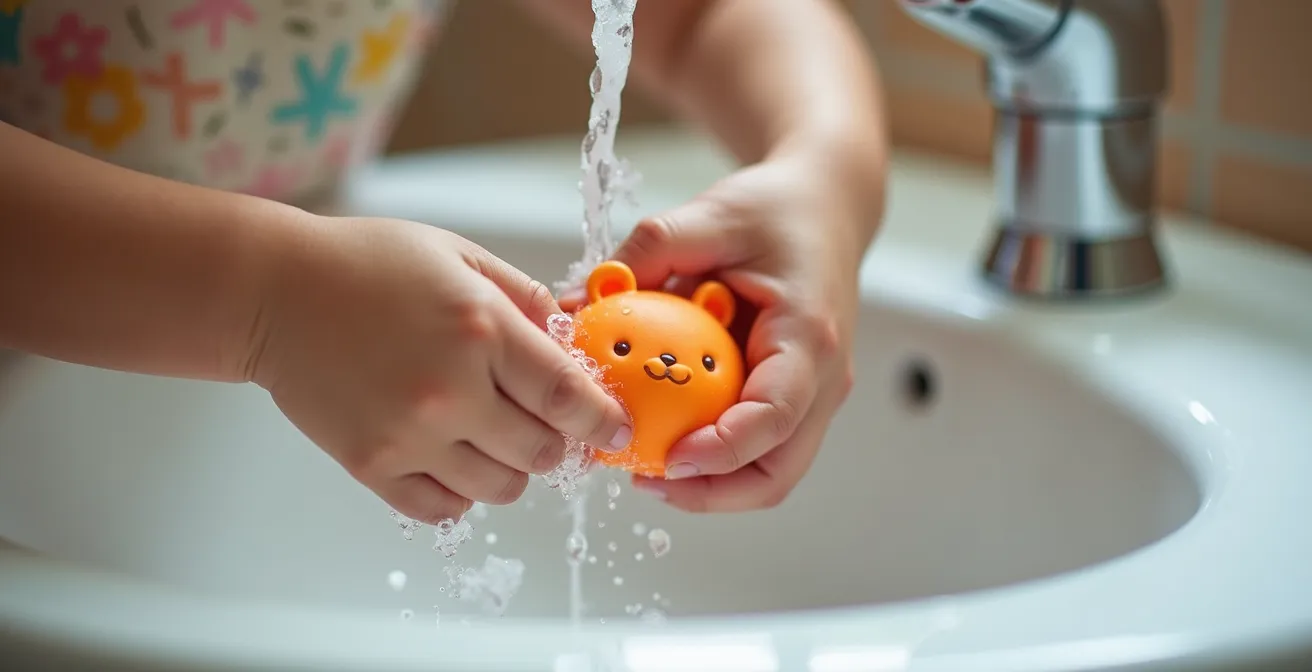
As this image demonstrates, using a dedicated tool focuses the child’s attention on the specific action of scrubbing under the nails. By pairing a visual lesson like the glitter experiment with a practical tool, you equip your child with both the knowledge and the means to perform a truly effective hand wash, neutralizing a critical weak point in their hygiene defense.
Sanitizer or Soap: Which one fails against stomach bugs?
In the modern parent’s arsenal, alcohol-based hand sanitizer is often seen as a convenient cure-all. It’s quick, portable, and effective against many pathogens, including the virus that causes COVID-19 and common cold viruses. However, this reliance creates a dangerous false sense of security when it comes to one of the most common and disruptive school-borne illnesses: norovirus, the highly contagious bug responsible for most cases of “stomach flu.” When it comes to norovirus, hand sanitizer is largely ineffective.
The reason lies in the virus’s structure. Norovirus is a “non-enveloped” virus, meaning it lacks the outer lipid membrane that alcohol-based sanitizers are designed to destroy. As Dr. Michelle Barron, a UCHealth infection prevention expert, explains, “Alcohol can’t break the shield.” Soap and water, on the other hand, work differently. The physical friction of scrubbing and the surfactant properties of soap work together to lift and wash the virus particles off the skin and down the drain. CDC research quantifies this failure, showing that alcohol-based sanitizers achieve merely a 0.14 to 0.34 log10 reduction against norovirus, which is not enough to prevent infection. This makes proper handwashing with soap and water a non-negotiable protocol during stomach bug season.
Understanding which tool to use against which pathogen is essential for an effective decontamination strategy. This table breaks down the effectiveness of each method against common germs found in school environments.
| Pathogen Type | Soap & Water | Alcohol Sanitizer (60-95%) | Best Choice |
|---|---|---|---|
| Norovirus | Highly Effective | Ineffective | Soap & Water |
| COVID-19 | Effective | Highly Effective | Either |
| Common Cold | Effective | Effective | Either |
| C. difficile | Effective | Ineffective | Soap & Water |
| E. coli | Highly Effective | Moderately Effective | Soap & Water |
The data is clear: while sanitizer has its place for on-the-go cleaning when soap and water aren’t available, it should never be a replacement for traditional handwashing, especially when gastrointestinal illnesses are circulating. The 20 seconds spent at the sink is your family’s most powerful defense against a week of misery.
The sharing habit that spreads mononucleosis and strep fast
While “sharing is caring” is a foundational lesson of childhood, it becomes a high-risk activity from a public health standpoint when it involves items that come into contact with saliva. Pathogens like Streptococcus (strep throat) and the Epstein-Barr virus (mononucleosis) are transmitted primarily through oral secretions. This means the seemingly innocent acts of sharing a water bottle, taking a sip of a friend’s drink, or trying a bite of their snack are among the most efficient ways to spread these illnesses through a classroom.
The challenge is that these sharing behaviors are deeply ingrained social rituals. A direct “no sharing” rule can feel punitive and socially awkward for a child. A more effective strategy involves teaching safe sharing protocols and polite refusal scripts. This approach acknowledges the social desire to share while creating hygienic boundaries. Contact tracing during school outbreaks provides clear evidence of this risk; studies have shown that children who share water bottles and food are 3x more likely to contract respiratory infections within 48 hours of exposure compared to those with strict no-sharing policies.
Instead of a blanket ban, empower your child with specific techniques that allow them to be generous without compromising their health. This “Decoy Strategy” provides them with tools to navigate these social situations confidently.
- Pack duplicates: For items like lip balm, pack two—one for personal use and one that can be shared (applied with a clean finger, not directly).
- Teach the pour technique: The desire to share a drink can be satisfied by pouring some into a separate cup for a friend, rather than drinking from the same container.
- Practice polite refusal scripts: Role-play scenarios where your child can say, “I’m just getting over a little cold, so I better not share, but I can ask the teacher for another cup for you!”
- Bring extra water bottles: For sports or team events, bringing a spare, clearly marked bottle for lending can prevent risky sharing.
- Use a sticker system: Mark personal items like water bottles and lunch boxes with unique stickers to reinforce a sense of ownership and make them easily identifiable.
When to deep clean the backpack vs. just wiping it down?
The school backpack is a workhorse, but it’s also a major germ vector that is often overlooked in routine cleaning. As established, it travels from potentially contaminated school floors to your home. But how often does it need to be cleaned, and to what extent? A daily deep clean is impractical, while never cleaning it allows a significant pathogen load to build up. The solution is a triage-based approach: the level of cleaning should match the level of contamination or risk.
A simple daily shake-out can remove crumbs and debris that can breed bacteria. A weekly wipe-down of high-touch areas like zippers and straps with a disinfectant wipe can manage the surface-level germ load from daily handling. However, certain events trigger the need for a full deep clean. A spilled lunch, a leaky water bottle, or a known illness outbreak in the classroom (like strep throat or flu) are all red-flag events. In these cases, a simple wipe-down is insufficient. The moisture from spills can lead to mold growth, and a confirmed pathogen exposure requires a full sanitization to break the chain of transmission.
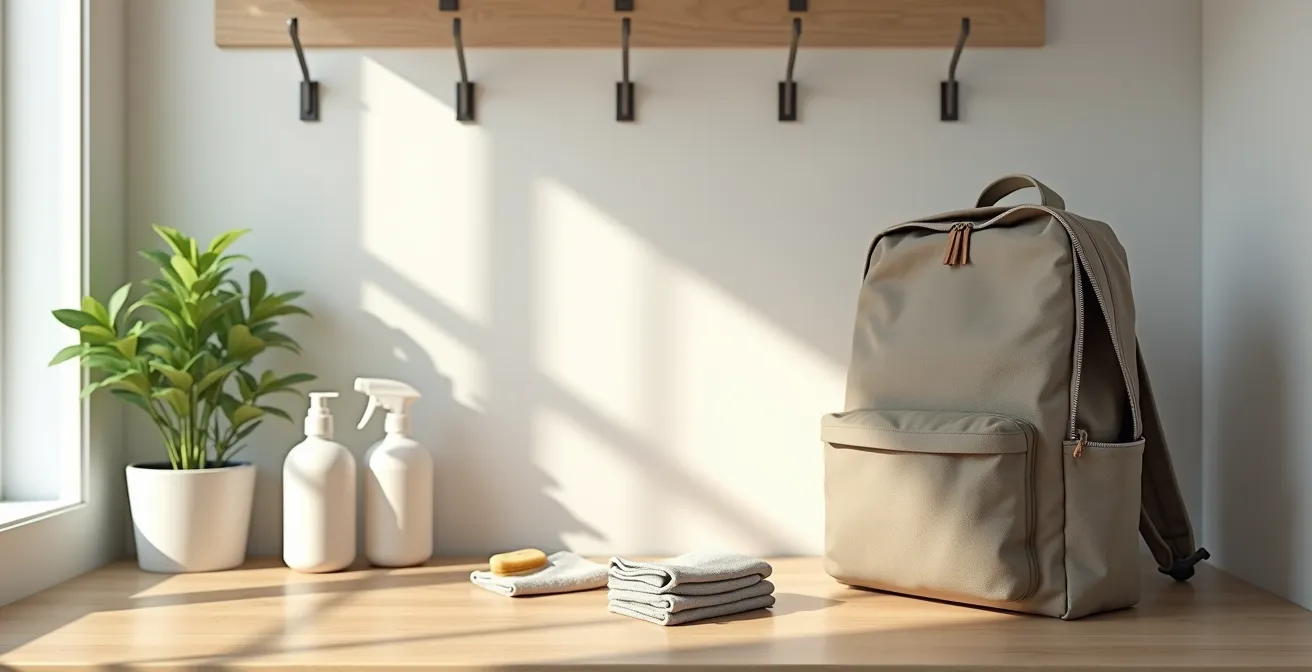
Having a dedicated cleaning station, as shown above, can make this process feel less like a chore and more like a routine part of home maintenance. The following decision matrix provides a clear, practical guide for when to empty, wipe down, or deep clean your child’s backpack to maintain a proper hygienic standard.
| Trigger Event | Action Needed | Method | Frequency |
|---|---|---|---|
| Daily use | Empty & shake out | Remove crumbs, papers | Daily |
| End of week | Wipe down | Disinfectant wipes on zippers, straps | Weekly |
| Food/drink spill | Deep clean | Machine wash or hand scrub | Immediately |
| Illness in classroom | Deep clean | Full sanitization | Within 24 hours |
| Season change | Deep clean | Complete wash & dry | Quarterly |
By following this matrix, you can manage the hygiene of this key item efficiently, applying the right level of effort at the right time without becoming overwhelmed. This ensures the backpack remains a useful tool, not a traveling container of germs.
Why sterile environments might trigger allergies and asthma?
After establishing a rigorous protocol for entryway decontamination, it’s natural to wonder if this intense focus on hygiene could have a downside. This leads to a crucial and seemingly contradictory question in modern public health: can a home be *too* clean? The answer, according to a growing body of scientific evidence, is yes. The “Hygiene Hypothesis” suggests that a lack of exposure to a wide variety of microbes in early childhood can lead to an improperly trained immune system, increasing the risk for allergic and autoimmune diseases like asthma and eczema.
An overly sterile environment deprives the developing immune system of the necessary data to learn how to distinguish between genuine threats (like the influenza virus) and harmless substances (like pollen or pet dander). Without this early education, the immune system can become over-reactive, launching an aggressive inflammatory response to benign triggers. The goal, therefore, is not sterility, but achieving a healthy microbiome balance. This involves targeting acute, high-risk pathogens from crowded environments like schools while simultaneously encouraging exposure to diverse, beneficial microbes from the natural world.
This isn’t just a theory; it’s backed by data. Urban microbiome research revealed that 48% of healthy, allergy-free children had significant early-life exposure to both common allergens and a rich diversity of protective bacteria. This suggests that the immune system thrives on this complex interplay. The strict after-school protocol is a targeted strike against specific invaders, not an all-out war on microbes. It’s about washing the city off, then going outside to play in the dirt.
How to get out the door by 8 AM with a baby and a toddler?
The morning rush with young children can feel like a chaotic race against the clock. The secret to a smoother, healthier morning, however, isn’t found in what you do at 7:30 AM, but in what you accomplished the night before. By implementing a brief but systematic “Evening Sanitary Reset,” you not only streamline your morning logistics but also conduct a critical daily decontamination that reduces illness and absenteeism. This 15-minute routine is the operational core of your family’s health defense strategy.
The stress of searching for a clean uniform, a missing shoe, or a non-crusty lunchbox is a primary source of morning friction. By tackling these tasks in the calm of the evening, you offload that cognitive burden from your already-strained morning brain. More importantly, you address the pathogen load that has accumulated on school items throughout the day, preventing germs from sitting and multiplying overnight in a dark backpack or lunchbox.
Case Study: The Evening Reset Routine’s Impact
Observational studies of family routines have highlighted the profound impact of evening preparation. Families who implemented a consistent “Sanitary Reset” routine—involving emptying and wiping down backpacks, preparing the next day’s clothes, and setting up an entryway “launch pad”—reported significant benefits. On average, these families experienced 23% less morning-related stress and, crucially, logged 15 fewer sick days per child over the course of a school year compared to families who did most of their preparation in the morning. This demonstrates a direct link between a simple hygiene protocol and tangible improvements in both family well-being and health outcomes.
This evening routine doesn’t need to be a monumental task. By breaking it down into a simple checklist, it can be completed quickly and efficiently, setting the stage for a calm, healthy start to the next day.
Your 15-Minute Evening Sanitary Reset Checklist
- Empty & Shake: Completely empty the backpack over a trash can to remove all crumbs, wrappers, and loose papers.
- Wipe & Dry: Use a disinfectant wipe on the lunch box interior and exterior, then leave it open on the counter to air dry completely.
- Refill & Stage: Place clean, filled water bottles in their designated spot in the “launch pad” area.
- Layout Clothes: Set out the complete, clean outfit for the next day on a dresser or chair, including socks and underwear.
- Position for Launch: Place the cleaned, repacked backpack and shoes neatly at the entryway, ready for a quick grab-and-go morning.
Key takeaways
- The home entryway is a critical decontamination zone; shoes and backpacks must be contained there to limit pathogen spread.
- For gastrointestinal bugs like norovirus, vigorous handwashing with soap and water is essential as alcohol-based sanitizers are ineffective.
- A balanced approach is vital: a strict protocol for school germs should be paired with plenty of natural outdoor exposure to build a robust immune system.
Building Immunity Naturally: Does Playing in Dirt Actually Help?
Yes, it absolutely does. After focusing intensely on protocols to eliminate specific, high-risk pathogens, it’s essential to zoom out to the ultimate goal: raising a child with a strong, resilient, and well-trained immune system. The strict after-school decontamination protocol is a targeted tactic, not a life philosophy. It’s designed to intercept acute threats from a high-density environment (school), but it should not be mistaken for a mandate to create a sterile home.
Building natural immunity is an active process that requires data. “Playing in the dirt”—along with interacting with pets, gardening, and spending time in nature—provides the immune system with a vast library of diverse, low-risk microbes. This exposure is critical for teaching T-cells to differentiate between a harmless environmental microbe and a dangerous pathogen like influenza. This process of education reduces the likelihood of the immune system overreacting to benign substances, which is the root cause of allergies and asthma. The decontamination protocol and natural exposure are not opposing ideas; they are two sides of the same coin, representing a sophisticated, balanced hygiene strategy.
Think of it like this: your after-school protocol is the stringent security check at the international border, designed to stop known threats. Playing outside is the cultural exchange program that enriches and educates the population. You need both for a healthy, functioning society. The following rules of thumb can help you maintain this crucial balance in your daily life.
- DO: Wash hands thoroughly after returning from school, after using the toilet, and before preparing or eating food. This targets key transmission moments.
- DON’T: Use antibacterial soaps or sanitize toys and household surfaces daily. This creates an unnecessary sterile environment.
- DO: Enforce a strict “shoes off at the door” policy. This is one of the highest-impact actions for reducing pathogen load.
- DON’T: Keep children confined to indoor, sterile-feeling environments constantly. Encourage them to get outside, regardless of the weather.
- DO: Allow and encourage outdoor play, interaction with family pets, and activities like digging in a garden. This is vital immune system training.
By implementing this evidence-based, balanced approach, you move beyond simply reacting to illness. You are actively managing your family’s health, creating a home that is both a safe harbor from acute pathogens and a healthy training ground for a resilient immune system. Start tonight by implementing the 15-minute Sanitary Reset and empower your family for a healthier school year.