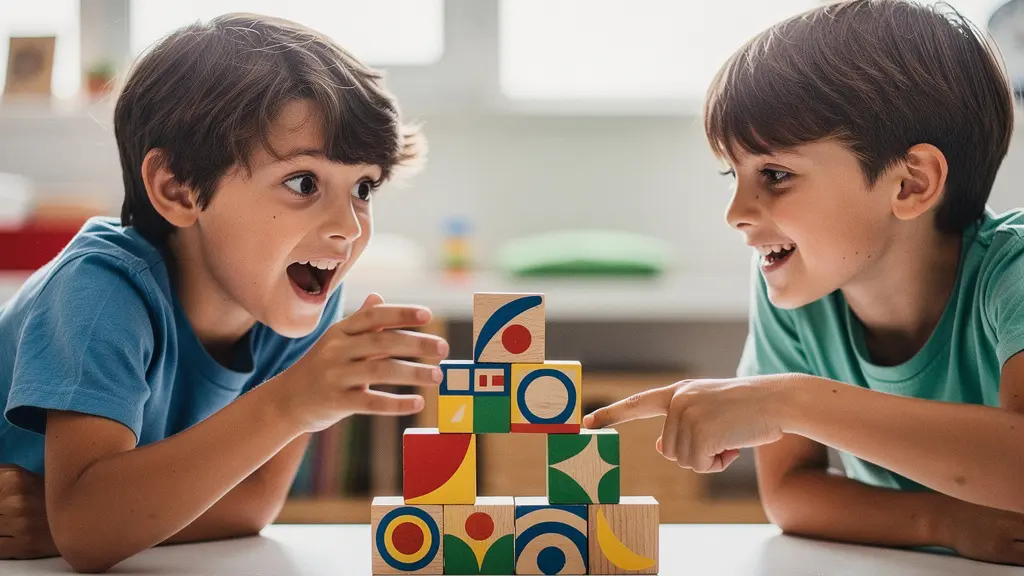
The constant fighting between your children isn’t a sign of parenting failure; it’s an untapped curriculum for teaching vital life skills.
- Most parental interventions, like immediately punishing or forcing a resolution, actually prevent children from learning to negotiate and self-regulate.
- Structured cooperative play, where success is shared, is a powerful tool to shift sibling dynamics from competitive rivalry to collaborative teamwork.
Recommendation: Shift your role from being a judge who ends the fight to a ‘process referee’ who guides them through it. Your goal is not to stop the conflict, but to make it productive.
The sound of it is unmistakable: the rising tension, the sharp cry of “Mine!”, and the inevitable eruption of a full-blown sibling squabble. For parents of multiple children, this cycle can feel like a relentless, exhausting part of daily life. The default reaction is to rush in, identify the culprit, enforce a quick solution, and restore a fragile peace. We tell them to share, to be nice, to take turns, hoping the message will one day stick. But what if this instinct to immediately extinguish the fire is actually preventing them from learning how to handle heat?
The conventional wisdom about stopping sibling rivalry often misses a fundamental point. Conflict is not the problem; it’s a mandatory part of human development. Every argument over a toy is a raw, unpolished opportunity to learn negotiation, empathy, patience, and problem-solving. When we consistently step in as the judge and jury, we rob them of these critical practice sessions. We teach them that an external authority will always solve their problems, rather than equipping them to solve the problems themselves. This is a crucial distinction that can shape their social and emotional intelligence for years to come.
This guide offers a different perspective, a mediation-focused approach that reframes your role. Instead of being the judge, you will become the ‘process referee.’ Your job isn’t to decide who is right or wrong, but to ensure the *process* of their disagreement is fair and constructive. We will explore how to turn conflicts into a curriculum. This involves understanding the developmental reasons behind their impulsiveness, choosing activities that build teamwork, and using specific language that validates feelings while holding firm boundaries. By embracing structured conflict, you can transform your home from a courtroom into a training ground for cooperation.
This article will guide you through the practical strategies to make this shift. We’ll examine why common reactions backfire and provide concrete tools, from choosing the right games to managing shared spaces, to help your children build a foundation of mutual respect and collaboration.
Summary: From Conflict to Cooperation: A Guide to Sibling Teamwork Through Play
- Why intervening immediately prevents kids from learning negotiation?
- How to choose board games that require teamwork instead of competition?
- Shared Clean-Up or Individual Zones: Which builds better sibling bonds?
- The “Forced Sharing” mistake that actually increases selfishness
- How to teach patience to a child who grabs toys?
- When to switch from racing to escaping a room together?
- How to talk to your child about a coach they don’t like?
- Why Group Learning Is Essential for Only Children Before School Starts?
Why intervening immediately prevents kids from learning negotiation?
When a child grabs a toy and another shrieks, our first impulse is to restore order. We play judge: “You had it first,” or “You need to share.” While well-intentioned, this immediate intervention short-circuits a vital learning process. Negotiation, compromise, and emotional regulation are complex skills that are not innate; they are learned through practice. Every time we impose a solution, we take away a repetition from their social-skills workout. They learn to appeal to a higher authority (you) rather than to engage with each other.
The biological reason for their struggle is crucial to understand. The part of the brain responsible for impulse control and seeing another’s perspective, the prefrontal cortex, is under construction throughout childhood. In fact, some neuroscience research shows that the prefrontal cortex may not fully mature until the mid-twenties. Expecting a five-year-old to consistently manage their frustration and fairly negotiate is like expecting them to solve algebra. They don’t have the hardware for it yet. This is why your role as a ‘process referee’ is so important. You are not a judge of the outcome, but a coach for the process of disagreeing.
Instead of solving the problem for them, you guide them through the steps. You provide the external structure their developing brains lack. This means slowing things down, verbalizing the emotions at play, and outlining a fair procedure for them to follow. It’s more time-consuming in the moment, but it’s an investment that pays dividends in self-sufficiency and emotional intelligence down the line. You are not just stopping a fight; you are teaching them how to prevent, or resolve, the next one on their own.
Your Action Plan: The Process Referee Framework
- Establish ‘rules of conflict’ beforehand: Before play starts, agree on ground rules everyone understands, such as no shouting, no physical contact, and taking turns to speak.
- Name emotions neutrally: When friction arises, act as a sportscaster. “I see two children who both want the red truck. You look frustrated, and you seem worried you won’t get a turn.” This validates feelings without taking sides.
- Use timers for turn-taking: A visible timer is an impartial authority. It builds trust that waiting is not forever and that a turn will eventually come, making patience a concrete and rewarded skill.
- Pause and reset if conflict escalates: If the rules are broken, don’t punish. Simply pause the activity. “We are shouting, which is against our rules. We will pause and try again later when we are calm.” This links consequences to the process, not your anger.
- Model repair and resolution: Verbally guide them through the solution. “Okay, you can give it back, and your brother can hand it to you when his turn is done.” This models the language of peaceful exchange.
How to choose board games that require teamwork instead of competition?
The games on your shelf can be powerful, unseen coaches in your home, either training your children for rivalry or for collaboration. Many classic games are zero-sum: for one person to win, everyone else must lose. This can be fun, but for siblings prone to conflict, it constantly reinforces the idea that their sibling is an obstacle to their own success. This is known as negative interdependence. When one child consistently dominates, it can lead to frustration, accusations of cheating, and a refusal to play at all.
The alternative is to intentionally introduce cooperative games. These games are designed with ‘positive interdependence’ built in, meaning players must work together to beat the game itself. Success is shared, and failure is a team problem to be solved. Research on sibling dynamics has shown that cooperative video games like *Overcooked* or board games like *Pandemic* foster essential teamwork skills. Players are forced to communicate, share information, and coordinate their actions to achieve a common goal. They learn that helping their sibling directly helps themself, fundamentally reframing their relationship within the context of the game.
This doesn’t mean you must banish all competitive games. The goal is balance. Introduce cooperative games as a way to actively train the ‘teamwork muscle.’ Start with simple games and gradually move to more complex ones as they build their skills in shared planning and communication. The right game can turn ‘me versus you’ into ‘us versus the problem’.
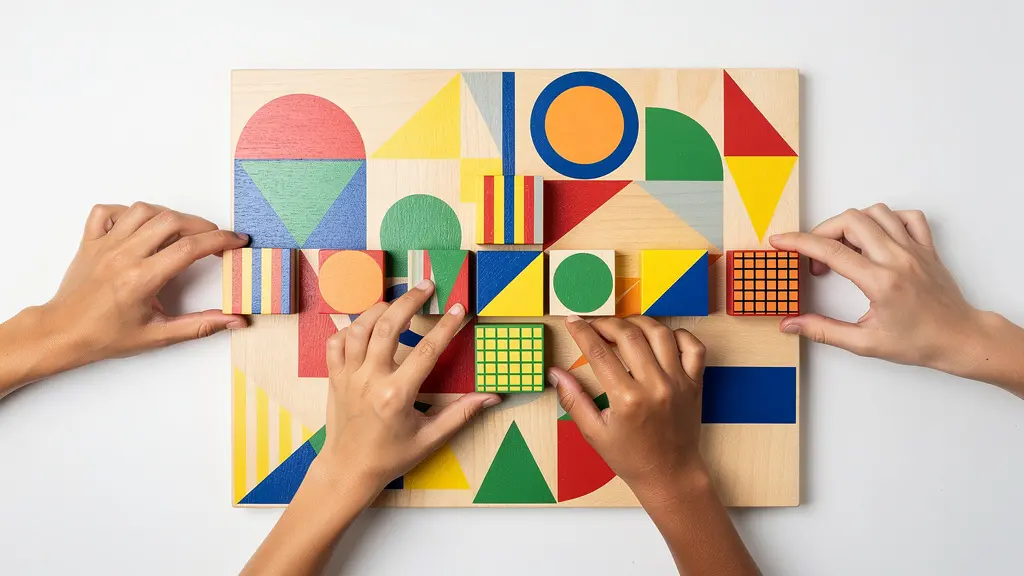
The table below provides a framework for selecting games based on the specific cooperative skill you want to develop. By being intentional with your game choices, you can create a low-stakes environment for your children to practice the art of working together.
| Skill to Develop | Game Type | Examples | Age Range |
|---|---|---|---|
| Shared Planning | Strategy Cooperative | Pandemic, Forbidden Desert | 8+ |
| Communication | Information Sharing | Hanabi, The Mind | 7+ |
| Physical Coordination | Active Cooperation | Keep the balloon up, Three-legged race | 4+ |
| Creative Teamwork | Building Projects | LEGO challenges, Fort building | 5+ |
Shared Clean-Up or Individual Zones: Which builds better sibling bonds?
“Clean your room!” is a classic parenting directive, but when a room is shared, it can become another battleground. One child feels they do all the work while the other gets a “free ride.” This can lead parents to create strict ‘individual zones,’ splitting the room down the middle. While this can reduce arguments over whose mess is whose, it can also reinforce a sense of separation and ownership that works against building a team mentality. It sends the message: “This is my problem, that is your problem.”
Cooperative play among siblings is more than just a fun way to pass time — it’s essential for building communication skills, empathy, problem-solving, and a sense of teamwork.
– Kindred Kids Research Team, 11 Tips for Encouraging Cooperative Sibling Play
A more effective approach is often a hybrid model that combines personal responsibility with shared goals. Each child can be responsible for their own bed and personal storage, but larger tasks like vacuuming or organizing the shared bookshelf become ‘team projects.’ This reflects the reality of most collaborative work in life: a mix of individual accountability and collective effort. You can frame these shared tasks as ‘missions’ with a shared reward, like choosing a movie or having extra story time after the ‘mission’ is complete.
One highly successful technique is the ‘Shared Space Charter.’ Research on cooperative play spaces highlights how projects that physically span both ‘zones’—like building a large train track or creating a wall mural—naturally foster collaboration. One family successfully implemented a ‘Shared Space Charter’ where siblings aged 5 and 8 wrote their own rules for shared items and boundaries. According to the study, this simple act of co-creation led to 60% fewer conflicts over a three-month period. By giving them ownership of the rules for their shared environment, the parents transformed the power dynamic from a parent-enforced system to a sibling-managed treaty.
The “Forced Sharing” mistake that actually increases selfishness
The phrase “You have to share” is one of the most common refrains in the parenting playbook. It seems logical: we want to raise generous children, so we must teach them to share. However, this approach often backfires spectacularly. When a child is forced to give up a toy they are engrossed in, they don’t learn generosity. They learn that a more powerful person can arbitrarily take their things. This can increase their sense of possessiveness and anxiety around their belongings, leading them to hoard or hide toys to avoid having them taken away. It teaches compliance, not compassion.
True sharing is a voluntary act of generosity that comes from a place of security and empathy. A child is more likely to share when they feel secure in their own ownership and trust that they will get the item back. Instead of forcing the act, focus on coaching the skills that lead to voluntary sharing: patience and trust. One of the most effective methods is a ‘toy library’ or turn-taking system. When one child wants a toy another is using, the role of the parent-referee is to say, “It’s [Sibling’s Name]’s turn right now. We can set a timer for 5 minutes, and then it will be your turn.”
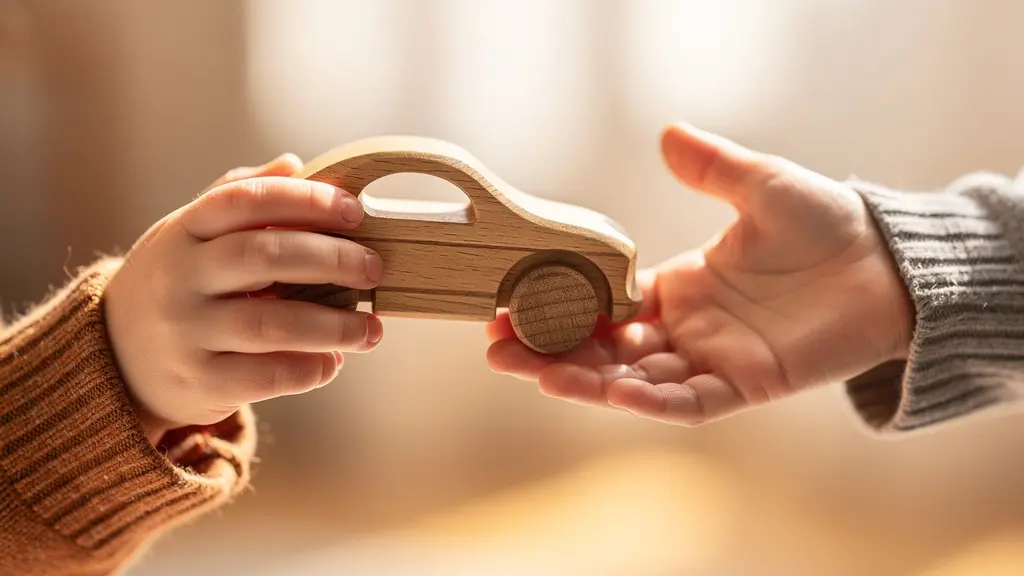
This approach does several things: it respects the playing child’s right to finish their turn, it teaches the waiting child that their turn *will* come, and it uses an impartial authority (the timer) to manage the exchange. This builds trust in the system. Given that research indicates that 4 in 5 children grow up with at least one sibling, these early interactions become the primary training ground for social dynamics. By facilitating a system of voluntary, structured exchange, you are teaching a far more profound lesson than forced sharing ever could: that respecting others’ rights is the foundation of a community where everyone feels secure enough to be generous.
How to teach patience to a child who grabs toys?
A child who grabs is often a child who cannot tolerate the intense feeling of wanting something *right now*. Their impulse to grab is a physical expression of an overwhelming emotion they don’t have the words for. Our typical response, “Be patient!” or “Stop grabbing!”, is a command that doesn’t teach the underlying skill. It’s like telling someone in a panic to “Just calm down!”—it rarely works because it doesn’t address the root feeling.
The key is to first validate the emotion and then guide the action. This is the practice of ‘Emotional Articulation.’ Instead of reprimanding the grab, you narrate the feeling. Get down on their level and say calmly, “I see you want that red truck RIGHT NOW. It’s so shiny and fun. It feels really, really hard to wait for your turn.” This simple act of acknowledgment is incredibly powerful. It tells the child, “I see you. I understand your struggle.” It defuses the emotional intensity and makes them more receptive to your guidance. Only after validating the feeling do you restate the boundary: “But it’s your brother’s turn. We don’t grab. We can ask for a turn when he is done.”
Case Study: Emotional Articulation in Practice
A parent documented a powerful shift using this exact technique with their 3-year-old who frequently grabbed toys. Instead of the usual reprimands, they consistently used validating phrases like, “You really want that block. It’s hard to wait.” This was paired with the consistent use of a timer for turn-taking. The results were remarkable. According to the parent’s log, after just two weeks of this validation-first approach, grabbing incidents decreased by 70%. More importantly, the child began to use words to express his desire (“My turn next?”) instead of his hands. This demonstrates that by giving children the language for their emotions, we give them an alternative to physical impulsiveness.
This process teaches them that their strong feelings are acceptable, but their actions have limits. Over time, they internalize this language and can begin to self-regulate, moving from “I want it, so I take it” to “I want it, and I can wait for it.”
When to switch from racing to escaping a room together?
Races and competitive activities are a natural part of childhood. They teach kids about striving, speed, and handling the disappointment of losing. However, if every activity is a race, it can entrench a competitive mindset, especially if one sibling is consistently faster or stronger. The moment a child’s fun is contingent on beating their sibling is a good time to intentionally shift the dynamic from racing against each other to escaping a problem together.
This is where collaborative challenges, like a DIY ‘escape room,’ come in. The concept is simple: instead of a finish line, there is a shared goal that requires combined effort. You don’t need an elaborate setup. As one family demonstrated in a ‘Snack Box Mystery’ game, the challenge can be as simple as finding hidden puzzle pieces around a room. Each piece might have a clue tailored to each child’s skill level—a simple math problem for the older one, a letter-recognition task for the younger one. They can’t solve the final puzzle to unlock the box of snacks without each other’s contributions. This structure makes their sibling an ally, not a rival.
But how do you know if they are ready for this switch? A child who has a major meltdown every time they lose a race may not yet have the emotional regulation for a complex cooperative game. You are looking for signs of ‘cooperation readiness.’ The focus should be less on age and more on developing skills. Can they celebrate a team win? Can they accept a sibling’s suggestion? These are the building blocks of successful teamwork.
Cooperation Readiness Checklist:
- Can your child explain an idea to their sibling using words?
- Can they accept a sibling’s suggestion without immediate rejection?
- Do they show interest in helping their sibling succeed, even in a competitive game?
- Can they lose a race without a major meltdown (most of the time)?
- Can they wait for their turn without constant reminders?
If you can answer ‘yes’ to most of these, they are likely ready to tackle more complex collaborative challenges. If not, continue focusing on the foundational skills of turn-taking and emotional validation in simpler settings.
How to talk to your child about a coach they don’t like?
The skills of cooperation and conflict resolution learned at home don’t stay there. They are tested in the outside world—on the playground, in the classroom, and on the sports team. When your child comes home complaining about a coach they don’t like, it’s another opportunity to act as a ‘process referee.’ The temptation is to either immediately dismiss their feelings (“The coach knows best”) or rush to fix the problem for them (“I’ll call the coach right now!”).
A more empowering approach is to use a communication framework that helps them move from vague complaints to specific, actionable issues. Start by simply listening and validating. Use the same “sportscaster” voice you use for sibling squabbles: “Tell me what happened at practice. It sounds like you felt frustrated when the coach explained the drill.” This separates their feelings (which are always valid) from the events themselves.
Once they feel heard, help them connect their feelings to an unmet need. A child who says “The coach is mean” might actually be feeling an unmet need for inclusion, fairness, or clear instruction. Help them articulate this: “It sounds like you need to feel included by the team,” or “You need to understand the rules of the drill to feel confident.” This shifts the focus from blaming the coach to identifying a solvable problem. From there, you can role-play how to respectfully approach the coach. This teaches them a crucial life skill: how to advocate for themselves constructively, a skill that will serve them far beyond the sports field.
A Framework for Constructive Conversation:
- Start with observation: Ask them to describe what actually happened, without judgment. “Tell me what you saw and heard at practice.”
- Identify feelings: Help them put a name to their emotion. “How did you feel when that happened? Frustrated? Confused? Left out?”
- Connect feelings to needs: Ask what they needed in that moment. “What would have helped you feel better? Did you need more explanation? Did you need to feel like part of the team?”
- Practice request language: Brainstorm what they could ask for. Instead of “You’re not being fair,” they could practice saying, “Could you explain the drill one more time for me?”
- Role-play the conversation: Practice the conversation with them, with you playing the coach. This builds their confidence to handle the situation themselves.
Key Takeaways
- Shift from Judge to Referee: Your role isn’t to declare a winner in a sibling fight, but to guide them through a fair process of negotiation and resolution.
- Choose Cooperation over Competition: Intentionally select games and activities where siblings must work together to succeed, framing them as allies instead of rivals.
- Validate Feelings, Don’t Force Actions: Acknowledge a child’s frustration and teach patience through structured turn-taking, rather than mandating sharing, which can build resentment.
Why Group Learning Is Essential for Only Children Before School Starts?
Examining the experience of only children provides a powerful lens through which we can understand the social skills that siblings are (ideally) learning every day. An only child often operates as the de facto leader at home; their play isn’t typically interrupted by a sibling grabbing a toy or proposing a different game. While this can foster independence and creativity, it provides fewer opportunities to practice the messy, essential skills of group dynamics: negotiation, compromise, and being a follower.
Structured group activities before school—like team sports, drama classes, or group building projects—are therefore crucial for only children. They are thrust into situations where they must learn to share resources, follow rules set by others, listen to peers’ ideas, and work toward a shared goal. They learn the vital skill of being a ‘follower’—of accepting another child’s leadership for the good of the group, a skill they rarely need to practice at home. This highlights the inherent value of the sibling “curriculum.”
This is the ultimate goal for our multi-child homes as well. We are not just raising siblings; we are raising future team members, partners, and citizens. The constant, low-stakes conflicts of childhood are their primary training ground. A review of play therapy studies found that positive sibling interactions are incredibly effective at teaching these skills; it showed that 67% of studied sibling pairs showed improved emotional regulation and self-soothing skills through guided play. By acting as a process referee and facilitating cooperation, you are not just making your home more peaceful. You are giving your children a foundational education in what it means to be human in a world full of other humans.
Begin today to shift your perspective from being a judge of outcomes to a coach of the process. By embracing conflict as a curriculum and guiding your children with patience and structure, you can transform sibling rivalry into a powerful engine for building lifelong bonds and essential social skills.