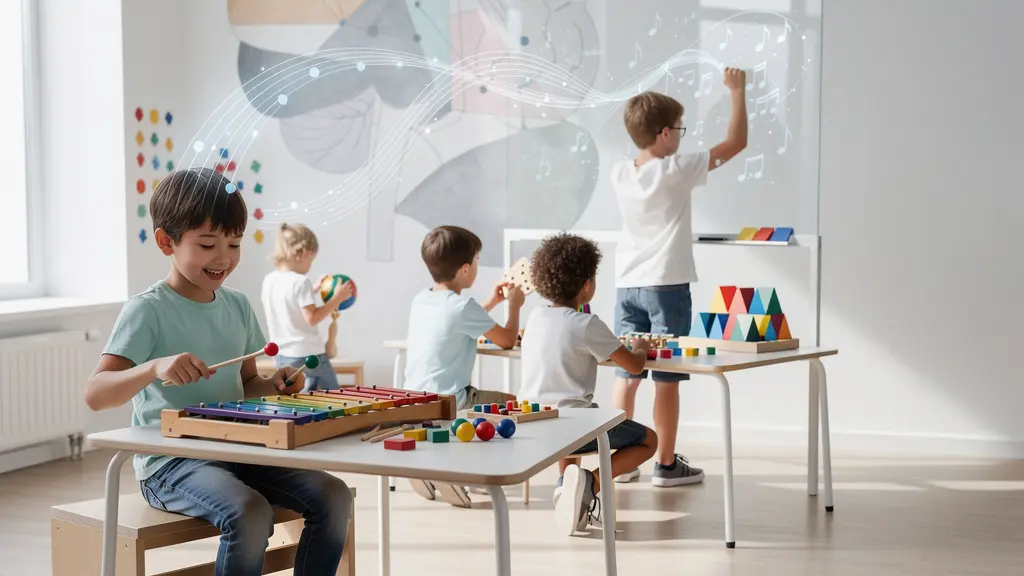
Contrary to the belief that child development is about accumulating knowledge, the real key to boosting intelligence lies in building a superior ‘cognitive architecture’. This article reframes activities like music, bilingualism, and even physical play not as simple enrichment, but as targeted, science-backed training programs that fundamentally upgrade a child’s core mental ‘operating system’—enhancing memory, problem-solving, and critical thinking for life.
As a parent, you’re constantly navigating a sea of advice on how to give your child the best possible start. We’re told to encourage music lessons, consider a second language, and ensure plenty of physical activity. These are often presented as items on a developmental checklist, positive “enrichment” activities that are broadly ‘good’ for a child’s brain. This perspective, however, misses the most fascinating part of the story and the true power you hold as a parent.
The conventional wisdom is not wrong, but it is shallow. It tells you the *what*, but not the profound *why*. What if these activities weren’t just about learning a skill, but about fundamentally rewiring the very architecture of your child’s thinking? What if learning the piano was less about future concerts and more about building the neural pathways for advanced mathematics? What if speaking two languages wasn’t just a communication tool, but a constant, background workout for the brain’s “executive function suite”?
This is the shift in perspective we will explore. We are moving beyond the idea of simple enrichment and into the realm of cognitive architecture. This article will demystify the precise neuro-educational mechanisms at play. You’ll discover how these seemingly separate activities are, in fact, powerful, interconnected tools for building a more flexible, resilient, and powerful brain. We will unpack how movement solidifies memory, how explaining a concept to a teddy bear forges critical thinking, and which core cognitive skills are the true predictors of academic success.
This guide provides a roadmap to understanding how you can move from being a provider of activities to becoming the architect of your child’s cognitive future. Below, we delve into the specific, science-backed ways these lifestyle choices foster long-term brain plasticity and intelligence.
Summary: Building Your Child’s Cognitive Architecture
- Why learning piano helps a child understand fractions better?
- Does teaching two languages at once cause speech delays?
- Why running around aids memory retention more than sitting still?
- The memorization mistake that kills critical thinking skills
- When is the best time of day for difficult cognitive tasks?
- How to teach algorithms using a deck of cards?
- Why reframing movement as “challenges” changes the mindset?
- Which Cognitive Skills Matter Most Before Kindergarten Entry?
Why learning piano helps a child understand fractions better?
The connection between music and math is not a metaphor; it’s a direct neurological reality rooted in the concept of embodied cognition. Learning piano provides a physical, tangible experience of mathematical concepts that are otherwise abstract. When a child learns rhythm, they are not just counting; they are internalizing the relationships between wholes, halves, and quarters. This isn’t theoretical—it’s felt in the hands and heard by the ears.
This process directly trains spatial-temporal reasoning, the ability to mentally visualize patterns and sequences. Neuroscientifically, the brain regions activated by processing musical rhythm overlap significantly with those used for spatial reasoning. This explains why one activity primes the other. In fact, research from the University of California found a 34% greater improvement in spatial-temporal reasoning among preschoolers who received piano lessons compared to those who had computer lessons.
Case Study: Musical Notation as Embodied Fraction Learning
Children learning piano naturally practice fractional division through rhythm. When counting ‘1-and-2-and-3-and-4-and,’ they are literally practicing eighth notes. They learn that two half notes occupy the same time as one whole note, an embodied lesson that 1/2 + 1/2 = 1. This hands-on, auditory learning creates stronger and more intuitive neural pathways for understanding fractions than abstract mathematical instruction alone, making the leap to 2/8 equaling 1/4 a much more intuitive process.
This doesn’t mean every pianist is a math genius, but it demonstrates that music education is a powerful tool for building the foundational cognitive architecture that makes abstract thinking, like higher math, significantly easier to grasp.
Does teaching two languages at once cause speech delays?
This is one of the most persistent myths in early childhood development, and the scientific consensus is clear: it is unequivocally false. Teaching a child two languages from birth does not cause speech delays or confusion. While a bilingual child’s vocabulary in each individual language might be smaller than a monolingual child’s in the very early stages, their total vocabulary (across both languages) is typically equal or even larger.
Instead of a hindrance, early bilingualism is a profound cognitive workout for the brain’s executive function suite. The bilingual brain is constantly, unconsciously practicing inhibitory control. To speak in one language, it must suppress the other. This mental juggling act strengthens the “control center” of the brain, leading to measurable advantages in tasks requiring focus, task-switching, and problem-solving. It’s like having a personal brain gym running in the background of every conversation.

The notion that a child’s brain is a “limited container” that can be overwhelmed by two languages is based on outdated and flawed assumptions. As researchers Krista Byers-Heinlein and Casey Lew-Williams state in a comprehensive review for PMC, ” Attitudes against early bilingualism are often based on myths and misinterpretations, rather than scientific findings.” The brain is a muscle, and bilingualism is one of the best forms of resistance training for it.
Why running around aids memory retention more than sitting still?
The instruction to “sit still and study” may be one of the most counterproductive pieces of advice for effective learning. Vigorous physical activity is not a distraction from learning; it is a crucial primer for it. The science behind this lies in a powerful protein called Brain-Derived Neurotrophic Factor (BDNF), which is often described as “Miracle-Gro for the brain.”
When a child engages in aerobic exercise—running, jumping, dancing—their brain releases a flood of BDNF. This protein is critical for neurogenesis (the creation of new neurons) and synaptic plasticity (the strengthening of connections between neurons). In essence, exercise prepares the brain’s soil, making it more fertile for new information to take root. Studying *after* a period of intense physical activity allows the brain to consolidate memories more effectively.
To leverage this biological mechanism, parents can optimize the “post-exercise consolidation window.” It’s not about studying while running, but about using the neurochemical state that follows exercise to maximize learning. Here are some practical ways to apply this:
- Schedule 20-30 minutes of vigorous physical activity before a homework or study session.
- Allow for a 15-20 minute cool-down period between exercise and study for the brain to reach its optimal state for learning.
- Prioritize the most memory-intensive tasks (like memorizing vocabulary or historical dates) for the 1-2 hour window following physical activity.
- Incorporate movement into learning itself, like acting out historical events or pacing while reciting information to create physical associations with the content.
This connection highlights that cognitive development is not a disembodied process. The body and brain are an integrated system, and nurturing one directly benefits the other.
The memorization mistake that kills critical thinking skills
The biggest mistake in learning is equating memorization with understanding. Rote memorization—cramming facts without context or comprehension—is the cognitive equivalent of junk food. It provides a temporary feeling of fullness (passing a test) but builds no long-term intellectual muscle. It actively harms the development of critical thinking because it trains the brain to be a passive receptacle, not an active processor of information.
Critical thinking is built on flexible, interconnected knowledge. It requires the ability to analyze, synthesize, and apply information in new contexts. Rote memorization creates isolated, brittle neural pathways. When the context changes slightly, the information becomes inaccessible. Conversely, activities that demand active processing, such as music, build a more robust cognitive toolkit. A 2018 study found that musically trained individuals showed enhanced working memory, a core component of the executive function suite that is vital for manipulating information and thinking critically.
Solution: The Feynman Technique for Kids
The antidote to rote memorization is to encourage metacognition—thinking about one’s own thinking. A simple way to do this is a child-friendly version of the Feynman Technique. After learning something, ask your child to teach it back to you, a younger sibling, or even a stuffed animal in the simplest terms possible. This act of explanation immediately reveals gaps in their understanding. They move from simply “knowing” a fact to truly comprehending its mechanics, forcing them to build genuine, flexible knowledge instead of just a memory trace.
The goal is to shift the focus from “What did you learn?” to “How do you know that?” This simple question encourages the development of a curious, analytical mind rather than a simple database of facts.
When is the best time of day for difficult cognitive tasks?
The brain’s capacity for learning is not static throughout the day; it operates on a distinct rhythm. Understanding and aligning with a child’s natural cognitive cycle can dramatically improve their ability to tackle difficult tasks. While every child is unique, general neuroscientific principles can guide parents in scheduling their day for optimal learning and reduced frustration.

For most children (and adults), the brain has two key peaks. The first, typically occurring from mid-morning to around noon, is the peak for analytical and focus-intensive tasks. During this window, levels of cortisol (the alertness hormone) are high, and working memory is at its sharpest. This is the ideal time to schedule activities that require logical reasoning, concentration, and problem-solving, such as math problems or complex reading.
The second, more subtle peak occurs in the late afternoon or early evening. While the brain might be more tired and less capable of brute-force focus, this state of reduced “inhibitory control” can be a surprising asset. It’s often during this “off-peak” time that the brain is more open to creative insights and divergent thinking. This is an excellent window for brainstorming, creative writing, or open-ended artistic projects. Trying to force a difficult analytical task during this creative window often leads to frustration, while scheduling a creative task during the analytical peak might stifle imagination.
The key is to observe and adapt. Notice when your child is most alert and focused versus when they are more dreamy and imaginative. By matching the task to the brain’s natural state, you are not just managing time; you are practicing intelligent cognitive load management.
How to teach algorithms using a deck of cards?
The word “algorithm” sounds intimidatingly technical, but it’s simply a set of rules for solving a problem. You can teach this fundamental concept of computational thinking without any screens at all, using just a deck of playing cards. This hands-on approach builds a deeper, more intuitive understanding than passively watching a video or using an app, a crucial insight in an era of increasing screen time. Indeed, a comprehensive 2024 review incorporating 157 peer-reviewed studies highlights the complex and often mixed effects of digital devices on cognitive development, reinforcing the value of unplugged learning activities.
One of the most classic algorithms to teach is a Binary Search. It’s a highly efficient way to find something in a sorted list by repeatedly dividing the search interval in half. Here’s how you can play it with your child:
- Take ten cards (e.g., Ace to 10 of a single suit) and lay them face down in numerical order.
- Ask your child to guess a specific card you’ve thought of (e.g., the 7 of Hearts).
- After their guess, instead of just saying yes or no, you turn over the middle card (the 5th card) and ask, “Is the card you’re looking for higher or lower than this one?”
- If they say “higher,” they can eliminate the first five cards. They’ve just cut the problem in half with one question.
- Repeat the process with the remaining set of cards until they find the correct one.
- Connect this game to everyday decisions by using “IF-THEN” logic: “IF it’s raining, THEN we wear boots, ELSE we wear sneakers.” This shows them that algorithms are just a structured way of making decisions.
This simple game teaches efficiency, logical deduction, and systematic problem-solving—the core components of algorithmic thinking. It transforms an abstract computer science concept into a fun, tangible puzzle, building a strong foundation for future STEM skills.
Why reframing movement as “challenges” changes the mindset?
The language we use to frame an activity has a profound impact on a child’s mindset and resilience. Telling a child to “go practice jumping” frames the activity as a repetitive task. Asking them, “Can you beat your record for jumping over this rope?” transforms it into a challenge. This subtle shift is at the heart of fostering a growth mindset, the belief that abilities can be developed through dedication and hard work.
A “task” implies a fixed standard of performance. A “challenge” implies a journey of improvement. It inherently communicates that effort is the path to success and that current ability is not a permanent state. This reframing is a direct application of the work by Stanford psychologist Carol Dweck, a leading authority on the topic.
A ‘challenge’ implies that ability is malleable and can be improved through effort. This reframing actively teaches resilience and a positive orientation towards effort.
– Carol Dweck, Growth Mindset Theory Application
When a child faces a “challenge,” failure is not an endpoint; it’s data. If they don’t clear the rope, the immediate question becomes, “What can I try differently next time? Bend my knees more? Run faster?” This process of self-correction and strategic adjustment is a workout for the prefrontal cortex, building problem-solving skills and emotional regulation. By framing physical activities—and by extension, academic ones—as challenges, parents teach their children to embrace effort, persist through setbacks, and view learning as an exciting process of growth rather than a stressful test of innate talent.
Key Takeaways
- Embodied Cognition: Activities like playing the piano build the neural architecture for abstract concepts like mathematics by making them physical and tangible.
- Bilingualism as a Brain Gym: Speaking two languages is a constant workout for the brain’s executive functions, enhancing focus, problem-solving, and cognitive flexibility without causing speech delays.
- Movement as a Memory Primer: Physical exercise releases BDNF (“Miracle-Gro for the brain”), preparing it to learn and consolidate memories more effectively.
Which Cognitive Skills Matter Most Before Kindergarten Entry?
While early literacy and numeracy are important, the skills that are the most powerful predictors of long-term academic success are not what most parents focus on. The true foundation lies in the strength of a child’s executive functions. This “air traffic control” system of the brain governs three core abilities: working memory, inhibitory control, and cognitive flexibility.
These skills are what allow a child to follow multi-step directions, resist the impulse to shout out, and adapt when the rules of a game change. Government data from the UK for 2023-2024 shows that while a majority of children are meeting developmental milestones, there is still significant room for improvement, with 78.4% of children achieving the expected level of development at age 2-2.5. Focusing on executive functions is the most effective way to nurture this development.
The good news is that these skills are not fixed; they are built through play and interaction. The most important thing a parent can do is foster metacognition—the ability to think about thinking. Simple games and, more importantly, the questions you ask can build a robust executive function suite, creating a child who is not just ready to learn, but who knows *how* to learn.
Action Plan: Fostering Executive Functions Before Kindergarten
- Prompt Self-Reflection: Instead of asking “What’s the answer?”, ask “How did you figure that out?” to encourage metacognition.
- Practice Inhibitory Control: Play classic games like “Simon Says” and “Red Light, Green Light” that require a child to stop a prepotent response.
- Build Working Memory: Give multi-step directions for chores or play, such as “First, get your blue cup, and then, put it on the table next to the plate.”
- Develop Cognitive Flexibility: Change the rules of a familiar game mid-play to see how quickly they can adapt their strategy.
- Encourage Self-Regulation: Talk through a plan before starting an activity (e.g., “First we’ll get the blocks, then we’ll build a tower, then we’ll put them away.”).
By focusing on these underlying processes rather than just the academic outcomes, you are building the core cognitive architecture that will support all future learning. This is the most crucial investment you can make in your child’s education.
Ultimately, your role as a parent is that of a cognitive architect. By intentionally choosing activities like music, bilingualism, and challenge-based play, you are not just filling your child’s schedule; you are providing the raw materials and the blueprint for building a more resilient, adaptive, and powerful mind. Start today by reframing one activity as a challenge or by teaching back one new concept.