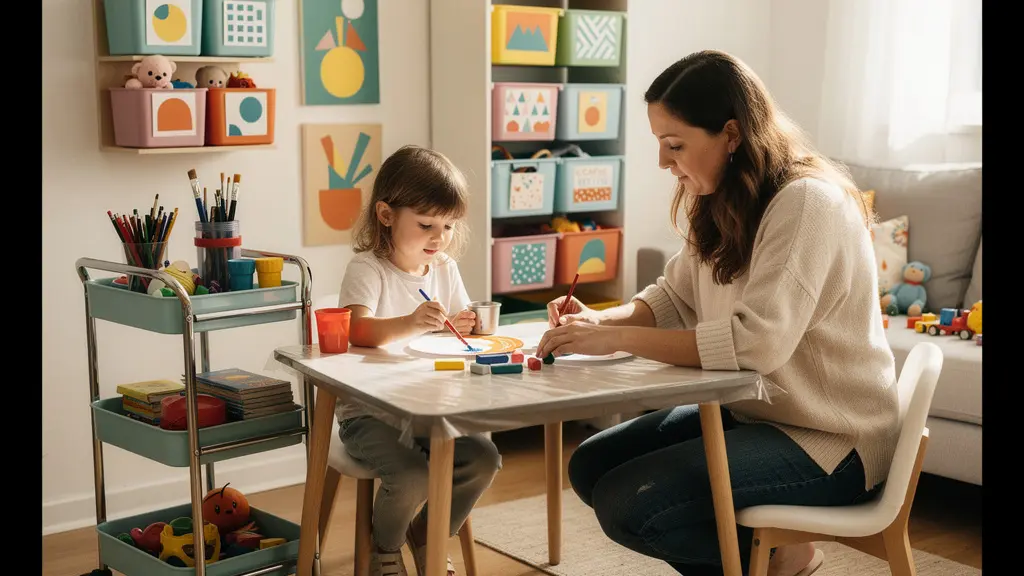
The secret to mess-free creative play isn’t buying more washable products; it’s adopting a minimalist mindset that values process over product.
- Constant entertainment and cluttered supplies actively hinder a child’s ability to enter deep, imaginative states.
- Curating a small selection of high-impact, open-ended materials (like loose parts) generates more hours of play than bulky, single-use kits.
Recommendation: Shift your focus from managing clutter to designing a simple “play ecosystem” with clear boundaries and a regular rotation of supplies to keep creativity high and chaos low.
For parents living in compact urban apartments, the desire for a child to explore their creativity often crashes into the reality of limited space. The vision of finger-painting and sculpture-building is quickly replaced by the fear of a Jackson Pollock-style paint disaster on the rental walls and a living room floor that resembles a craft store explosion. Many guides offer solutions that revolve around buying specific “mess-free” products or designating the bathroom as the sole art zone, treating creativity as a problem to be contained.
These approaches, however, miss a fundamental point. They focus on managing the aftermath of chaos rather than preventing it at its source. But what if the true key to a tidy, creative home wasn’t about better cleaning supplies, but about a fundamental shift in how we think about play itself? What if the secret lies not in restriction, but in intentional curation and embracing the elegant power of “less is more”?
This article reframes the entire problem. We will move beyond simple tidying hacks to build a sustainable and inventive philosophy for play in small homes. We will explore how to design a “play ecosystem” that nurtures deep imagination, fosters independence, and, by its very nature, keeps the house orderly. We will demonstrate that by prioritizing the process of creation over the final product, you can unlock your child’s artistic drive while maintaining the minimalist peace of your home.
This guide provides a complete blueprint, from understanding the psychology of creative boredom to setting up a damage-proof art corner and selecting materials that offer the highest play value for the smallest footprint. Let’s explore how to make your small apartment a haven for both creativity and calm.
Summary: A Minimalist’s Guide to Tidy Creative Play
- Why constantly entertaining your child kills their creative drive?
- How to create a damage-proof art corner in a rental property?
- Loose Parts vs. Craft Kits: Which offers more hours of play?
- The “Helicopter Play” mistake that stops deep imagination
- When to rotate art supplies to reignite interest instantly?
- Playroom or Living Room Corner: Which keeps the house tidier?
- Why focusing on the ‘doing’ matters more than the ‘result’?
- Wooden vs. Electronic Educational Toys: Which Is Better for Focus?
Why constantly entertaining your child kills their creative drive?
In our hyper-stimulated world, a child’s cry of “I’m bored!” can feel like a parental failure. The immediate instinct is to solve it: turn on a screen, offer a new toy, or suggest a structured activity. We strive to fill every moment with engagement, believing we are nurturing their development. However, this constant entertainment is counterproductive. It robs children of the single most important ingredient for creativity: unstructured mental space. True imagination isn’t summoned on demand; it emerges from the quiet, often uncomfortable, void of having nothing specific to do.
This phenomenon is linked to a brain network known as the Default Mode Network (DMN). This network becomes active not when we are focused on a task, but when our minds are wandering, daydreaming, or simply at rest. It’s the brain’s creative engine, connecting disparate ideas and memories to form novel concepts. A 2024 study using advanced brain-imaging techniques revealed that the DMN is highly active during mind-wandering and creative thinking tasks, demonstrating a direct neurological link between “doing nothing” and creative problem-solving.
Children often enter creative play after long stretches of boredom. Adults, too, can rediscover inner landscapes when not constantly bombarded by stimulation.
– Create Me Free Research, Rest, Boredom, and the Default Mode Network
When we constantly provide entertainment, we prevent the DMN from fully engaging. We train the child’s brain to be a passive consumer of content rather than an active generator of ideas. Allowing for moments of “creative friction”—that initial restlessness of boredom—is like tilling the soil. It feels unproductive at first, but it is the essential preparation for seeds of imagination to sprout. In a small apartment, this is a superpower: you don’t need more toys, you need more moments of quiet expectation.
How to create a damage-proof art corner in a rental property?
The fear of losing a security deposit can be a major barrier to creative play. But creating a safe and inspiring art corner in a rental doesn’t require permanent changes. The key is to establish a system of “contained freedom”—a clearly defined, protected space where your child has the liberty to explore without you worrying about spills and stains. The goal is a designated zone that is both damage-proof and easy to dismantle, leaving no trace behind.
A brilliant solution for a small apartment is a mobile art station. A multi-tiered rolling utility cart, like the IKEA RÅSKOG, becomes a self-contained creative hub. It can hold all necessary supplies in organized containers and can be easily moved to the area with the best light or rolled away into a closet when playtime is over. This mobility prevents a permanent “art clutter” takeover of your living space.
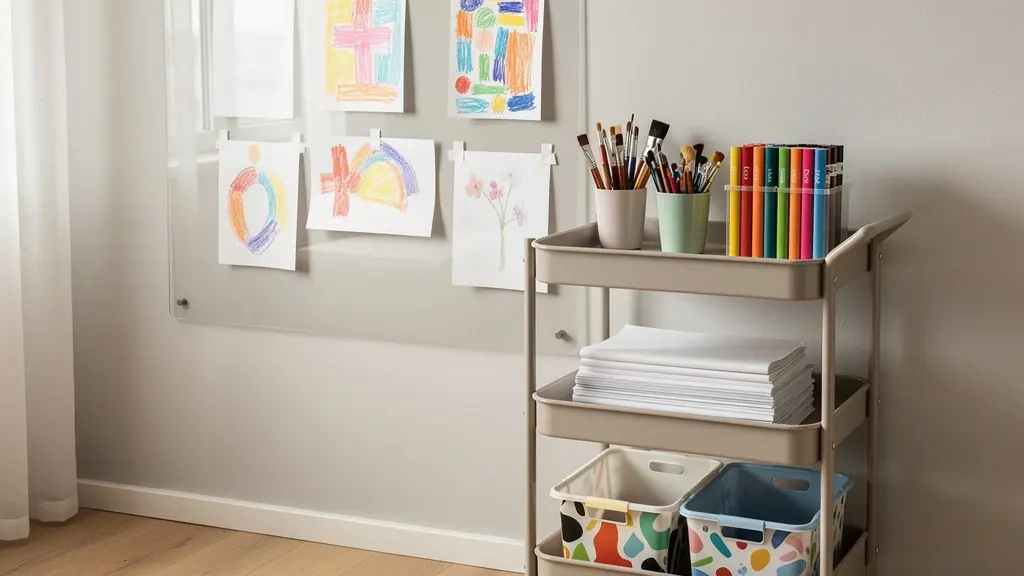
As this setup shows, protecting surfaces is simple. Instead of forbidding messy materials, create safe zones. A large vinyl tablecloth or a builder’s tuff tray on the floor defines the play area and catches any spills. For walls, removable clear contact paper or a large plexiglass sheet can be temporarily affixed with non-damaging command strips, creating a vertical canvas for painting or collage that can be wiped clean. By investing in smart, non-permanent solutions, you build a “yes” space where creativity can flourish without risk.
Loose Parts vs. Craft Kits: Which offers more hours of play?
When stocking a small apartment, every item’s “play-to-space” ratio matters. This is where the distinction between loose parts and craft kits becomes crucial. A craft kit offers a single, guided experience: a box of specific materials with instructions to create a predetermined outcome, like a model airplane or a beaded necklace. It’s a closed-ended, convergent activity. Once completed, its play value is largely exhausted.
Loose parts, in contrast, are the cornerstone of a minimalist play ecosystem. They are a collection of open-ended materials that can be moved, combined, redesigned, and taken apart in infinite ways. Think pebbles, buttons, fabric scraps, bottle caps, sticks, and wooden blocks. They have no set instructions and invite divergent thinking. A child isn’t asked “What can you make?” but rather “What can you do with this?” This simple shift unlocks exponentially more hours of play from a much smaller footprint.
A direct comparison reveals the superior return on investment from loose parts, a critical factor for families in tight quarters. The analysis in the following table is based on data from play experts who advocate for sensory and open-ended activities.
| Aspect | Loose Parts | Craft Kits |
|---|---|---|
| Initial Cost | $10-30 for diverse collection | $15-40 per kit |
| Play Hours Generated | 50+ hours (ongoing) | 2-5 hours (single use) |
| Storage Space Required | 1-2 small bins | Large box per kit |
| Combinatorial Possibilities | Infinite combinations | 1-3 predetermined outcomes |
| Cognitive Entry Barrier | High (requires imagination) | Low (instructions provided) |
| Long-term Play Value | Grows with child’s development | Age-specific, limited reuse |
As confirmed by a comparative analysis from play specialists, the long-term value is clear. Ten craft kits might fill a large storage unit and provide 20 hours of directed activity. One bin of well-curated loose parts can be stored on a single shelf and provide hundreds of hours of imaginative exploration, evolving with the child as they grow. For the space-conscious parent, the choice is an obvious one.
The “Helicopter Play” mistake that stops deep imagination
You’ve created the space, provided the materials, and allowed for boredom. Your child is finally engrossed in their own world, mixing colors or stacking blocks. Then, the parental urge to “help” kicks in. “Why don’t you try building a tower?” or “Let’s make the sun yellow, not purple.” This well-intentioned guidance, often called “helicopter play,” is the equivalent of shaking someone awake just as they’ve fallen into a deep sleep. It shatters the fragile state of creative flow.
Deep imagination requires uninterrupted immersion. When a child is truly engaged, they are running complex simulations in their mind, testing hypotheses, and building narratives. Every parental interjection, question, or suggestion forces them to switch from their internal world to the external one. It breaks their concentration and subtly communicates that their process is wrong or could be “better.” Over time, this can lead to a reliance on external validation and a fear of experimenting freely.
The alternative is to become a “sportscaster,” not a “coach.” A coach directs the play, but a sportscaster simply narrates what they see, providing presence without interference. Instead of suggesting, observe. “I see you’re swirling the blue and red together.” This validates their action without judging it. Ask questions of wonder, not direction. “I wonder what will happen if you add that piece?” This encourages their own scientific process. Most importantly, physically step back. Creating a few feet of distance makes you an observer rather than a participant, giving the child the psychological space they need to take creative risks.
When to rotate art supplies to reignite interest instantly?
Even the most engaging open-ended materials can lose their luster over time. In a small apartment, the temptation to have everything available at once leads to visual clutter and, paradoxically, a decline in engagement. When a child is overwhelmed with choice, they often choose nothing or fall back on the same repetitive actions. The solution is not to buy more, but to implement a simple, powerful system: material rotation.
Toy rotation is a core principle of Montessori education, and it works wonders for art supplies. The idea is to keep only a small, curated selection of materials available at any given time and to store the rest out of sight. This creates an environment of novelty and focus. When a “new” set of materials is presented, it’s perceived as special and exciting, instantly reigniting interest.
Case Study: The Montessori Rotation System in a 500 sq ft Apartment
A family living in a small apartment successfully used a rotation system to keep creative play fresh. They created themed boxes (e.g., a “Sculpture Box” with clay and pipe cleaners; a “Nature Box” with leaves and pebbles) and swapped them every two to three weeks. They learned to identify a “creative plateau”—when their toddler used materials in the exact same way for three days in a row—as the signal it was time to rotate. According to their account, a “Re-Introduction Ceremony,” where they presented the rotated materials on a fresh tray, was enough to instantly renew their child’s engagement and focus.
So, when is the right time to rotate? The optimal frequency is typically every two to three weeks. This is long enough for a child to deeply explore the possibilities of the current set but short enough to prevent boredom from setting in. Watch for signs of a creative plateau. Is the play becoming repetitive? Are the materials being ignored? These are your cues. The re-introduction of a stored set of paints or a box of fabric scraps will feel like a brand-new gift, proving that abundance is a matter of perception, not quantity.
Playroom or Living Room Corner: Which keeps the house tidier?
For those in small homes, the idea of a dedicated playroom is often an unattainable luxury. The debate then shifts to a more practical question: is it better to establish a permanent, fixed play corner in the living room, or is there a tidier alternative? While a fixed corner seems logical, it often suffers from “creep,” where toys and projects slowly expand and take over the adult living space, leading to constant visual clutter.
A more effective and minimalist-friendly approach is the “Play Zone on Demand.” This concept transforms a portion of your living space into a play area temporarily, with clear rituals for setup and cleanup. The system hinges on a visual cue, such as a specific, distinctive play mat. When the mat is unrolled, it signals that the space is now a play zone and that all creative activities must happen within its borders. This provides the contained freedom children need to focus.
When playtime is over, a “Closing Ceremony” turns cleanup into part of the game. The mat is rolled up, and toys are returned to a designated, accessible storage unit, like a simple cube shelf that might also serve as a low-profile room divider. The living room is instantly restored to an orderly adult space. This method is psychologically powerful for both parent and child, creating clear boundaries between “play time” and “rest time.”
| Solution Type | Tidiness Score (1-10) | Child Independence | Adult Space Preserved |
|---|---|---|---|
| Dedicated Playroom | 6/10 | High | 100% |
| Fixed Living Room Corner | 4/10 | Medium | 60% |
| Play Zone on Demand (Mat System) | 9/10 | High | 95% |
| Visible Organized Storage (Kallax) | 8/10 | Very High | 80% |
As an effectiveness comparison from parenting experts shows, the “Play Zone on Demand” model consistently scores highest for tidiness and preserving adult space, while still promoting high levels of child independence. It’s the ultimate small-space solution, offering the benefits of a dedicated play area without the permanent sacrifice of square footage.
Key Takeaways
- True creativity sparks from boredom, not constant entertainment. Protect your child’s unstructured time.
- A mobile art cart and removable surface protectors create a “yes” space for art without damaging your rental.
- Focus on “process-praise” (e.g., “I see how hard you worked on that!”) instead of praising the result to build resilience and reduce mess-anxiety.
Why focusing on the ‘doing’ matters more than the ‘result’?
As parents, we are conditioned to praise outcomes. “What a beautiful drawing!” “You built a perfect tower!” This is “product praise,” and while it feels encouraging, it carries a hidden, detrimental message. It teaches a child that the value of their effort lies only in the final, tangible result. This mindset is a direct cause of both creative anxiety and, surprisingly, mess. When the goal is a “perfect” product, experimentation is stifled, and every “mistake” or spill feels like a failure.
Shifting to “process-praise” is a simple but transformative change. This means focusing your comments on the effort, the choices, the problem-solving, and the discoveries made along the way. Instead of valuing the *what*, you value the *how*. This shift liberates a child from the pressure to perform. They learn that the real joy is in the exploration—the mixing of colors, the feeling of clay, the challenge of balancing blocks. This focus on the “doing” is the heart of intrinsic motivation.
When the process is the reward, the mess becomes evidence of a rich experience, not a failed outcome. A child who is praised for their perseverance in trying to get a block to balance is more likely to try again after it falls. A child praised for their adventurous color mixing is less worried about whether the final picture “looks like something.” This reduces frustration and the tendency to abandon a project mid-mess. It’s a foundational mindset shift for a tidy, creative home.
Your Action Plan: Process-Praise Language Swaps
- Instead of “What a beautiful picture!” say “You spent so much time choosing those colors!”
- Replace “Good job!” with “I noticed you tried three different ways to stack those blocks!”
- Swap “That’s perfect!” for “You kept working even when it was tricky!”
- Change “What did you make?” to “Tell me about what you discovered while creating!”
- Replace “It looks just like a…” with “I see you experimented with mixing those materials!”
Wooden vs. Electronic Educational Toys: Which Is Better for Focus?
The final piece of the minimalist play ecosystem is the careful selection of tools. In the “educational toy” market, a major divide exists between traditional, open-ended materials like wooden blocks and modern electronic toys that promise to teach letters and numbers. For parents concerned with fostering focus and imagination, the choice is clear.
Electronic toys are typically convergent. They have a right answer, a set path, and a defined goal. They beep when the correct button is pushed and buzz when it’s not. While useful for drilling a specific skill, they guide a child’s attention rather than allowing the child to direct it. They promote a passive-receptive mode of learning, which often leads to shorter attention spans and a need for constant external feedback.
Open-ended toys, such as a simple set of wooden blocks or modeling clay, are divergent. They are 90% child, 10% toy. They do nothing on their own, requiring the child to supply the narrative, the goal, and the action. This active engagement is a powerful workout for the brain’s executive functions, including focus, planning, and self-regulation. Research in cognitive development shows that children engaged in divergent play show 40% higher scores on creative thinking assessments compared to those using convergent toys. The silence and tactile nature of wooden toys create a calm, focused environment, free from the distracting lights and sounds that overstimulate and fragment attention.
For a small apartment, the choice is also a practical one. A set of high-quality wooden blocks offers infinite play possibilities and will last for generations, embodying the minimalist principle of investing in fewer, better things. Electronic toys are often plastic, age-specific, and quickly become obsolete clutter. By choosing tools that demand imagination, you are investing in your child’s ability to focus deeply—a skill far more valuable than knowing which button to press.
Ultimately, fostering creativity in a small space is an act of design, not of constant cleanup. By embracing boredom, creating contained freedom, curating high-impact materials, and praising the process, you build a home that is rich in imagination but free from chaos. It is a minimalist approach that yields maximalist results in your child’s development and your own peace of mind.