
The secret to raising a critical thinker isn’t providing answers, but mastering the art of the ‘productive pause’ to let their reasoning grow.
- Most parents instinctively rush to solve problems for their children, accidentally stifling the development of independent thought.
- By reframing everyday moments—from story time to commercials—as collaborative investigations, you build their cognitive toolkit for life.
Recommendation: Instead of answering your child’s next question, try reflecting it back with, “That’s a fascinating question. What are your first thoughts on it?” and see what unfolds.
As a parent, you’re flooded with questions. “Why is the sky blue?” “Can spiders fly?” “Why did that character do that?” The instinct is powerful, immediate: provide the answer. We want to be helpful, to be the knowledgeable source, to quiet the query and move on. We believe that filling our children’s minds with facts is the path to intelligence. But what if this very instinct, this rush to provide clarity, is the primary obstacle to developing their most crucial intellectual muscle?
The common advice is to ask open-ended questions and encourage curiosity, but these are just starting points. True cognitive growth doesn’t happen when a child passively receives information. It ignites in the space of not-knowing, in the fertile silence after a question is posed—a space most of us are in a hurry to fill. This is the ‘productive void.’ It’s in this moment of pause, of slight discomfort, that a child’s mind is compelled to search, to connect, to hypothesize. It’s the difference between giving them a fish and teaching them to not just fish, but to analyze the water, study the currents, and design their own lure.
This guide is about learning to resist the urge to be an oracle. Instead, it offers a framework for becoming an ‘intellectual partner’ to your child. We will explore how to transform bedtime stories into ethical sandboxes, deconstruct TV commercials, and turn a broken toy into a masterclass in engineering. It’s about shifting your role from the ‘one who knows’ to the ‘one who wonders alongside them,’ cultivating a mind that doesn’t just seek answers, but questions them.
To navigate this journey, we’ve structured this guide around common, everyday scenarios. Each section provides a philosophical shift and a practical method to turn passive observation into active, critical thought. Here is what we’ll explore together.
Summary: Turning Daily Routines into a Philosophy Playground for Kids
- Why answering your child’s questions immediately hinders their growth?
- How to read a bedtime story to spark ethical debates?
- Fact or Opinion: How to explain the difference to a 6-year-old?
- The protection mistake that prevents problem-solving practice
- How to teach kids to spot the “hook” in TV commercials?
- The error of prioritizing counting over problem-solving skills
- How to give a hint without giving the answer?
- 5 STEM Activities Using Kitchen Ingredients for Rainy Afternoons
Why Answering Your Child’s Questions Immediately Hinders Their Growth?
Answering a child’s question instantly satisfies their curiosity, but it also ends the inquiry. When you provide a swift, neat answer, you inadvertently teach them that knowledge is something to be received from an authority, not constructed through effort. This creates a dependency on external sources for solutions, a habit that becomes increasingly problematic in a world of instant information. In fact, recent findings reveal that 77% of 13-18 year-olds used generative AI in 2024, often to get immediate answers for homework, bypassing the thinking process entirely.
The alternative is to create a ‘productive void’. This is the deliberate, thoughtful pause you take before responding. It’s an invitation for your child’s brain to switch from ‘receiving mode’ to ‘processing mode.’ In that silence, they begin to scan their own knowledge, formulate initial hypotheses, and identify the true core of their confusion. You are not abandoning them in their curiosity; you are respecting them as a capable thinker and initiating an intellectual partnership.
Instead of being the “Answer-Giver,” become the “Question-Navigator.” Your role is to guide them through the process of finding their own way. This builds not just knowledge, but cognitive endurance, confidence, and the foundational understanding that they are capable of figuring things out. It’s a fundamental shift from “Here’s the answer” to “Let’s explore that together.”
Your Action Plan: The Question Navigator Framework
- Acknowledge with enthusiasm: Start with “That’s a great question!” or “I was wondering about that too!” This validates their curiosity and makes them feel like a valued partner in the conversation.
- Reflect it back: Ask, “What parts of this do we already know?” or “What are your first thoughts on it?” This prompts them to inventory their existing knowledge.
- Break it down together: Clarify the core of the inquiry with, “What’s the main thing you’re trying to figure out here?” This teaches them to isolate variables and define the problem.
- Guide the research process: Propose, “How could we find out the answer together?” This could mean looking in a book, observing something in nature, or planning a simple experiment.
- Celebrate the process, not just the answer: Conclude with, “I love how you thought through that!” or “Wasn’t that an interesting journey?” This reinforces the value of the intellectual effort itself.
This small change in your conversational pattern has a profound long-term impact. You’re not just answering one question; you’re teaching your child a methodology for tackling every question they will ever have.
How to Read a Bedtime Story to Spark Ethical Debates?
Bedtime stories are often seen as a gentle way to wind down the day, a one-way transmission of narrative to a sleepy child. But within those pages lies an untapped resource: a perfectly safe ‘ethical sandbox’ where your child can grapple with complex human dilemmas. Classic tales are filled with characters facing choices about fairness, bravery, honesty, and responsibility. By treating these moments as invitations for discussion, you transform a simple story into a profound philosophical dialogue.
The key is the “philosophical pause.” When a character like the Little Red Hen asks who will help her, or when the Gingerbread Man runs from those who made him, resist the urge to turn the page. Pause. Let the tension of the moment hang in the air. This is where the magic happens, turning passive listening into active moral reasoning. You are giving them the chance to move beyond “what happened next” to “what *should* have happened” and “what would *I* have done?”

As the illustration above captures, this is a moment of deep connection and cognitive engagement. It’s not about finding the “right” moral answer, but about exploring the reasoning behind different choices. Ask questions like, “Was it fair that no one helped the hen?” “Why do you think they said no?” “What would have been a fairer way for that to happen?” You are teaching them that ethical questions often have multiple valid perspectives and that their own reasoning is a valuable tool for navigating them.
You aren’t just reading a story; you are co-creating a moral universe with your child, one where their voice and their reasoning truly matter. It’s a powerful way to show them that their thoughts on big, important ideas are not just welcome, but essential.
Fact or Opinion: How to Explain the Difference to a 6-Year-Old?
Explaining the difference between a fact and an opinion to a young child is a foundational step in building their critical thinking shield. In simple terms, a fact is something you can prove is true or false for everyone, while an opinion is what a specific person thinks or feels. This distinction is the first tool you give them to deconstruct the messages they encounter every day.
To make this tangible for a 6-year-old, use the “Ice Cream Test.” Hold up an imaginary cone. A statement like, “This ice cream is cold,” is a fact. We could touch it to prove it. But a statement like, “Chocolate is the most delicious ice cream flavor in the world,” is an opinion. It’s true for the person saying it, but their friend might believe with equal passion that vanilla is the best. There’s no universal “delicious-o-meter” we can use to check. One is verifiable; the other is a personal preference.
Turn this lesson into a playful game. Announce, “Let’s play ‘Fact or Opinion’!” Then, give them simple statements and have them shout out which category it falls into.
- “The sky is blue.” (Fact!)
- “Blue is the prettiest color.” (Opinion!)
- “We have a dog.” (Fact!)
- “Dogs are better than cats.” (Opinion!)
Start with obvious examples and gradually move to more subtle ones. This simple exercise isn’t just a vocabulary lesson; it’s the beginning of media literacy. It teaches them that not everything presented as true is a fact. Some things are designed to persuade, to appeal to feelings, and understanding that difference is a superpower.
By teaching them to ask, “Is that a fact that can be checked, or is that someone’s feeling about it?”, you are equipping them with a fundamental tool for navigating a world filled with information, misinformation, and persuasive advertising.
The Protection Mistake That Prevents Problem-Solving Practice
As parents, our instinct to protect our children is immense. When we see them struggling—with a puzzle they can’t solve, a LEGO tower that keeps collapsing, or a social spat with a friend—our first impulse is to swoop in and fix it. We offer the solution, rebuild the tower, or mediate the conflict. We believe we are being helpful, but we are actually making a critical mistake: we are robbing them of the most valuable part of the learning process—the struggle itself.
Every time you solve a problem *for* your child, you send an implicit message: “You are not capable of handling this on your own.” This erodes their self-efficacy and prevents them from practicing the crucial skills of frustration tolerance, creative thinking, and perseverance. As the educator and author bell hooks powerfully stated:
Most children are amazing critical thinkers before we silence them.
– bell hooks
Instead of “rescuing” them from their struggle, your role is to become the calm anchor in their storm of frustration. Validate their feelings (“I can see this is really tricky, and it’s okay to feel frustrated.”) and then gently shift the focus from failure to investigation. This reframing is essential for creating psychological safety, where trying and failing is seen as a normal part of learning, not a catastrophe.
Case Study: The Post-Failure Debrief
Consider the common scenario of a child whose LEGO tower keeps tumbling down. Instead of showing them how to build it “correctly,” a parent can use this as a learning opportunity. The first step is validating the emotion: “Wow, that’s the third time it’s fallen. That must be so frustrating.” The next step is to shift into an investigative partnership: “Let’s be detectives. What do you notice happens right before it falls? Is the bottom part wobbly? Is the top part too heavy?” This approach shifts the focus from the ‘right answer’ to the process of exploration, making the child feel safe enough to analyze the failure and try a new strategy.
By allowing for struggle, you are not being a neglectful parent. You are being a wise educator, one who understands that strong minds, like strong muscles, are only built through resistance.
How to Teach Kids to Spot the “Hook” in TV Commercials?
Children are a primary audience for advertisers, who are masters of crafting persuasive messages that blur the line between want and need. Teaching your child to deconstruct advertising is one of the most practical critical thinking skills you can impart. It’s a real-world application of distinguishing fact from opinion, with the added layer of identifying emotional manipulation. The goal is to help them develop what researchers call a ‘promotional intent’ schema—the understanding that an ad’s primary purpose is to sell, not to inform or entertain.
The good news is that this skill is highly teachable and incredibly effective. In fact, research suggests that children who develop a ‘promotional intent’ schema are 60% less susceptible to advertising manipulation. You can cultivate this by turning commercial breaks into a game of “Spot the Hook.” Watch an ad together and then, with the TV on mute, become advertising detectives.
The “hook” is the emotional promise the ad makes, often completely unrelated to the product itself. Does the cereal promise you’ll be a superhero? Does the toy promise you’ll have a hundred friends? Does the car promise adventure and freedom? By identifying the feeling the ad is selling, you help your child see the technique at play. This isn’t about making them cynical; it’s about making them savvy consumers of media who can make conscious choices rather than being driven by expertly crafted desires.
Checklist: The Commercial Detective’s Scorecard
- Identify the Product: First things first, what are they actually trying to sell? Is it a toy, a food, a service?
- Spot the Promise: What feeling or benefit do they promise you’ll get if you have this product? (e.g., happiness, popularity, strength).
- Find the Hook: How are they trying to make you feel that promise? Are they using happy families (Feelings), cartoon characters (Fantasy), or kids playing together (Friendship)?
- Question the Need: Is this something our family truly needs, or is it something that just looks fun to want?
- Check the Source: Who paid for this advertisement, and what is their goal? (The goal is always to sell the product).
By making this a regular practice, you are inoculating your child against a lifetime of persuasive messaging, empowering them to be masters of their own desires, not puppets of a marketing campaign.
The Error of Prioritizing Counting Over Problem-Solving Skills
In early childhood education, there’s often a heavy emphasis on rote memorization—learning the alphabet, counting to 100, and naming shapes. While these are useful building blocks, over-prioritizing them can come at the expense of a far more critical skill: problem-solving. A child who can count to 100 but panics when their shoelace is knotted has a knowledge base without an application engine. True intelligence lies not in the number of facts one can store, but in the ability to use what one knows to navigate the unknown.
This is the error of seeing learning as filling a bucket rather than lighting a fire. The “bucket-filling” approach values quantifiable outputs (how many letters can you recite?). The “fire-lighting” approach, central to critical thinking, values process (how do you approach a problem you’ve never seen before?). Everyday frustrations, like a toy that won’t work, are golden opportunities to light that fire. Instead of dismissing it as broken or replacing it, you can reframe it as a puzzle.
Learning Opportunity: The Broken Toy Investigation
When a favorite toy stops working, it’s a moment of high emotional stakes and immense learning potential. A parent can use this as a problem-solving challenge. As experts from Michigan State University Extension point out, teaching children the steps of problem-solving while fixing the toy helps them use critical thinking. The process starts with questions: “What is it supposed to do?” (Defining the problem). “What is it doing now?” (Observing the symptoms). “Let’s look inside. Do you see any loose wires or stuck gears?” (Investigation and hypothesis). This transforms a moment of loss into an empowering lesson in diagnostics and repair.
The goal is to cultivate a “fix-it” mindset over a “replace-it” mindset. This requires getting comfortable with taking things apart, exploring how they work, and not being afraid to fail. It’s about valuing the process of investigation over the pristine state of the object.
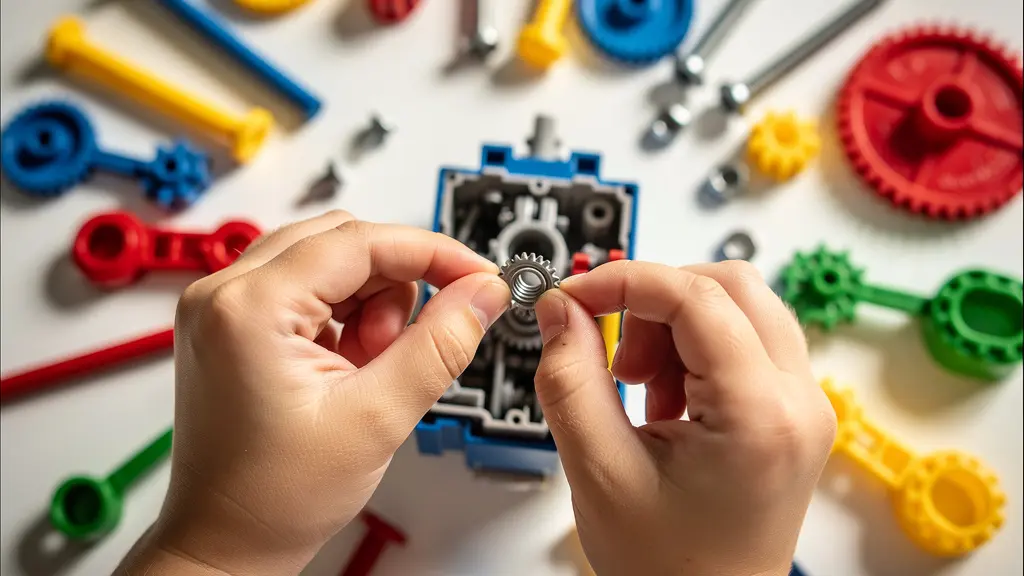
By prioritizing the “how” of thinking over the “what” of knowing, you equip your child with a versatile and resilient mind, capable of tackling any challenge that comes their way—whether it’s a broken toy or a complex life decision.
How to Give a Hint Without Giving the Answer?
You’ve successfully created a ‘productive void’ and your child is wrestling with a problem. They’re getting frustrated and are on the verge of giving up. “Just tell me!” they plead. This is a pivotal moment. Giving them the answer demolishes the learning opportunity. Doing nothing might lead to a meltdown. The solution is the artful hint, a technique I call ‘cognitive scaffolding.’ You aren’t giving them the answer; you are providing just enough support to help them build the next piece of their own solution.
The goal of a good hint is not to point to the answer, but to redirect the child’s attention to their own thinking process. This practice is directly linked to the development of metacognition—the ability to think about one’s own thinking. It’s one of the most powerful predictors of academic and life success. In fact, a study of children aged 3-6 found that those with high metacognitive abilities were significantly better problem-solvers than their peers. Every time you give a process-oriented hint, you are strengthening this metacognitive muscle.
A terrible hint is a smaller version of the answer (e.g., “Try the blue piece”). A great hint is a question that guides their focus. “What have you tried so far?” prompts them to review their process. “What’s the very first step?” helps them overcome the paralysis of being overwhelmed. “Is there a tool in your toolbox that could help with this part?” encourages them to think about resources. The key is that the cognitive work remains with the child. The following table breaks down different levels of support.
This “Hinting Hierarchy,” as detailed in a framework for developing problem-solving skills, offers a structured way to provide support without taking over.
| Support Level | Type of Hint | Example | When to Use |
|---|---|---|---|
| Level 1 | Process Hint | ‘What’s the very first step?’ | Child is overwhelmed, needs structure |
| Level 2 | Resource Hint | ‘Is there a tool that could help?’ | Child has tried but is missing a key element |
| Level 3 | Smaller-Question Hint | ‘Let’s focus on just this part first’ | Problem is too complex, needs breaking down |
| Rewind | Process Review | ‘Show me what you’ve tried so far’ | Child is stuck but may spot their own error |
By using this tiered approach, you are not just helping your child solve one puzzle. You are teaching them a systematic way to approach all future challenges, empowering them to become their own best problem-solvers.
Key Takeaways
- True critical thinking is fostered not by giving answers, but by creating a “productive void” that encourages a child’s own reasoning.
- Everyday activities, from reading stories to watching ads, are powerful opportunities to practice deconstruction and ethical reasoning in a safe environment.
- Your role as a parent is to shift from being an “oracle” to being an “intellectual partner” who guides, questions, and investigates alongside your child.
5 STEM Activities Using Kitchen Ingredients for Rainy Afternoons
A rainy afternoon cooped up indoors doesn’t have to be a recipe for boredom. Your kitchen is a fully-stocked science lab waiting to be discovered. Engaging in simple STEM activities with household ingredients is a perfect way to practice critical thinking in a hands-on, tangible way. The goal isn’t to create a perfect, Pinterest-worthy volcano, but to introduce your child to the most powerful thinking tool ever devised: the scientific method. It’s a structured way of being curious.
The scientific method is, at its heart, a framework for critical thinking. It’s about observing the world, asking a question, forming a testable guess (a hypothesis), conducting an experiment, and then analyzing the results to see if your guess was right. This process teaches children that “I don’t know” is not an endpoint, but the exciting starting point of an investigation. Research consistently shows that this kind of inquiry-based, hands-on learning is profoundly effective at enhancing critical thinking skills.
Here are five simple “experiments” that use the scientific method as their foundation:
- The Fizzy Reaction: Ask, “What will happen if we mix baking soda and vinegar?” Let them hypothesize (e.g., “It will bubble.”). Then, experiment. Follow up with a new question: “What if we use more vinegar? Will it make bigger bubbles?”
- Sink or Float: Gather a collection of small kitchen items (a grape, a plastic spoon, a bottle cap, an egg). For each item, ask “Will it sink or float?” This is the hypothesis. The test is dropping it in a bowl of water. You can then ask deeper questions: “Why do you think the heavy grape sank but the big plastic cap floated?”
- Color-Changing Cabbage: Red cabbage juice is a natural pH indicator. You can create a “magic potion” that changes color when you add acidic things (like lemon juice) or alkaline things (like baking soda solution). It’s a visually stunning way to explore chemical properties.
- Building with Food: Challenge your child to build the tallest possible tower using only toothpicks and marshmallows or grapes. This becomes a practical lesson in engineering, stability, and structural integrity. When it falls, it’s not a failure; it’s data for the next attempt.
- The Oil and Water Emulsion: Show them how oil and water don’t mix. Then ask, “Is there anything in the kitchen that could help them mix together?” The answer is an emulsifier, like a little bit of dish soap or mustard. This is a great, safe way to introduce basic chemistry concepts.
By embracing your role as a fellow scientist, you show your child that learning isn’t confined to a classroom. It’s a dynamic, exciting, and sometimes messy process of exploring the world with a curious and critical mind.