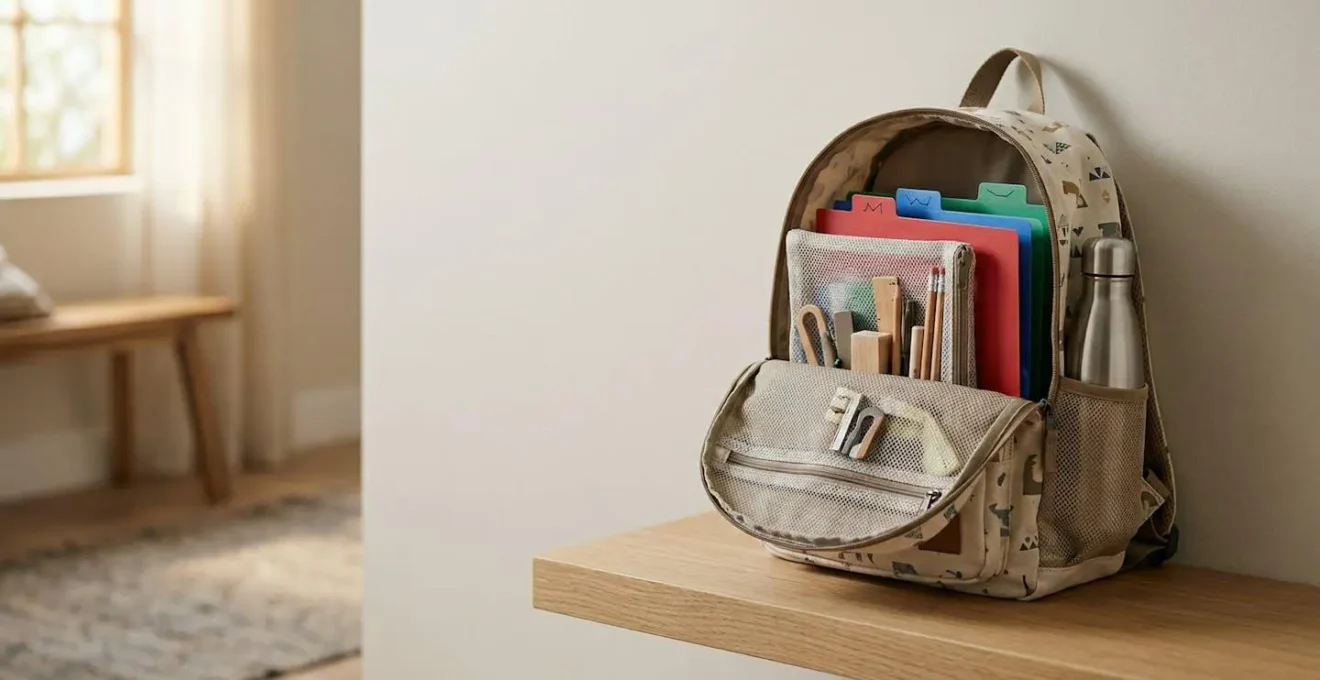
The secret to an organized backpack isn’t nagging your child; it’s engineering a system that works *with* their brain by reducing cognitive load and building external support for executive functions.
- A weekly “System Reboot” is non-negotiable to prevent chaos from accumulating.
- Simplify tools by using one large, transparent pouch instead of multiple hidden pockets.
- Limit the number of supplies to increase their perceived value and the child’s sense of ownership.
Recommendation: The most impactful first step is to create a dedicated “Launch Pad” zone at home to automate the daily routine of packing and unpacking.
The familiar chaos of a child’s backpack can feel like a daily battle. Crumpled papers, capless markers, and the mysterious disappearance of yet another set of pencils are common frustrations for parents, especially those whose children navigate the challenges of ADHD. The standard advice often falls flat: “just be more organized,” or “use more folders.” This approach places the burden on the child to overcome executive function deficits through sheer willpower—a strategy destined for failure. It treats the symptom, not the root cause, which is a brain that struggles with working memory, prioritization, and task initiation.
But what if we reframed the problem entirely? What if the backpack wasn’t a reflection of a child’s disorganization, but an opportunity to engineer their success? The true solution lies not in demanding better internal organization from the child, but in building a better external system for them. This is the principle behind the ‘Mobile Command Center’ concept: transforming the backpack from a chaotic dumping ground into a highly structured, predictable tool. It’s about creating an environment that scaffolds their developing executive functions, reducing cognitive load and making organization the path of least resistance.
This guide provides a systematic protocol to achieve just that. We will deconstruct the backpack and rebuild it as a functional system, piece by piece. From establishing a non-negotiable weekly reset to designing a home “launch pad” that automates routines, you will learn the practical, disciplined strategies that foster genuine responsibility and finally put an end to the weekly pencil hunt.
To navigate this systematic approach, the following guide breaks down each critical component. You will find a structured path to building a robust organizational framework for your child, moving from internal backpack management to the broader home environment.
Summary: The Backpack as a Mobile Command Center
- Why emptying the bag completely once a week saves sanity?
- Why one big pouch works better than 10 hidden pockets for ADHD kids?
- Stickers or Stamps: What survives the dishwasher and the playground?
- The clutter mistake: Why sending 20 pencils ensures none come back?
- How to separate “To Do” from “To Keep” effectively?
- Why carrying more than 15% of body weight damages posture?
- Why low shelves change behavior better than repeated verbal instructions?
- Hands-On Learning: Helping Active Kids Survive a Sedentary Classroom
Why Emptying the Bag Completely Once a Week Saves Sanity?
For a child struggling with executive function, a backpack is not just a bag; it’s a space where “out of sight” truly means “out of mind.” Items that enter the bag but aren’t immediately needed cease to exist in their working memory. This is why a permission slip from three weeks ago can coexist with a rotting apple and a single, lonely sock. The gradual accumulation of clutter isn’t a sign of carelessness; it’s a direct result of a neurological challenge. In fact, research has shown that children and teens with ADHD demonstrate significant deficits in working memory and organizational skills, making it nearly impossible to mentally track the contents of a cluttered space.
A weekly, complete clean-out is not just a chore; it’s a “System Reboot.” It forcibly brings every single item back into conscious awareness, wiping the slate clean before the cognitive load becomes overwhelming. This consistent routine prevents the slow creep of chaos and provides a predictable moment to reset the system. It externalizes the mental “refresh” that the brain struggles to perform on its own. By making it a non-negotiable part of the weekly schedule, you transform a reactive, frustrating task into a proactive, empowering habit. This discipline establishes a rhythm that the child can learn to depend on, reducing anxiety and last-minute scrambles.
Your Action Plan: The Weekly System Reboot
- Schedule a consistent time: Set a recurring appointment every week (e.g., Sunday at 6 PM) and label it “System Reboot” on a family calendar.
- Create a “Triage Mat”: Use a large placemat or poster board divided into four zones: ‘Action for Parents,’ ‘File at Home,’ ‘Return to School,’ and ‘Trash/Recycle.’ This provides a clear visual workflow.
- Empty and sort: The child must empty the entire backpack onto the mat and sort each item into the correct zone. This is a hands-on task, not a verbal one.
- Challenge every item: For each item being repacked, ask the question, “Do you need this for school *this week*?” This teaches active prioritization and reduces weight.
- Repack essentials only: The goal is to repack the bag with only what is necessary for the upcoming week, significantly reducing both physical and cognitive load.
Why One Big Pouch Works Better Than 10 Hidden Pockets for ADHD Kids?
Backpack manufacturers often advertise a multitude of pockets and hidden compartments as a feature of superior organization. For a neurotypical brain that can create and recall mental maps, this might be true. However, for a child with executive function challenges, this design is a trap. Each additional pocket represents another decision, another place to search, and another opportunity for an item to become “lost.” This complexity dramatically increases the cognitive load required to find a simple pencil, leading to frustration and abandonment of the system.
The most effective strategy is radical simplification. As the Healthline Medical Reviewers state when discussing backpack selection:
The first step in organization 101 is to find a backpack that works with the way your child’s brain works, not against it. Stay away from bags with a ton of pockets, hidden compartments, and zippers. Unfortunately, the more pockets and compartments there are, the higher the chances are that something will be hard to find.
– Healthline Medical Reviewers, Helping Kids with ADHD Organize Their Backpack
Instead of a dozen potential hiding spots, the system should offer one clear, unambiguous “home” for all small supplies. A single, large, and preferably transparent pouch eliminates the guesswork. The child knows that if they are looking for a pen, an eraser, or a highlighter, there is only one place it could possibly be. This removes the mental burden of having to remember a complex system of compartments. Visibility is key; a see-through pouch allows for at-a-glance inventory without even having to open it, further reducing the effort required to stay organized.
This “one-home” principle is a cornerstone of designing a supportive system. By minimizing the number of locations to check, you are directly scaffolding the child’s working memory and decision-making processes. It’s a disciplined approach that prioritizes function and low cognitive friction over the appearance of hyper-organization.
Stickers or Stamps: What Survives the Dishwasher and the Playground?
Once you’ve established a system, the next challenge is ensuring individual items make it back into that system. Labeling is a fundamental tactic, but its effectiveness is entirely dependent on durability. A paper sticker that peels off after one trip to the playground or a permanent marker that fades in the dishwasher is a wasted effort. The goal is a “set it and forget it” solution that withstands the rigors of a child’s life, from washing to weather.
The choice of labeling method must be systematic and matched to the surface and expected use of the item. Not all labels are created equal. Industrial-grade vinyl labels and no-iron fabric labels are the gold standard for durability on hard surfaces and clothing, respectively. They are designed to be waterproof, fade-resistant, and can often survive both the dishwasher and washing machine. In contrast, methods like permanent markers and laundry stamps offer a lower barrier to entry but require frequent reapplication as they inevitably fade and smudge. According to labeling experts, the durability of identification depends 80% on correct application, so cleaning and drying surfaces before applying a high-quality label is paramount.
The following matrix breaks down the durability of common labeling methods to guide your selection for a truly resilient identification system. This data is compiled from extensive testing and manufacturer specifications.
| Labeling Method | Best Surfaces | Dishwasher Safe | Washing Machine Safe | Playground/Sun Resistance | Durability Rating |
|---|---|---|---|---|---|
| Industrial Vinyl Labels (e.g., Mabel’s Labels, Name Bubbles) | Plastic, Metal, Hard Surfaces | Yes | Yes (on clothing tags) | High | ★★★★★ |
| No-Iron Fabric Labels | Fabric, Clothing, Hard Surfaces | Yes | Yes | High | ★★★★★ |
| Iron-On Labels | Fabric, Clothing | No | Yes | Medium-High | ★★★★☆ |
| Laundry Stamps | Fabric Only | No | Yes (fades over time) | Medium | ★★★☆☆ |
| Permanent Marker | Plastic, Metal, Fabric (temporary) | Fades | Fades | Low (smudges) | ★★☆☆☆ |
| Paper Stickers | Dry Indoor Items Only | No | No | Very Low | ★☆☆☆☆ |
The Clutter Mistake: Why Sending 20 Pencils Ensures None Come Back?
It seems logical: if your child constantly loses pencils, sending a large supply should solve the problem. In reality, this strategy backfires spectacularly. Flooding the system with an abundance of low-cost items teaches the brain a dangerous lesson: these objects are disposable and have no value. When there are 19 other pencils in the bag, there is zero incentive to track, care for, or retrieve the one that just rolled under the desk. This is a fundamental principle of value perception. Scarcity creates value; abundance destroys it.
To foster responsibility, you must reverse this logic. Instead of a disposable army of 20 pencils, implement a disciplined, minimalist system. By providing a very limited, high-quality set of tools, each item becomes significant. The child is more likely to feel a sense of ownership and responsibility for their “special” pen or their single “emergency” pencil. This approach also dramatically simplifies inventory management; it is far easier to track three specific items than a nebulous handful.
The “Three-Tier Pencil System” is a structured protocol that embodies this principle:
- Tier 1 – The ‘Daily Driver’: The child selects one high-quality mechanical pencil or a special multi-color pen. This is their primary tool, and they have ownership over its selection and care.
- Tier 2 – The ‘Buddy Pencil’: Designate a second, distinct pencil specifically for lending to classmates. Label it clearly as ‘LOANER.’ This teaches the social skill of helping while also introducing the concept of tracking borrowed items.
- Tier 3 – The ‘Emergency Spare’: Keep one sealed, backup pencil in a specific, rarely-opened compartment. This is the safety net, to be used only if the Daily Driver is truly lost or broken.
The hard rule is to never send more than three writing instruments in total. This engineered scarcity is not about deprivation; it’s a powerful psychological tool to build the very sense of responsibility you are trying to cultivate.
How to Separate “To Do” from “To Keep” Effectively?
Paper is the single greatest source of clutter and overwhelm in any backpack. A disorganized pile of worksheets, permission slips, art projects, and old notices creates a constant source of stress. Without a clear system, the child has no way to differentiate between a critical homework assignment due tomorrow and a lunch menu from last month. The solution is to create a physical, kinesthetic workflow that makes sorting and prioritizing paper a simple, mechanical process.
The most effective method is a single, multi-tabbed accordion folder. This becomes the sole “home” for all loose papers. The key is to assign a clear purpose to each section. A simple and powerful setup uses color-coded tabs for each school subject, a dedicated pocket for blank paper, and a brightly colored “parent folder” for items requiring parental action. This turns the abstract task of “organizing papers” into a concrete matching game. This paper goes in the blue math pocket; this one goes in the red “parent” pocket.
This system provides a tangible sense of accomplishment, as described by one parent who found success with this method. The ADDitude Magazine article “School Organization 101” features a powerful example:
Case Study: Success with an Accordion Folder System
Jeanie Scott from Houston reports her experience with her 11-year-old son who has organizational challenges. They found that an accordion folder was a game-changer. As she noted in an article for ADDitude Magazine, ‘We assign each school subject its own pocket, and reserve a pocket for blank paper and one for notices to bring home — all labeled.’ This simple system dramatically reduced lost homework by ensuring every paper had a designated home, providing a visual and tactile workflow that directly supports executive function.
To manage the flow of paper *into* the accordion folder, teach the “4D Rule”:
- Do it: If it takes less than 2 minutes (e.g., sign a permission slip), do it now.
- Delegate it: Place it in the ‘Action for Parents’ folder.
- Defer it: File it in the correct subject tab for future study.
- Ditch it: Recycle it immediately.
This creates an “inbox zero” mentality for paper, preventing buildup before it even starts.
Why Carrying More Than 15% of Body Weight Damages Posture?
The cognitive burden of a disorganized backpack is only half the story; the physical burden is just as detrimental. A chronically overloaded backpack forces a child’s body into unnatural compensatory postures that can have long-term consequences. When a bag’s weight exceeds the recommended threshold of 10-15% of the child’s body weight, it pulls them backward, forcing them to lean forward at the hips or arch their back to maintain balance. This forward head posture puts significant strain on the neck and spine.
This isn’t just an anecdotal observation; it’s a biomechanical reality. A heavy bag alters the body’s center of gravity. To compensate, a child will often round their shoulders and tilt their head forward, increasing pressure on the cervical spine. Over time, this can lead to chronic pain, muscle imbalances, and poor postural habits that persist into adulthood. The physical discomfort is also a significant distraction, consuming mental resources that should be dedicated to learning. A child who is physically strained is less able to focus and engage in the classroom.
Scientific evidence confirms this threshold. Rigorous biomechanical studies confirm that the craniovertebral (CV) angle—a key indicator of forward head posture—changes significantly once a backpack’s load reaches 15% of a child’s body weight. This change is the body’s first line of defense against the excessive load, an adaptation that, while necessary for balance, initiates a cascade of musculoskeletal strain. Keeping the backpack light is therefore not just a matter of comfort; it’s a critical component of ensuring a child’s physical and cognitive readiness to learn.
Why Low Shelves Change Behavior Better Than Repeated Verbal Instructions?
A parent’s most common—and least effective—organizational tool is the verbal reminder. “Hang up your backpack!” “Did you remember your lunch?” “Where are your shoes?” These repeated instructions are a source of friction and frustration for both parent and child. They require the child to stop, process the command, and initiate a task—all activities that rely heavily on challenged executive functions. A far more powerful and disciplined approach is to use environmental scaffolding: designing the physical space to make the desired behavior the easiest possible option.
This is the principle behind the “Launch Pad.” A Launch Pad is a designated zone, typically by the main exit of the home, where everything needed for the next day is pre-staged. It is a physical, visual checklist that requires no nagging. By installing low hooks at the child’s height, a small bench for sitting to put on shoes, and clearly labeled bins for items like sports gear or instruments, you create a workflow that is intuitive and automatic. The environment itself does the reminding.
This isn’t just a parenting hack; it’s a proven behavioral strategy. As research from the IRIS Center at Vanderbilt University highlights:
Changes in classroom environmental arrangement, such as rearranging furniture, implementing activity schedules, and altering ways of providing instructions around routines, have been found to increase the probability of appropriate behaviors and effectively decrease the probability of challenging behaviors.
– IRIS Center Vanderbilt University, Early Childhood Environments: Designing Effective Classrooms
What works in the classroom works in the home. By changing the environment, you are not just hoping for a change in behavior; you are systematically engineering it. The Launch Pad removes decision fatigue and reliance on working memory from the morning and afternoon routine, preserving the child’s limited executive function resources for the more demanding tasks of the school day.
Key Takeaways
- The core principle is to build external systems that support a child’s internal executive function challenges.
- Simplicity is paramount: one pouch, a limited number of supplies, and a clear paper workflow reduce cognitive load.
- Consistent, scheduled routines like a weekly “System Reboot” and using a home “Launch Pad” are more effective than constant verbal reminders.
Hands-On Learning: Helping Active Kids Survive a Sedentary Classroom
For many active children, especially those with ADHD, a traditional sedentary classroom can feel like a cage. The need for physical movement and sensory input doesn’t disappear when the bell rings. When this need isn’t met through appropriate channels, it often emerges as disruptive behavior: fidgeting, tapping, or getting out of their seat. A key strategic shift is to reframe the Mobile Command Center not just as an organizational tool, but as a Kinesthetic Toolkit—a curated set of supplies that provides discreet, purposeful sensory input.
This approach channels the need for movement into productive, non-disruptive actions. The act of managing the system itself—clicking a multi-color pen, moving papers in the accordion file, zipping a pouch—provides small, purposeful physical actions. Beyond this, you can intentionally pack a “Silent Fidget Module” within the main pencil pouch. These are not toys, but tools designed to help channel excess energy into focus. It’s important to recognize this need, as comprehensive research indicates that executive dysfunction is present in about 33%–50% of children with ADHD, highlighting that many require tailored sensory and kinesthetic support.
A well-designed Kinesthetic Toolkit might include:
- Textured pencil grips: These provide constant, low-level tactile stimulation during the act of writing.
- Therapy or thinking putty: This can be squeezed silently under a desk during listening activities, providing an outlet for restless hands.
- Gear rings or silent fidget spinners: These offer quiet kinesthetic input without the noise or visual distraction of traditional spinners.
- A Velcro strip under the desk: A simple, effective, and invisible tool for sensory seekers who benefit from touching and scratching different textures.
By proactively providing these tools, you give the child a sanctioned way to meet their sensory needs, allowing them to better regulate their attention and survive, even thrive, in a classroom environment that may not be naturally suited to their learning style.
Now that you have the complete framework for the Mobile Command Center, the path forward is clear. The next logical step is to move from theory to practice by scheduling and executing the first System Reboot with your child this weekend.