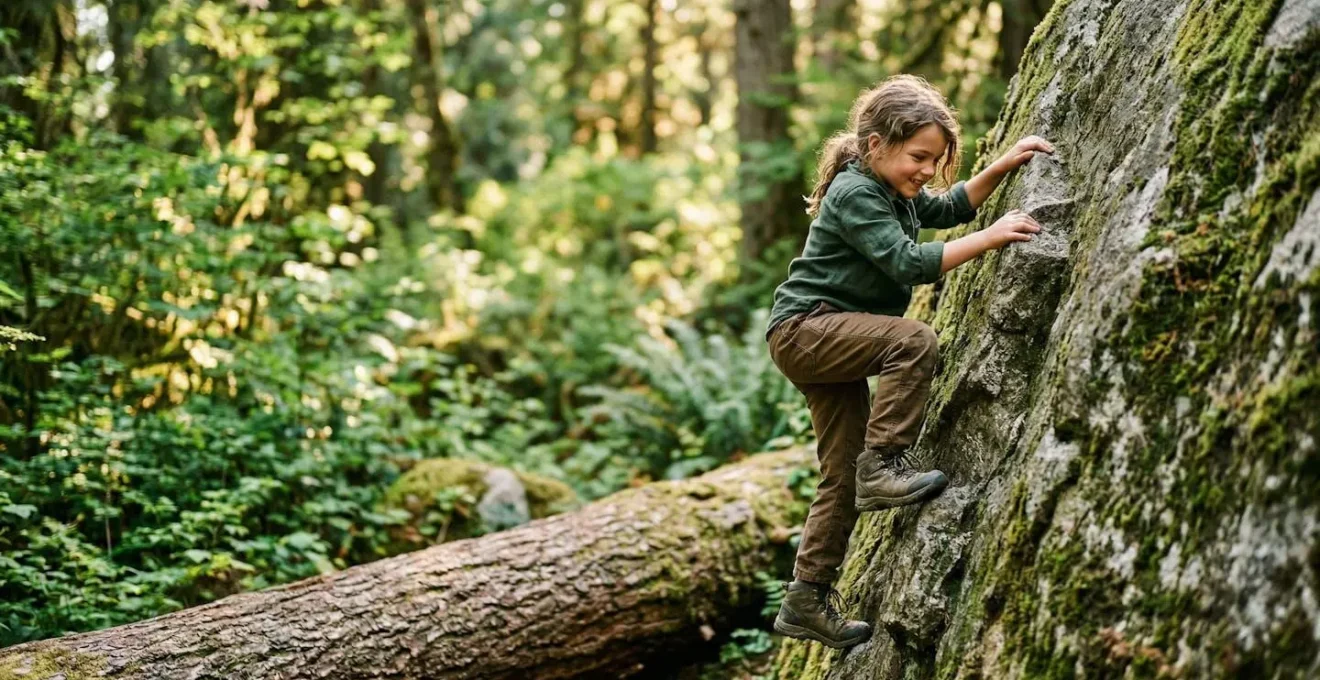
For parents paralyzed by the fear of splinters and tumbles, the constant refrain of “Be careful!” often falls on deaf ears or creates more anxiety. This guide shifts the focus from fear-based warnings to empowerment. By teaching your child the language of nature and a simple ‘sensory audit’ for risks, you transform them from a liability to be protected into a competent partner in adventure. It’s not about letting go; it’s about equipping them with the wild wisdom to hold on for themselves.
The sound of it is like a nervous tic for parents everywhere: “Be careful!” It slips out as they scramble up a rock, as they eye a low-hanging branch, as they pick up a stick that looks suspiciously like a sword. We want them to be safe, to be protected from the scrapes, bumps, and potential horrors our imaginations so vividly conjure. We see the splinter, the fall, the ER visit. Yet, in our well-meaning efforts to bubble-wrap their childhood, we might be robbing them of the very thing they need to navigate the world with competence: confidence.
Many parenting guides will tell you the benefits of risky play—it builds resilience, improves motor skills, and fosters independence. This is all true. But knowing the benefits doesn’t quiet the frantic drum of anxiety in a parent’s chest. A recent poll found that 40% of parents feel nervous when their child goes ‘too far’ or climbs ‘too high’, hovering close by during any new physical challenge. The truth is, you cannot simply switch off this fear. You must transform it.
But what if the goal wasn’t just to let them take risks, but to teach them how to *read* risk? What if we could replace “Be careful!” with “What’s your plan?” This is the heart of ‘wild wisdom.’ It’s a shift from issuing commands to starting a dialogue. It’s about empowering your child with the sensory tools to assess their own environment, to understand the grammar of the wild—the difference between a living branch and a dead one, the story a loose rock tells, the appropriate use of a good, solid stick.
This guide won’t ask you to ignore your fear. Instead, it will give you a practical framework to channel that protective energy into teaching. We will explore how to conduct a sensory audit of a tree branch, redefine the purpose of a stick, and establish a safety protocol for getting lost. We will dissect the language that builds anxiety, understand the science behind outdoor play’s benefits for vision and health, and ultimately, see how mastering the smallest risks builds the foundation for unshakeable self-esteem.
The journey from a fearful supervisor to a confident guide begins now. This article provides the map and the compass, breaking down the essential skills you can pass on to your child, one wild adventure at a time.
Summary: A Parent’s Guide to Safe Risk-Taking in Nature
- How to teach a child to check a branch before trusting it?
- How to allow stick play without it turning into a sword fight?
- What should they do exactly if they can’t see you?
- The language mistake that makes kids anxious or ignore you
- Fun games to teach hazard identification without fear
- Why kids who play outside less are more likely to need glasses?
- Why plastic raincoats make kids sweat and freeze?
- The Confidence Payoff: Why Mastering Small Risks Builds Real Self-Esteem
How to teach a child to check a branch before trusting it?
The urge to climb is written into a child’s DNA. To a parent, every tree looks like a ladder to the emergency room. Instead of a flat “No climbing,” we can teach them the ancient language of the forest, turning them into discerning engineers of their own ascent. This is the first lesson in wild wisdom: learning to ask the tree for permission before climbing. It’s a sensory audit that engages sight, sound, and touch, transforming a fearful moment into a lesson in physics and biology.
Begin by making it a game. You are ‘Tree Detectives.’ Your first clue is sight. Look for the ‘story’ of the branch. Does it have green leaves or buds? That’s a sign of life and strength. Is the bark peeling, full of holes, or covered in fungus? Those are warnings that the branch is old or sick. Teach them to look for cracks where the branch meets the trunk. A healthy connection is everything.
Next is the sound check. Have them hang gently from the branch with just a little weight and listen. A strong, living branch will be mostly silent or give a slight, flexible groan. A dangerous, dry branch will often protest with a sharp creak or crackle. This is the tree’s voice, and you’re teaching your child to listen to it. Finally, the tactile assessment. Feel the bark. Is it firm and solid, or brittle and flaky? This simple touch provides a wealth of information about the wood’s integrity.
Only after this multi-sensory check comes the weight test. This isn’t a full-body leap of faith but a series of small, controlled ‘bounces’ to see how the branch responds. By externalizing the safety check into a clear, repeatable process, you are handing the tools of risk assessment directly to your child. They are no longer just climbing; they are problem-solving and engaging in a dialogue with their environment. This builds the foundational skills for a lifetime of safe exploration.
This process of observation and testing is precisely what outdoor learning programs foster, leading to enhanced motor skills, balance, and an intuitive understanding of the natural world. It’s the first step in building the competence loop.
How to allow stick play without it turning into a sword fight?
The moment a child picks up a stick, a parent’s brain often flashes to a single image: a poke in the eye. The immediate instinct is to shout “Put that down!” But a stick is one of nature’s most versatile open-ended toys. Banning it entirely closes a door to immense creativity. The key is not to forbid the tool, but to redefine its purpose. Instead of a weapon, a stick can be a magic wand, a fishing rod, a horse, a pencil for writing in the dirt, or a crucial building material.
The most effective way to prevent a sword fight is to offer a more compelling alternative. Frame the activity with a creative challenge before the stick is even picked up. “Let’s see who can build the strongest mini-fort for this beetle,” or “I wonder if we can make a giant bird’s nest with all the sticks we can find.” This immediately channels their energy from combat into construction and collaboration. It shifts the focus from individual dueling to a shared goal. Research confirms this; a 2024 position statement from the Canadian Paediatric Society highlights that risky play, when guided, supports cooperation and communication.
This is also a moment for simple, clear rules. A good forest school rule is that a stick must be shorter than your arm, and you must be able to see a “bubble of space” all around you before you can swing it. This gives the child a concrete measure of safety they can understand and control. You’re not just saying “be safe”; you’re explaining *how* to be safe in a way they can visualize and enact. It’s about respecting the power of the stick.
By providing a creative prompt and clear boundaries, you transform the humble stick from a perceived threat into a tool for imagination, engineering, and art. The stick becomes a way to interact *with* nature, not a way to act *against* a sibling. You’re not stopping play; you’re elevating it.
Ultimately, a child with a stick can be learning leverage, balance, and structural integrity, all while believing they are simply building a fairy house. That’s the magic we want to cultivate.
What should they do exactly if they can’t see you?
For any parent, this is the nightmare scenario. One moment they’re right behind you on the trail, the next… silence. Panic is a parent’s first reaction, but it is the child’s panic that is most dangerous. Teaching a child what to do when they are lost is perhaps the single most important piece of wild wisdom you can impart. The instructions must be simple, memorable, and counter-intuitive to a child’s panicked instinct to run and find you.
The most effective and widely taught method is the “Hug-a-Tree” program. It’s a simple protocol designed to override a child’s fear-driven impulse to wander further. Instead of a long list of confusing rules, you can frame it as a series of comforting actions. If they realize they are lost, their one and only job is to stop moving and find a “friend tree” to hug. This single action achieves two critical goals: it keeps them in one place, making them exponentially easier to find, and the physical act of hugging something solid can calm their nervous system and prevent panicked running.
Once they’ve hugged their tree, the next step is to make themselves heard and seen. This is where a simple, cheap whistle on their jacket zipper becomes the most valuable piece of gear they own. The rule is “three blows for help” – the universal distress signal. A whistle carries much farther than a voice and uses far less energy than screaming. You should practice this, so they know it’s a tool for emergencies only, not for casual play. Teach them that if they hear people calling their name, they must answer. Many lost children hide because they are scared they’re in trouble, so it’s vital they know that rescuers are friends coming to help.
This simple, non-fearful preparation is a gift of security. It replaces a terrifying unknown with a clear, actionable plan. Knowing that your child has this knowledge doesn’t mean you’ll be any less vigilant, but it can provide a profound sense of peace, knowing they are equipped not just with your love, but with life-saving skills.
Your Child’s Wilderness Safety Plan: The Hug-A-Tree Method
- Stop Immediately: The moment you realize you can’t see your grown-up, stop walking. Running only gets you more lost. Staying put makes you an easier target to find.
- Find a “Friend Tree” and Hug It: Pick one tree and stay with it. This calms your body and mind, and it keeps you in one place. This is your home base until you are found.
- Make Yourself Big and Loud: If you’re in a clearing, you can make an X on the ground with sticks. Most importantly, use your emergency whistle. Blow three short, loud blasts. Wait, and repeat. It’s much louder than your voice.
- Stay Warm and Dry: If you have a jacket, zip it up. Huddle at the base of your tree to stay out of the wind. Staying warm is your most important job after staying put.
- Answer the Call: When you hear people calling your name, yell back as loud as you can! Do not hide. The searchers are there to help you and are so happy to find you.
This protocol transforms the child from a passive victim of circumstance into an active participant in their own rescue.
The language mistake that makes kids anxious or ignore you
It’s the most common phrase in the parental lexicon, an automatic response to any perceived danger: “Be careful!” We say it with the best of intentions, but what does it actually communicate? To a child in the middle of a focused physical or mental task—like navigating a tricky series of roots or balancing on a log—it is, at best, useless noise. At worst, it is actively harmful. The phrase is a conversation-stopper. It doesn’t tell them *what* to be careful of, *how* to be careful, or *why* they should be careful. It simply injects a dose of your own anxiety into their moment of concentration.
When a child hears “Be careful!”, one of two things happens. They may stop what they are doing, suddenly anxious and unsure of their own abilities, their confidence shattered by your perceived lack of faith. The flow state is broken. Or, more commonly, they simply tune it out. They’ve heard it a thousand times before with no negative consequences, so it becomes meaningless background noise, teaching them to ignore your voice in moments that might actually matter.
The alternative is to shift from being a director to a narrator or a co-investigator. Instead of a vague command, use specific, observational language. Replace “Be careful!” with:
- “I see those rocks are a little wobbly. What’s your plan for getting across?” (This encourages foresight and planning).
- “That branch looks wet. How’s the grip up there?” (This prompts a real-time sensory check).
- “You’re climbing really high! How does it feel to be up there?” (This helps them connect with their own body and emotions, including fear or excitement).
This approach, which is central to the forest school philosophy, transforms you into a supportive partner. You are showing them you are paying attention, that you trust them to think, and that you are there to help them problem-solve, not just to shout warnings from the sidelines. As one expert advises, the key is to engage, not to command.
Pause for 15-30 seconds to observe a child’s state of play before intervening. Help children problem-solve by using phrases that create a teaching moment by enquiring how a child is feeling during risky play and what their next actions will be.
– Dr. Suzanne Beno, Canadian Paediatric Society Position Statement on Risky Play
By changing your language, you change the entire dynamic. You are no longer managing your own fear by projecting it onto them; you are building their competence by inviting them into a dialogue about risk.
Fun games to teach hazard identification without fear
Teaching children to spot hazards shouldn’t feel like a scary lecture about everything that could possibly go wrong. It should be a game, turning them into sharp-eyed detectives of the natural world. The goal is to cultivate awareness, not anxiety. By gamifying hazard identification, you empower them with the skills of observation and critical thinking, making them active partners in their own safety. It’s about sharpening their “wild wisdom” in a way that feels like play, not a pop quiz.
One of the simplest and most effective games is “Eagle Eye.” The rules are easy: as you walk, one person is the designated “Eagle Eye” for a few minutes. Their job is to quietly spot things that might be a hazard without alarming anyone. This could be a patch of slippery moss on a rock, a low-hanging branch at head-height, a hornet’s nest, or a patch of poison ivy. When they spot something, they don’t shout “Danger!” Instead, they say “I spy with my Eagle Eye…” and describe the object. Then, as a group, you can talk about why it’s something to be aware of and what the safe way to navigate around it is. This teaches observation without panic.
Another great game is “Nature Detective.” This game focuses on reading the “clues” nature leaves behind. A pile of freshly dug dirt might mean an animal burrow to avoid stepping in. A large, dead branch on the ground tells the story of a weak limb that fell from a tree above, reminding you to look up. Are there lots of acorns on the ground? The path might be bumpy and easy to twist an ankle on. This game teaches children to see the forest not as a static background, but as a dynamic environment full of stories and information that can inform their choices.
Finally, there’s “Red Light, Green Light, Nature Edition.” In this version, “green light” means a clear, safe path. “Red light” means stop and assess a potential hazard. When you call “Red light!”, everyone freezes and points to what the hazard might be—a steep, muddy slope, a creek that’s wider than it looks, or a trail that suddenly disappears. It’s a fun, active way to practice pausing and thinking before plunging ahead. These games transform safety from a list of ‘don’ts’ into an engaging, collaborative process of discovery.
You are teaching them to keep their eyes and minds open, which is a far more effective safety tool than any rulebook.
Why kids who play outside less are more likely to need glasses?
It might seem like an old wives’ tale, but a mountain of modern science confirms a startling link between time spent outdoors and a child’s eyesight. The global rise in myopia, or nearsightedness, is a growing public health concern. In the U.S. alone, recent data shows that 42% of people are now myopic, a sharp increase from 25% in the 1970s. While genetics and screen time play a role, one of the most powerful and surprising protective factors is simply being outside.
The mechanism is fascinating. When children are indoors, much of their time is spent focusing on things up close—books, screens, toys. This constant near-work encourages the eyeball to elongate slightly over time, which is the physical change that causes myopia. Outdoors, the visual environment is completely different. Children are naturally looking at things far away: the top of a tree, a cloud in the sky, a friend down the field. This “long-distance gazing” forces the eye to relax and focus at a distance, counteracting the strain of near-work.
Even more importantly, the sheer brightness of outdoor light, even on a cloudy day, appears to be a key ingredient. Outdoor light is hundreds of times brighter than typical indoor lighting. This bright light is thought to stimulate the release of dopamine in the retina, a neurotransmitter that has been shown to inhibit the eyeball elongation that leads to nearsightedness. The evidence is compelling and quantifiable.
You don’t need a clinical trial to see the benefits; you just need to open the door. The simple act of encouraging unstructured play in the backyard or a local park is not just building their bodies and confidence; it’s actively protecting their vision. In a world of increasing screen time, outdoor play has become one of the most powerful and accessible tools we have to ensure our children see the world clearly, in every sense of the word. A 2024 meta-analysis published in Ophthalmic Research revealed that compared to minimal outdoor time, increasing it to 16.3 hours a week could reduce the risk of myopia onset by 53%.
This isn’t about banning screens, but about ensuring a healthy balance, where the vast, bright, and distant world of nature gets its fair share of your child’s attention.
Why plastic raincoats make kids sweat and freeze?
A rainy day offers a world of sensory delights: stomping in puddles, catching raindrops on your tongue, the fresh smell of wet earth. But for a child, the difference between a joyful rainy-day adventure and a miserable, shivery ordeal often comes down to one thing: their raincoat. The classic, cheap, plastic or PVC raincoat seems like a sensible choice—it keeps the water out. The problem is, it also keeps the water *in*, creating a personal swamp that can quickly turn dangerous.
The science is simple thermodynamics. Children are little furnaces, generating a huge amount of heat and moisture (sweat) when they run and play. A non-breathable plastic raincoat acts like a plastic bag. It blocks rain from getting in, but it also completely blocks sweat from getting out. This trapped moisture soaks their base layers of clothing. As long as they’re running, they might just feel hot and clammy. But the moment they stop, the evaporative cooling effect kicks in. The trapped water on their skin and in their clothes begins to evaporate, pulling massive amounts of heat away from their body. This is why a child can feel like they’re freezing to death just minutes after feeling hot and sweaty, even if the rain has stopped.
This cycle of sweating and freezing isn’t just uncomfortable; it can lead to hypothermia in surprisingly mild conditions. It’s a classic mistake that can ruin an outing and create a negative association with being outdoors in “bad” weather. The solution lies in the principle of layering and using the right materials.
Case Study: The Critical Role of Clothing in Outdoor Education
Outdoor education programs, like those run by the Wild London Trust, place enormous emphasis on appropriate clothing in their risk assessments. Their documents show that preventing children from getting wet and cold is not about comfort, but a primary safety concern. They identify that the use of proper gear is a “critical mitigation strategy” to prevent everything from minor discomfort to shock. Instructors model correct clothing choices and conduct checks to ensure children understand how their gear affects their ability to stay warm and safe during extended play in challenging weather, demonstrating that the right clothing is as important as any other piece of safety equipment.
Instead of a single plastic layer, think in threes: a moisture-wicking base layer (like merino wool or synthetics, never cotton), an insulating mid-layer (like fleece), and a waterproof but *breathable* outer shell. This system allows sweat to escape while keeping rain out, ensuring your child stays dry from the inside and the outside. It’s an investment, but one that pays dividends in hours of happy, safe, and puddle-stomping fun.
Good gear doesn’t just make the outdoors more comfortable; it makes it more accessible, turning “bad weather” into just… weather.
Key takeaways
- Replace “Be careful!” with specific, empowering questions like “What’s your plan?” to foster critical thinking instead of anxiety.
- Teach children a “sensory audit” for risks—using sight, sound, and touch—to make safety a tangible, repeatable skill.
- Reframe the purpose of natural objects like sticks from “weapons” to “tools” for creativity by providing compelling alternative activities like building.
The Confidence Payoff: Why Mastering Small Risks Builds Real Self-Esteem
We’ve talked about the “how”—the practical skills of checking a branch, the language of risk, the right gear. But it’s crucial to circle back to the “why.” Why do we, as parents, fight through our own anxiety to let our children climb that little bit higher? Because the payoff is one of the most precious things we can help cultivate: genuine, earned confidence. Not the “everyone gets a trophy” kind of self-esteem, but the deep, unshakable belief in one’s own capabilities that comes from facing a challenge, assessing it, and overcoming it.
This is the magic of the competence loop. A child sees a small challenge—a large rock, a steep grassy bank, a fallen log to balance on. They apply the skills you’ve taught them: they do a quick sensory audit, they form a plan. They execute that plan and succeed. The feeling that follows is pure, unadulterated achievement. That success hardwires a new belief: “I can do hard things.” This new confidence then makes them willing to take on a slightly bigger challenge, which, when conquered, builds even more competence. This positive feedback loop is the engine of resilience.
It’s vital to understand that the size of the challenge doesn’t matter to the brain’s reward system. For a toddler, successfully navigating a tussock of grass without falling is a monumental victory. For a seven-year-old, reaching the third branch of a tree can feel like summiting Everest. As research on outdoor play and confidence development shows that children who successfully climb to the top of a structure for the first time experience genuine achievement that builds self-efficacy and encourages them to attempt new challenges.
This is the ultimate antidote to parental fear. When you see your child’s face, lit up with pride after they’ve navigated a tricky spot on their own, you are seeing the result of your own courage. Your courage to step back, to ask questions instead of giving commands, and to trust in the wild wisdom you have helped them grow. You haven’t just prevented an injury; you’ve helped build a human who is more capable, more resilient, and more confident in their ability to meet the world on their own terms.
Your next step is simple. On your next walk, find one opportunity to ask “What’s your plan?” instead of saying “Be careful!” and watch what happens.