
The key to a strong bond isn’t more time; it’s mastering emotional attunement to make short moments profoundly impactful.
- Focus on co-regulating your child’s nervous system through present, focused interaction, not just proximity.
- Replace guilt-driven gifts with connection rituals that build predictable security and trigger bonding hormones.
Recommendation: Shift from trying to ‘manage’ your child to becoming a ‘Benevolent Leader’ who offers both warmth and clear boundaries for long-term emotional safety.
The sound of the front door closing behind you is often a finish line and a starting gun all at once. For many working parents, the relief of being home is immediately shadowed by a wave of guilt. You see your child, eager for your attention, and the day’s exhaustion feels like a wall between you. You know you *should* be present, engaged, and full of energy, but the reality is you’re running on empty. The common advice is to carve out “quality time,” but what does that even mean when every minute feels borrowed?
We’re told to put our phones away, create elaborate routines, or schedule special outings. While well-intentioned, these suggestions often miss the core of the issue. They focus on the *what*—the activities—without addressing the *how* and the *why* of genuine connection. The problem isn’t a lack of love or desire; it’s a lack of understanding of the emotional and neurological mechanics of bonding. The pressure to perform as the “perfect parent” after a draining workday can ironically push your child further away, leaving both of you feeling disconnected and misunderstood.
But what if the solution wasn’t about adding more to your already overflowing plate? What if the secret to building deep, lasting emotional security lies not in the quantity of hours, but in the quality of your emotional presence in small, powerful moments? This article will guide you through a different approach, one rooted in the principles of emotional attunement and co-regulation. We will explore how to make the first few minutes at home the most important of the day, why being a parent is more effective than being a friend, and how to navigate common pitfalls like guilt-driven gifts and discipline for strong-willed children. It’s time to trade guilt for connection.
This guide will explore the practical strategies and psychological shifts that transform brief interactions into powerful moments of bonding. Follow along to discover how to build the secure, loving relationship you and your child deserve, one small connection at a time.
Summary: Your Roadmap to Reconnection
- Why 20 minutes of focused play is worth more than 3 hours of proximity?
- How to reconnect with your child in the first 10 minutes home?
- Friend or Parent: Which role builds deeper security long-term?
- The “Guilt Gift” trap: Why buying toys weakens emotional connection?
- When and how to apologize to your child to restore trust?
- How to use lighting to calm a chaotic household in the evening?
- How to relax on weekends without destroying Monday’s routine?
- Why Positive Reinforcement Interactions Fail With Strong-Willed Children?
Why 20 minutes of focused play is worth more than 3 hours of proximity?
As a working parent, your most limited resource is time, and the most common misconception is that connection requires hours of it. The truth is, three hours of you being physically present in the same room—answering emails while your child plays nearby—is less valuable than 20 minutes of truly focused, attuned interaction. The magic isn’t in the duration; it’s in the depth of the connection, which has a measurable biological effect. In fact, neuroscience research reveals that brains become synchronized when parents and children engage in genuine, back-and-forth play. This neural synchrony is the foundation of emotional security and learning.
This concept is called emotional attunement. It’s the act of being fully present with your child’s emotional state, not just their physical activity. When you get down on the floor, make eye contact, and let your child lead the play, you are sending a powerful, non-verbal message: “You matter. I see you. I am here with you.” This is a form of co-regulation, where your calm, focused presence helps regulate your child’s nervous system, calming their stress from the day and reinforcing your bond.
So, how do you make these 20 minutes count? It starts with a mindset shift. It’s not another task on your to-do list; it’s a sacred pause. Put your phone and other devices completely out of sight. The goal isn’t to teach or direct, but to follow their lead and delight in their world. If they want to line up toy cars, you become the most interested car-liner in the world. This focused attention fills their emotional cup far more effectively than hours of distracted proximity, building a resilient bond that can withstand the daily separations.
Ultimately, these short bursts of dedicated play become the bedrock of your relationship. They prove to your child that even with limited time, they are your priority. This predictability and presence create a profound sense of safety and love.
How to reconnect with your child in the first 10 minutes home?
The transition from work to home is one of the most challenging and crucial moments of the day. You walk in carrying the mental load of your job, while your child is overflowing with the need to connect after being apart. Rushing into evening logistics like dinner and homework can create a “missed connection” that sets a stressful tone for the rest of the night. The key to bridging this gap is creating a deliberate Connection Ritual in the first few minutes you are home.
This isn’t about grand gestures. It’s about a small, predictable, and sacred moment of reunion. Before you even walk in the door, take a deep breath. Mentally leave the stressors of your workday behind. Your child is exquisitely sensitive to your emotional state, and they will mirror the calm you bring, not the chaos you’re leaving.
The Transition Ritual in Practice
A simple but effective approach is to create a personal signal that the workday is officially over and family time begins. This might be taking off your work shoes and putting on “home slippers,” changing out of your work clothes, or simply sitting in your car for one minute of silence before entering the house. This small act tells your brain it’s time to reset and be fully present. The ritual signals to yourself that you are transitioning roles, allowing you to greet your family with intention rather than on autopilot.
When you greet your child, get down to their eye level. This simple physical act communicates respect and focus. Create a special handshake, a specific way you hug, or a silly phrase you both say. This becomes *your* thing, a predictable anchor in their day that screams, “I’m back, and you are the first thing on my mind.”
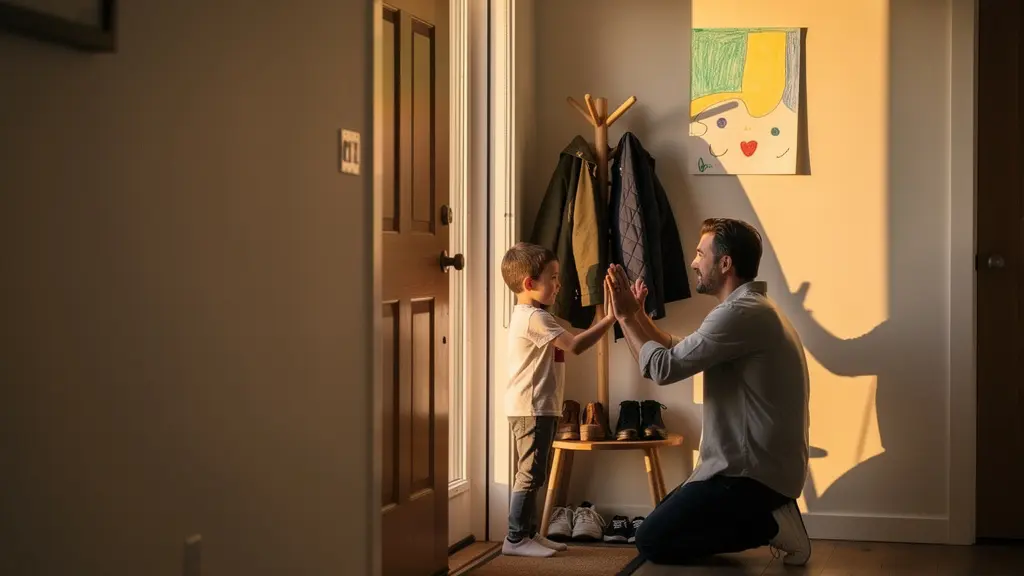
As you can see, the environment is secondary to the moment of connection itself. By intentionally designing these first few minutes, you are not just saying hello; you are co-regulating with your child, calming their nervous system, and reaffirming your bond. This ritual prevents the common scenario where a child “acts out” to get the attention they crave, creating a smoother and more loving evening for everyone.
This small investment of intentional presence at the start of the evening pays enormous dividends, transforming a potentially chaotic transition into a beautiful moment of reunion.
Friend or Parent: Which role builds deeper security long-term?
A parenting model based on fear and punishment not only prevents you from connecting with your child but also prevents your child from connecting with their sense of inner security and worth. Instead of trying to control your child, view the parent-child relationship as a ‘mutual, reciprocal partnership’.
– Shefali Tsabary, NPR Life Kit interview on The Parenting Map
In the quest for a close relationship, it’s easy to fall into the trap of wanting to be your child’s best friend. You want them to like you, to confide in you, and to see you as an equal. While this comes from a place of love, blurring the lines between parent and friend can inadvertently create anxiety and insecurity for a child. Children don’t need another friend; they need a calm, confident, and loving guide. They need a Benevolent Leader.
A friend offers peer-level support and flexible boundaries, which is wonderful for a playdate but insufficient for a developing child. A parent, in the traditional sense, can sometimes be seen as firm and directive, providing structure but potentially lacking warmth. The role of a Benevolent Leader is the optimal balance of both. It’s a leader who provides clear, consistent boundaries (the structure that creates safety) while also offering immense warmth, empathy, and respect (the attunement that builds connection). This approach creates a secure base from which a child can explore the world, knowing they have a safe harbor to return to.
The following table, based on principles of child development, breaks down how these different roles impact a child’s sense of security. As an analysis from the National Association for the Education of Young Children (NAEYC) implies, quality interactions are built on this balance.
| Aspect | Friend Role | Parent Role | Benevolent Leader (Balanced) |
|---|---|---|---|
| Boundaries | Flexible, negotiable | Firm, non-negotiable | Clear but explained |
| Emotional Safety | Peer-level support | Secure base, container for feelings | Both supportive and stabilizing |
| Long-term Security | May create uncertainty | Provides structure | Optimal balance of warmth and structure |
| Communication Style | Equal, casual | Directive, instructional | Collaborative with final authority |
Embracing the role of a Benevolent Leader doesn’t mean you can’t be friendly or have fun with your child. It means that when difficult moments arise, you are able to hold the boundary with love. You can say, “I know you’re disappointed we have to leave the park, and it’s okay to feel sad. It’s time to go home now.” You validate the feeling (friend-like warmth) while holding the limit (parental structure). This consistency is what truly builds deep, long-term security.
Your child’s trust in you grows not when you bend to their every whim, but when they know you are a steady, reliable presence who can handle their biggest feelings and keep them safe.
The “Guilt Gift” trap: Why buying toys weakens emotional connection?
Parental guilt is a powerful motivator, and one of its most common manifestations is the “Guilt Gift.” After a long week of late nights at the office or a business trip, it feels natural to want to compensate for your absence with a new toy or treat. It provides a momentary flash of joy for your child and a fleeting sense of relief for you. However, this pattern, known as the Guilt-Gift Cycle, can subtly undermine the very connection you’re trying to build.
The problem is that gifts are a transaction, whereas connection is an emotional experience. When a child is missing you, they are not craving a new object; they are craving *you*—your presence, your attention, your attunement. Relying on gifts teaches a child to associate material goods with love and can create a dynamic where they expect objects as compensation for your absence. More importantly, it misses a crucial biological opportunity for bonding. As research on bonding shows, genuine human connection triggers the release of oxytocin, the “love hormone,” in both parent and child. This powerful hormone reduces stress and anxiety and deepens feelings of attachment. A plastic toy simply cannot replicate this profound biological process.
Breaking the Guilt-Gift Cycle requires shifting your focus from “what can I give?” to “how can I connect?” Instead of stopping at the toy store on the way home, commit that time and energy to one of the alternatives that truly fills your child’s emotional cup. It’s not about spending more money or time, but about investing your presence more intentionally. The next time you feel the pull of guilt, use it as a cue to lean into connection, not consumption.
Action Plan: Meaningful Alternatives to Guilt-Gifts
- Create a ‘special time’ coupon book: Instead of a toy, gift a homemade coupon for “20 minutes of uninterrupted building block time” or “One extra bedtime story.”
- Write a heartfelt note: Leave a simple note acknowledging your absence and expressing excitement about a specific activity you’ll do together soon.
- Start a shared project: Begin a puzzle, a Lego model, or a craft that you can only work on together, turning your reunion into a collaborative event.
- Establish a one-on-one ritual: Make “Saturday Morning Pancakes” or “Friday Night Movie” a sacred, non-negotiable time that your child can count on.
- Share your stories: Dedicate ten minutes to simply sharing one small, child-friendly story about your day and then listen intently to one of theirs.
These actions communicate your love and commitment far more powerfully than any store-bought item, building a foundation of emotional wealth rather than a pile of soon-to-be-forgotten toys.
When and how to apologize to your child to restore trust?
Even the most attuned and loving parent has moments they’re not proud of. You might lose your temper after a long day, speak with a sharp tone, or be emotionally distant when your child needs you. In these moments, the impulse can be to ignore it and move on, hoping the child will forget. But children don’t forget; they internalize. They create stories in their minds to explain your behavior, and that story is almost always, “It’s my fault. I am the problem.” This is where a genuine apology becomes one of the most powerful tools for building trust and emotional security.
Apologizing to your child is not a sign of weakness; it’s a demonstration of immense strength and respect. It models accountability, emotional honesty, and the process of repair, which are essential life skills. A successful apology, however, goes beyond a simple “I’m sorry.” It needs to be timely, sincere, and explanatory, without making excuses. The goal is to take ownership of your feeling and separate it from your child’s identity.
The “repair” after a conflict is often more important than the conflict itself. It teaches your child that relationships can withstand mistakes and that love is resilient. It shows them that you are human, and it gives them permission to be human, too. This vulnerability is the glue that holds a strong parent-child bond together.
The Four-Step Apology in Practice
Imagine you snapped at your child. Later, when you’ve both calmed down, you kneel to their level and say, “I’m sorry, sweetheart. Mommy had a rough day today, and I’m feeling sad. My frustration right now has nothing to do with you. Tomorrow is a new day to try again.” This simple script does four crucial things: it expresses remorse, it names your emotion, it explicitly takes the blame off the child, and it offers hope for reconnection. Without this explanation, a child’s brain will invent a narrative where they did something wrong to cause your mood, eroding their sense of worth.

As this image suggests, the apology is an act of gentle reconnection. It’s a moment to restore the physical and emotional closeness that was disrupted. It reinforces the message that no matter what happens, your connection is safe and can always be repaired.
By embracing the power of a sincere apology, you are not just fixing a single mistake; you are teaching your child one of the most profound lessons about love: that it is strong enough to hold even our imperfections.
How to use lighting to calm a chaotic household in the evening?
The evening wind-down period can often feel like a battle against a tide of chaotic energy. A simple yet profoundly effective tool for shifting the household mood from frantic to calm is the strategic use of lighting. Our bodies are naturally wired to respond to light cues. Bright, blue-toned overhead lights mimic midday sun, signaling to our brains that it’s time to be alert and active. In the evening, this can disrupt the natural production of melatonin, the hormone that tells our body it’s time to sleep.
This is especially critical in our modern world, where exposure to screens is pervasive. Beyond just limiting tablets and phones, it is important to manage the light in the environment. Creating a “sunset” inside your home about 60-90 minutes before bedtime can work wonders. This involves turning off harsh overhead lights and switching to warmer, dimmer sources like table lamps or floor lamps. Opt for bulbs with a warm color temperature (under 2700K) to create a soft, amber glow that is soothing to the nervous system.
This change in lighting can become a powerful, non-verbal Connection Ritual. You can call it the “evening calm-down” or the “sunset ritual.” Involving your child in the process—letting them be the one to switch on the “sleepy lights”—gives them a sense of control and makes the transition a shared, positive experience. It becomes a clear and gentle signal to everyone in the family that the day is drawing to a close and it’s time to transition to quieter activities like reading, gentle play, or cuddling. This simple environmental shift supports everyone’s circadian rhythms, reduces evening hyperactivity, and creates a peaceful atmosphere conducive to connection.
By consciously curating your home’s lighting, you are not just changing the ambiance; you are actively co-regulating your family’s nervous systems and paving the way for a more peaceful and connected end to the day.
How to relax on weekends without destroying Monday’s routine?
Weekends present a classic paradox for working parents: you desperately need to rest and recharge, but a complete abandonment of routine can lead to a chaotic Sunday night and a dreaded “Monday morning struggle” for the whole family. The key is not to choose between structure and relaxation, but to find a flexible rhythm that allows for both. This is achieved by maintaining a few key Weekend Anchor Points.
Instead of a rigid, minute-by-minute schedule, identify 2-3 core routines that will remain consistent. These anchors provide a predictable skeleton for the weekend, giving children the security they need while leaving plenty of room for spontaneity. A powerful anchor could be a consistent wake-up window (e.g., everyone is up between 8 and 9 AM, rather than 7 AM on weekdays and 11 AM on weekends). Other effective anchors include maintaining a consistent family dinner time or preserving the beloved bedtime story ritual, even if bedtime itself is a little later.
We also have a standing Saturday morning date – this simple routine provides consistency while allowing flexibility for the rest of the weekend.
– A working parent’s experience
Another powerful strategy is the “Sunday Evening Reset.” This is a 30-minute ritual dedicated to transitioning back to the weekly rhythm. It’s not about chores; it’s about connection and preparation. You might pack lunches together while listening to a family playlist, review the calendar for the upcoming week so everyone knows what to expect, or simply spend time reading together. This conscious transition smooths the jarring shift from weekend freedom to weekday structure, reducing anxiety for both children and parents.
Finally, be intentional about the *type* of relaxation you choose. While it’s tempting to default to screen time for everyone, this often leaves family members feeling more drained and disconnected. Prioritize restorative activities like a walk in nature, playing a board game, or working on a shared project. These activities recharge your batteries while simultaneously strengthening your family bond, ensuring you end the weekend feeling rested and connected, not just “off the hook.”
By using these anchor points, you can protect your family’s routine and your own sanity, making weekends a time of true rest and reconnection.
Key Takeaways
- True connection is about emotional attunement in short bursts, not the total number of hours spent together.
- Establish small, predictable “Connection Rituals” upon returning home to co-regulate and reaffirm your bond.
- Adopt the role of a “Benevolent Leader” by providing both loving warmth and clear, consistent boundaries for long-term security.
Why Positive Reinforcement Interactions Fail With Strong-Willed Children?
Parents of strong-willed children often find themselves frustrated when traditional discipline methods, including positive reinforcement like sticker charts or praise, seem to backfire. You might offer a reward for good behavior only to be met with a power struggle, or give praise that seems to fall on deaf ears. This isn’t because your child is “disrespectful” or “defiant”; it’s because their internal motivation system is wired differently. Strong-willed children are often driven by a deep need for autonomy and a sense of their own agency, not by external validation.
For these children, a reward can feel like a bribe, an attempt to control them, which triggers their innate resistance to being managed. Similarly, generic praise like “Good job!” can feel inauthentic or manipulative. They are more interested in mastering a task for their own satisfaction than for your approval. As Dr. Shefali Tsabary notes, “We parents can make anything look like disrespect. We have to look at it in a different way. The child is not trying to disrespect you. The child is just being a child.” Their behavior is an expression of their developing personality, not a personal attack on your authority.
The solution is to shift from reinforcement to collaboration. Instead of trying to impose your will, invite them into a problem-solving partnership. This respects their need for autonomy while keeping you in the role of the Benevolent Leader. For example, instead of “If you clean your room, you get screen time,” try, “Our playroom is getting messy and it’s hard to find things. What’s our plan to tackle this together?” This frames it as a shared challenge, not a command.
Reframing Strong Will as Leadership
This assertive nature is often misunderstood as aggression. However, as research on child development shows, assertiveness in children is about taking initiative—like inviting others to play or coming up with game ideas. When parents reframe this “strong will” as emerging leadership potential, it fundamentally changes the interaction. You move from trying to extinguish a “negative” trait to nurturing a positive one. You can acknowledge their big ideas and guide them on how to execute them in a way that respects others, turning a potential conflict into a coaching moment.
By working *with* their nature instead of against it, you foster a relationship built on mutual respect and genuine cooperation, which is far more powerful and lasting than any sticker chart.
Frequently Asked Questions on Building Bonds
When should we start dimming lights before bedtime?
Begin the transition 60-90 minutes before bedtime to allow melatonin production to naturally increase. This creates a physiological cue for the body to prepare for sleep and helps calm the nervous system.
What color temperature is best for evening lighting?
Warm-toned lights under 2700K are ideal. They emit a soft, amber-like glow that does not suppress melatonin, unlike the harsh blue-toned light from cool-white bulbs and electronic screens.
How can lighting changes become a family ritual?
Create a “sunset ritual” where everyone participates. Giving a child the job of “official lamp lighter” can make it a fun and empowering part of the evening routine, signaling a collective shift to a calmer state.