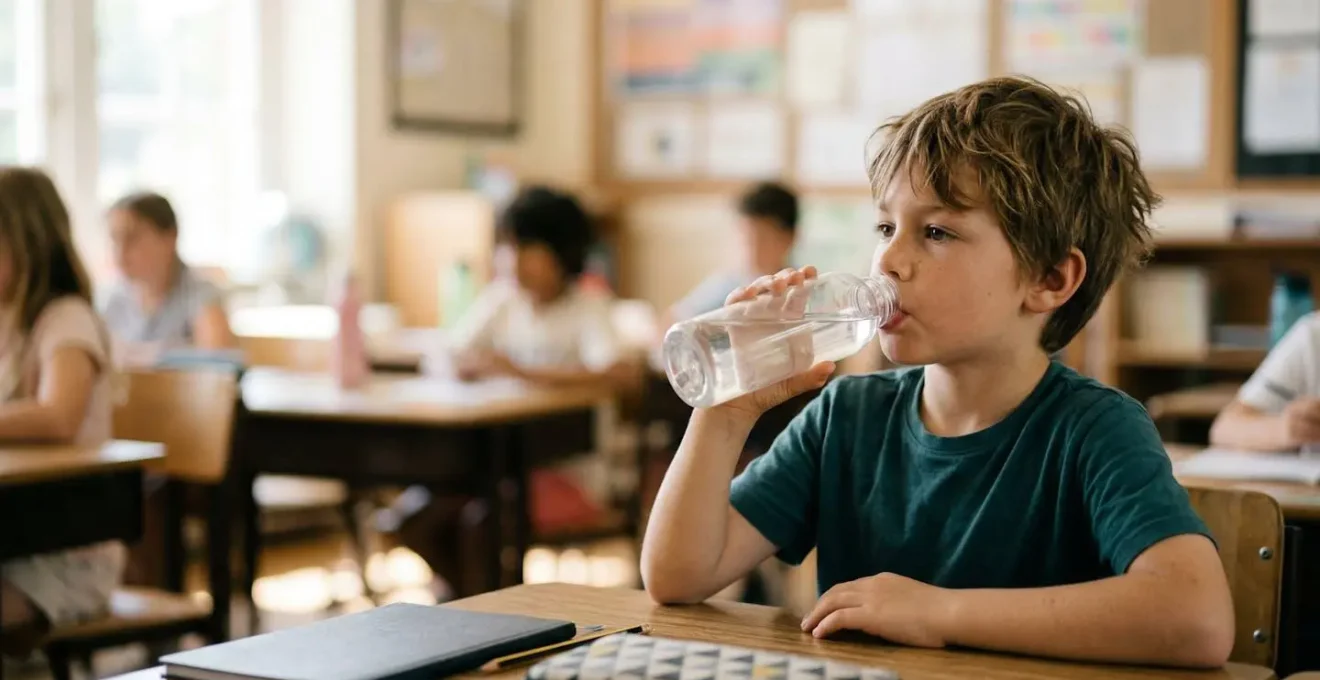
If you’re frustrated by the untouched water bottle your child brings home, you’re not alone. The solution isn’t just reminding them to drink more. This guide reveals the hidden environmental and psychological barriers to hydration at school. We’ll shift the focus from nagging to empowerment by teaching your child “Hydration Intelligence”—the ability to recognize their body’s needs and proactively manage their water intake for better focus, energy, and academic success.
It’s a familiar and frustrating scene for so many parents: you send your child to school with a full, reusable water bottle, only for it to return in the afternoon, still heavy and mostly full. Meanwhile, your child complains of a headache, seems irritable, or struggles to focus on homework. You know hydration is crucial, but the constant reminders to “drink your water” feel like they’re falling on deaf ears. You’ve tried the cool bottles and maybe even flavored water, but nothing seems to stick.
Most advice focuses on the obvious: pack a water bottle and tell them to drink. But what if the problem is more complex? What if the school environment, social pressures, and even your child’s own biology are creating hidden barriers to proper hydration? The real key to solving this isn’t about enforcing a rule, but about fostering a skill. It’s about moving beyond nagging and toward empowerment.
This is where the concept of “Hydration Intelligence” comes in. Instead of just focusing on the *what* (drink more water), we’re going to explore the *why* and the *how*. This guide will equip you with practical, coaching-based strategies to help your child understand their own body’s signals, navigate common “dehydration traps” during the school day, and take ownership of their well-being. By building this intelligence, you’re not just solving the headache problem; you’re setting them up for better health and sharper academic performance.
In the following sections, we will break down exactly how to cultivate this skill, from teaching self-assessment techniques to navigating tricky school policies. You’ll find actionable steps to transform that full water bottle into an empty one, and a tired, unfocused child into a vibrant, engaged learner.
Summary: A Parent’s Guide to Solving School-Day Dehydration
- How to teach kids to check their own hydration status?
- Fruit Infusions vs. Syrups: What counts as water?
- Why swimmers dehydrate without realizing it?
- The “Liquid is Liquid” mistake: Why juice doesn’t hydrate the same way?
- What to do if teachers limit bathroom breaks or water bottles?
- The hydration mistake that causes headaches after school
- Why you must increase water intake when adding more grains?
- Trendy School Backpacks: Balancing Spinal Health With Cool Factors
How to teach kids to check their own hydration status?
The first step in building Hydration Intelligence is to shift your child from being a passive recipient of instructions (“drink water!”) to an active manager of their own body. The goal is to teach them “body literacy”—the ability to read their body’s subtle cues. Instead of waiting for the obvious signal of thirst, which often means dehydration has already begun, you can empower them to become detectives of their own hydration levels throughout the day.
This isn’t about complex science; it’s about creating simple, repeatable check-in moments. For example, the “Pee Check” is a classic for a reason. You can find simple, kid-friendly urine color charts online to hang in the bathroom. Teach them that a pale, straw-like yellow means “great job!” while a darker, apple-juice color means “time to hydrate.” This visual feedback is concrete and easy for a child to understand and monitor independently.
Beyond that, you can create routines for them to “scan” their body. After recess or gym class, ask them: “How does your mouth feel? A little dry? How’s your energy? Feeling super or a bit slow?” By connecting physical sensations to the need for water, you’re building a powerful internal feedback loop. This self-awareness is far more effective than any external reminder you can provide and is a foundational skill for lifelong health.
Your Action Plan: The Self-Assessment Hydration Checklist
- Morning Baseline Check: Teach your child to observe their first urine of the day using a color chart. Pale yellow means they are well-hydrated, while dark yellow indicates a need for water.
- Post-Activity Body Scan: Create a routine where your child pauses after recess or sports to notice internal signals—a dry mouth, the sensation of thirst, a drop in energy, or “fuzzy thinking.”
- The “Skin Tent” Self-Test: Show them how to gently pinch the skin on the back of their hand. If it springs back quickly, they are likely hydrated; if it returns slowly, they may need water.
- Water-First Rule Before Snacking: Establish a habit where children drink a glass of water before reaching for a snack. This helps them distinguish true thirst from hunger signals.
By turning hydration into a skill rather than a rule, you empower your child with the autonomy and knowledge to take care of themselves, a gift that extends far beyond just finishing their water bottle.
Fruit Infusions vs. Syrups: What counts as water?
Once your child is more aware of their need to hydrate, the next challenge is making water appealing enough to compete with the sugary drinks they see everywhere. Many parents wonder what truly “counts” as healthy hydration. The answer is simple: plain water is always the gold standard. However, for kids who find it “boring,” natural fruit infusions are a fantastic way to add excitement without compromising on health.
This paragraph introduces the concept of making water appealing. To better visualize this, the illustration below shows how simple, natural ingredients can transform plain water.
As you can see, adding slices of orange, lemon, strawberries, or even a few mint leaves can make water look and taste more interesting. This is a visual and sensory upgrade that doesn’t add sugar or calories. It’s crucial to distinguish these natural infusions from commercial water enhancers, syrups, and powders. These products are often marketed as healthy but are frequently loaded with artificial sweeteners, colors, and sugars that negate the benefits of drinking water.
The line can be blurry, especially with drinks that seem healthy. As the American Academy of Pediatrics wisely points out when discussing fruit juice, which many consider a hydrating option:
While it can contain some vitamins, these drinks are high in sugar and calories and low in the healthy fiber found in whole fruit.
– American Academy of Pediatrics, Healthy Children – Choose Water for Healthy Hydration
The bottom line is to focus on addition, not subtraction. Add natural flavor with real fruit, but subtract the processed syrups and powders. This approach keeps hydration pure, effective, and enjoyable.
Why swimmers dehydrate without realizing it?
One of the most powerful ways to teach Hydration Intelligence is to highlight “dehydration traps”—situations where kids lose fluids without the usual warning signs. Competitive swimming is a perfect, if surprising, example. You’d think being surrounded by water would prevent dehydration, but the opposite is often true. In fact, the environment actively masks the body’s thirst signals.
The statistics are alarming. A University of Arkansas study found that two-thirds (approximately 67%) of young swimmers showed up to practice already in a state of dehydration. They are starting their workout with a significant fluid deficit, which impairs performance and recovery from the very first lap. This happens because the cool water and the pressure of being submerged trick the body.
The body doesn’t register sweating in the same way, and the hydrostatic pressure of the water on the body can suppress the hormones that trigger thirst. This creates a dangerous scenario where a child can be losing significant amounts of fluid through intense effort without ever feeling the urge to drink. This specific phenomenon highlights why waiting for thirst is an unreliable strategy for athletes.
Case Study: The Hidden Thirst of Young Swimmers
Research with 46 competitive swimmers aged 8-17 revealed a critical insight: swimmers don’t register thirst effectively due to the hydrostatic pressure of water on their bodies. This pressure tricks the body’s baroreceptors, which measure cardiovascular pressure, into signaling that the body is full of fluids when the opposite is happening. Furthermore, the study found that traditional hydration markers like urine color were inaccurate during and right after swimming, making it even harder for young athletes and their coaches to detect dehydration in aquatic environments.
This is why teaching proactive hydration—drinking on a schedule before, during, and after activity, regardless of thirst—is so critical. It helps children override their faulty internal signals and stay ahead of dehydration, whether they’re in the pool, on the soccer field, or just playing at recess.
The “Liquid is Liquid” mistake: Why juice doesn’t hydrate the same way?
A common misconception many well-meaning parents hold is the “liquid is liquid” belief—the idea that as long as a child is drinking something, they’re hydrating. This leads to offering fruit juice, sports drinks, or flavored milk as substitutes for water. While these drinks do contain water, they are not an equal replacement. The way the body processes them is fundamentally different, especially when it comes to sugar.
When a child drinks plain water, it’s absorbed directly and efficiently, serving its primary purpose of hydrating cells and regulating body temperature. When they drink juice, the body has an extra job to do: process the concentrated sugar. This can cause a rapid spike in blood sugar, followed by a crash, which can affect energy levels and mood. Furthermore, the body doesn’t register calories from liquids in the same way it does from solid food, so a child can consume a lot of sugar from juice without feeling full.
This is why leading health organizations are so clear about limiting juice intake. For instance, the American Academy of Pediatrics recommends limiting juice to no more than 4-6 oz for ages 4-6 and 8 oz for ages 7-18 per day. That’s a very small portion, far less than what many children consume. It’s meant to be a treat, not a primary source of hydration.
Instead of thinking of juice as “fruit in a glass,” it’s more accurate to see it as a sugary beverage. Teaching your child to see water as their body’s “fuel” and juice as a “sometimes food” helps them make smarter choices, protecting them from excess sugar consumption and ensuring their hydration is effective.
What to do if teachers limit bathroom breaks or water bottles?
Sometimes, the biggest barrier to your child’s hydration isn’t their preference but the “hydration environment” at school. Restrictive classroom policies around water bottle access or bathroom breaks can inadvertently create significant dehydration traps. With some studies showing that as many as half of U.S. students may be under-hydrated during the school day, this is a systemic issue that often requires a collaborative approach to solve.
If you discover that your child is hesitant to drink because they worry about not being allowed to use the restroom, or if water bottles are only permitted at certain times, the first step is to approach the teacher as a partner, not an adversary. Most educators are juggling the needs of many students and are focused on minimizing classroom disruptions. They may not have considered the link between their policy, hydration, and a student’s ability to learn.
Frame the conversation around your child’s well-being and academic success. Opening with something like, “I’ve noticed my child is getting headaches after school, and we think it’s related to hydration. I’d love to partner with you to find a solution that works for the classroom” sets a positive, collaborative tone. Here are some strategies to propose:
- Provide proactive solutions: Suggest a spill-proof bottle to alleviate worries about messes. You could also work with your child and the teacher to create a non-verbal signal for when they need a water or bathroom break, which is less disruptive than raising a hand.
- Reference school wellness policies: Many school districts have official wellness policies that support water access. A quick search on the district’s website can provide powerful language to support your request, framing it as a shared goal.
- Obtain a doctor’s note if needed: For persistent issues or if your child has a medical reason for needing consistent hydration (like preventing UTIs or migraines), a simple note from a pediatrician can depersonalize the request and provide formal documentation.
By working together, you can help create a classroom environment that supports not just your child’s hydration, but that of all students, leading to a more focused and energized learning space for everyone.
The hydration mistake that causes headaches after school
The after-school headache is the classic red flag that brings the issue of dehydration into sharp focus for parents. Your child walks in the door, drops their heavy backpack, and complains that their head is pounding. This isn’t just a random ailment; it’s often the cumulative effect of a “slow-burn” dehydration that has been building all day long. The mistake isn’t a single event, but a failure to drink consistently, leading to a fluid deficit that finally manifests as pain once the stimulation of the school day wears off.
This is where the direct link between hydration and cognitive function becomes painfully clear. The brain is approximately 75% water, and even mild dehydration can impact its function significantly. When the body is low on water, it can cause brain tissue to shrink slightly, pulling away from the skull and triggering the pain receptors that we perceive as a headache.
What’s most concerning for parents and educators is that the headache is a late-stage symptom. The negative impact on academic performance begins much earlier. In fact, research indicates that by the time thirst is felt, mental performance including memory and concentration may have already decreased by as much as 10%. Your child could be struggling to focus in their afternoon math class long before their head even starts to hurt.
The solution to the after-school headache isn’t a painkiller; it’s proactive hydration throughout the day. By teaching your child to sip water consistently, even when they don’t feel thirsty, you’re not just preventing a headache—you’re protecting their ability to learn, focus, and feel their best from the first bell to the last.
Why you must increase water intake when adding more grains?
As you focus on improving your family’s nutrition, you might be adding more whole grains, fruits, and vegetables to your child’s diet—all fantastic choices rich in fiber. But here lies another hidden dehydration trap: increasing fiber without also increasing water can backfire, leading to digestive discomfort, constipation, and ironically, contributing to dehydration.
Fiber is a superstar for digestive health, but it needs a partner to do its job effectively. Think of fiber like a dry sponge. Its magic lies in its ability to absorb water. When it does, it becomes soft and bulky, which helps move waste smoothly through the digestive system. Health experts recommend that total dietary fiber intake should be 25 to 30 grams per day for adults, with kids’ needs varying by age. A simple rule is to take your child’s age and add 5 to get their target grams per day (e.g., a 7-year-old needs about 12 grams).
However, if you add more fiber to your child’s diet (e.g., switching from white bread to whole-wheat, adding more beans or oatmeal) without ensuring they’re drinking enough water, that “sponge” stays dry. Instead of helping things move along, it can actually create a blockage, causing gas, bloating, and constipation. In this process, the body may even pull water from elsewhere to try to soften the stool, contributing to overall dehydration.
The takeaway is simple: whenever you make a healthy choice to boost fiber, make it a double-win by also consciously increasing water intake. Pair that whole-grain sandwich at lunch with a full bottle of water, and that high-fiber afternoon snack with another glass. This ensures the fiber can do its job properly, supporting both great digestion and optimal hydration.
Key Takeaways
- Empower, Don’t Command: The most effective strategy is to teach your child “Hydration Intelligence” so they can learn to monitor their own body’s needs.
- Identify Hidden Traps: Dehydration isn’t just about heat; it’s triggered by exercise (like swimming), school rules, and even healthy high-fiber foods.
- Partner with the School: Frame conversations with teachers around collaboration and your child’s academic performance to find solutions for water and bathroom access.
Trendy School Backpacks: Balancing Spinal Health With Cool Factors
When choosing a school backpack, parents rightfully focus on ergonomics and spinal health. But a backpack is more than just a tool for carrying books; it’s a critical part of your child’s daily “hydration environment.” The right backpack can either encourage or discourage drinking water throughout the day. A trendy design might win “cool points,” but if it makes accessing a water bottle difficult, it’s failing at a crucial health function.
Think of the backpack as your child’s mobile hydration station. If the water bottle is buried deep inside the main compartment, behind textbooks and binders, the effort required to retrieve it can be a significant deterrent for a child between classes or during a brief break. The principle of “out of sight, out of mind” is incredibly powerful. A water bottle that is easily accessible is far more likely to be used.
When shopping for a new backpack, involve your child in the choice but guide them with a “hydration-first” lens. Look beyond the colors and characters and evaluate the features that support easy drinking. Here are some key features to prioritize:
- Accessibility Audit: The backpack must have an external, stretchy side pocket that can be easily reached without taking the pack off. This is the single most important feature for promoting hydration.
- Insulated Pocket Feature: Some backpacks offer insulated pockets. This is a game-changer for keeping water cool and refreshing, making it much more appealing to drink hours after it was filled.
- Leak-Proof Compartment Design: To protect expensive electronics and books, look for backpacks with separate compartments or waterproof-lined pockets specifically for bottles.
Ultimately, by choosing a backpack that makes hydration easy and appealing, you are removing one more barrier and setting your child up for success. The next time you see your child reach for a sip of water effortlessly from their side pocket, you’ll know you’ve made a choice that supports both their spine and their brain.