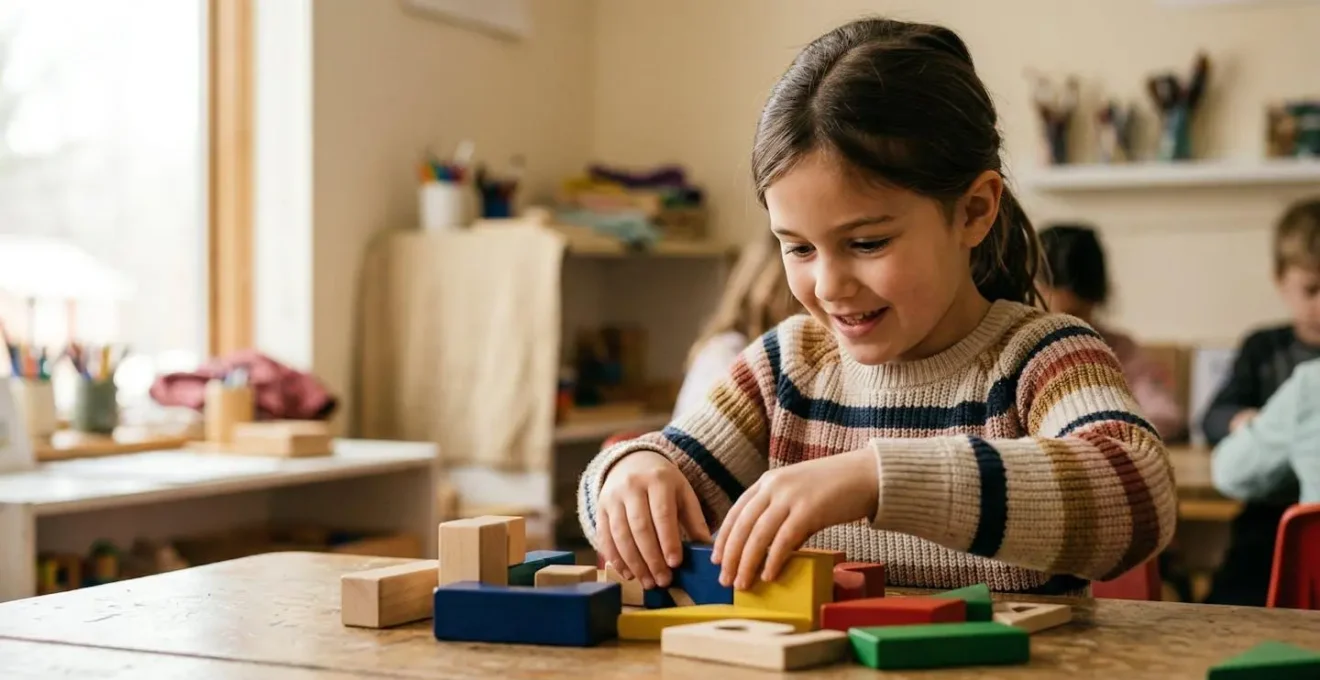
The core problem isn’t your child’s energy; it’s a classroom environment that mistakes the need for movement as a behavioral issue.
- Kinesthetic intelligence is a valid learning style where physical action is essential for cognitive processing, not a symptom of ADHD or defiance.
- Punishing a kinesthetic child by removing recess or movement is counterproductive and has been shown to worsen focus and behavior.
Recommendation: Shift from managing behavior to advocating for evidence-based accommodations. Use the strategies in this guide to build a case for your child’s teacher, reframing movement as a necessary learning tool.
As a special education consultant, I hear a familiar story from countless concerned parents: “My child is bright and curious, but they can’t sit still in class. They’re constantly getting in trouble for fidgeting, tapping, or being out of their seat. The teacher says they’re disruptive.” This is the fundamental conflict for children with high kinesthetic intelligence. Our modern education system, built on a foundation of stillness and quiet listening, often pathologizes a learning style that is deeply rooted in physical engagement. Parents are told to manage the behavior, to encourage more self-control, without being given the tools to understand the root cause. Many wonder if their child has ADHD, when in reality, their child might simply be thinking with their body.
The standard advice often involves finding better fidget toys or practicing sitting still at home, approaches that place the burden of adaptation entirely on the child. But what if this is the wrong framework? What if the constant motion isn’t a distraction *from* learning, but the very mechanism *of* learning? The crucial shift in perspective is to stop viewing this as a deficit to be corrected and start seeing it as a form of intelligence to be harnessed. Your child doesn’t need to be “fixed”; they need a learning environment that speaks their language—the language of movement, touch, and action.
This guide is designed to move you from a position of frustration to one of informed advocacy. We will dismantle the myth that stillness equals focus and provide you with a science-backed understanding of the cognitive-motor link. You will learn not just *what* to do, but *why* specific hands-on strategies work. We will explore how to turn spelling into a full-body activity, why building with blocks can be more academically valuable than a worksheet, and how to have a productive conversation with a teacher about the difference between a tool and a toy. The goal is to equip you with the language and evidence needed to help your child survive—and ultimately thrive—in a system not built for them.
To help you navigate these strategies, this article is structured to provide clear, actionable insights. Below is a summary of the key areas we will cover, each designed to build your advocacy toolkit.
Table of Contents: A Parent’s Guide to Kinesthetic Learning in the Classroom
- How to do spelling words while jumping on a trampoline?
- Why holding the numbers helps them understand the concept?
- When does a fidget spinner become a distraction?
- The punishment mistake that makes classroom behavior worse
- How to build a scene from a book to check understanding?
- Why fidgeting burns more calories than you think?
- Puzzle or Blocks: Which develops better spatial reasoning?
- How to Foster Critical Thinking in Kids Using Everyday Scenarios?
How to do spelling words while jumping on a trampoline?
The idea of a child jumping on a trampoline while practicing spelling might seem chaotic, but for a kinesthetic learner, it’s a highly effective cognitive strategy. The core principle is connecting a physical action to an abstract piece of information, creating a stronger memory trace. This is not just “burning off energy”; it’s a process called embodied cognition, where the body’s movements actively support the brain’s learning process. When a child jumps for each letter or syllable, they are encoding the word not just audibly or visually, but physically through proprioceptive input.
This cross-lateral movement—using both sides of the body in a coordinated way—is particularly powerful. It forces the left and right hemispheres of the brain to communicate more effectively. For a task like spelling, which involves both the logical-sequential processing of letters (often left-brain dominant) and the holistic recognition of the word shape (often right-brain dominant), this bilateral engagement is a game-changer. The rhythmic nature of jumping also helps regulate the nervous system, which can reduce the anxiety associated with academic tasks and improve focus.
As you can see, the dynamic action is the learning. To implement this, you can follow a simple, structured method that progressively builds the cognitive-motor link. It transforms a rote memorization task into an engaging, full-body experience. The key is to be systematic:
- Introduce Rhythmic Syllabification: Have the child jump once for each syllable of the word. For ‘el-e-phant’, they jump three times while saying each part aloud.
- Add Letter-by-Letter Jumping: Progress to one jump per letter while spelling the entire word out loud. This creates a powerful physical-auditory memory anchor.
- Create a Movement Alphabet: For tricky letters, assign specific movements. For example, ‘A’ could be arms up while jumping, and ‘B’ could be bouncing twice. This turns spelling into a kinesthetic sequence.
Instead of battling your child to sit still with flashcards, this approach works with their natural neurological wiring. It validates their need for movement and proves that learning can, and should, be an active process.
Why holding the numbers helps them understand the concept?
For many children, especially kinesthetic learners, abstract concepts like numbers are slippery and hard to grasp. The symbols ‘3’ and ‘5’ are just squiggles on a page until they are connected to a concrete, physical reality. When a child holds three blocks in their hand, they aren’t just seeing the number three; they are feeling its weight, its volume, and its “three-ness.” This tactile interaction moves mathematics from a purely visual and abstract domain into a tangible, experiential one. This isn’t just a cute learning aid; it taps into a deep neurological connection between our hands and our ability to process numbers.
The brain’s map of the body, the sensory homunculus, dedicates a disproportionately large area of the cortex to the hands and fingers. This is why fine motor skills are so intertwined with early cognitive development. A powerful longitudinal study tracking children from kindergarten to second grade found a significant correlation of r = 0.60 between finger dexterity and math ability. This suggests that the brain regions controlling fingers and those processing numbers are closely linked. When a child counts on their fingers or manipulates number blocks, they are literally “grounding” the abstract concept of quantity in a part of the brain wired for concrete experience.
This is the cognitive-motor link in action. By allowing a child to physically hold, arrange, and manipulate objects representing numbers, you are giving their brain more data points to build a robust understanding of a concept. They learn that 5 is not just the symbol after 4; it’s one more block than 4, it can be split into a group of 2 and a group of 3, and it feels heavier than 2. This multi-sensory approach builds a far more resilient and intuitive number sense than rote memorization ever could. The hands become the brain’s first calculator.
Therefore, when you advocate for your child, explaining that they need “manipulatives” is not asking for a toy. It’s requesting a necessary tool for their brain to properly engage with and comprehend mathematical concepts.
When does a fidget spinner become a distraction?
This is the million-dollar question in every classroom and the source of many parent-teacher conflicts. The market is flooded with brightly colored, whirring gadgets marketed as focus tools, but many teachers see them as toys that disrupt the entire class. The key to effective advocacy is to move the conversation away from the object itself and toward its function. A fidget is only effective when it serves as a tool for self-regulation, not as a source of entertainment. The line between tool and toy is crossed when the child’s cognitive attention shifts *to* the object, rather than the object helping them direct their attention *to the lesson*.
A true fidget tool should allow for subconscious, low-level motor movement that doesn’t require visual or significant mental engagement. Think of a stress ball squeezed under the desk, a textured strip on a pencil, or a resistance band on the chair legs. These provide proprioceptive or tactile input that can soothe a restless nervous system without demanding focus. A fidget spinner, in contrast, often requires visual tracking (watching it spin) and fine motor skill that pulls attention away from the teacher. If a child is staring at the fidget, they are not using it as a tool; it has become a toy.
The most effective way to communicate this to a teacher is by establishing a clear, collaborative framework. A teacher’s primary concern is maintaining a productive learning environment for all students. By acknowledging this and proposing a structured approach, you become a partner, not an adversary. This insight from a consensus of teacher practitioners is invaluable, as highlighted in an Edutopia article on the subject:
My rule is: If it’s helping you focus, it’s a tool. If it’s distracting you, or anyone else, it’s a toy and must be put away.
– Teacher practitioner consensus, Do Fidgets Help Students Focus? (Edutopia)
Propose a trial period with a discreet, silent fidget (like putty or a textured ruler) with the explicit agreement that if it becomes a visual focus or distracts others, it will be put away. This demonstrates respect for the classroom environment while advocating for your child’s neurological needs.
The punishment mistake that makes classroom behavior worse
One of the most common and counterproductive disciplinary tactics used for active children is taking away movement. When a child is fidgety or can’t stay in their seat, the reflexive response is often to make them lose recess, sit out of P.E., or stay still during a movement break. From an educator’s perspective, this seems logical: the child is failing at being still, so the consequence is enforced stillness. However, from a neurological standpoint, this is precisely the wrong approach. It’s like punishing a thirsty person by taking away their water. For a kinesthetic learner, movement is not a privilege; it is a physiological and cognitive necessity.
When you deprive an active child of the physical release their body and brain crave, you don’t get a calm, focused student. You get a student whose nervous system is even more dysregulated, making it physically and mentally harder for them to concentrate. The fidgeting and restlessness will likely increase, not decrease, as their body desperately seeks the input it needs to regulate. This creates a vicious cycle where the “punishment” directly exacerbates the “behavior,” leading to more punishment and escalating frustration for both the child and the teacher.
The evidence overwhelmingly supports the opposite approach: strategically integrating movement to improve focus. A powerful Canadian study on classroom activity breaks provided a clear demonstration. It found that following short movement breaks, students who typically struggled with focus showed a dramatic 20.6% increase in on-task behavior. The research concluded that these breaks benefit all students, but are especially crucial for those who struggle with attention. Punishing a child by removing this essential tool is not only ineffective but actively harms their ability to learn. This data forms the cornerstone of your advocacy: you are not asking for a favor, but for an evidence-based strategy to be implemented.
Your conversation with the teacher can be framed around this shared goal. Instead of “Please don’t take away recess,” try “I’m concerned that removing movement is making it harder for him to focus. Could we instead try a scheduled 2-minute movement break before long periods of sitting to see if it improves his on-task behavior?”
How to build a scene from a book to check understanding?
Asking a kinesthetic learner to write a paragraph summarizing a chapter is often a poor measure of their comprehension. Their difficulty may not lie in understanding the story but in translating that understanding into a static, written format. A far more effective and revealing method is to ask them to physically build or act out what they’ve read. This allows them to process and demonstrate their knowledge through their primary intelligence: movement and spatial manipulation. It shifts the assessment from “Can you write about it?” to “Can you show me you get it?”
Instead of a traditional diorama, which can become more of an art project, the focus should be on using objects (like LEGOs, clay, or simple blocks) to represent the dynamic elements of the story: character relationships, plot progression, and emotional conflict. For example, after reading a scene, you could ask, “Show me where the characters were standing. Why was Sarah facing away from Tom in that moment?” The physical positioning of the figures can reveal a deep understanding of subtext and emotional nuance that a written summary might miss. This method turns reading comprehension from a passive recall task into an active, problem-solving exercise.
This approach isn’t just for younger children. For older students, it can involve creating a “kinesthetic story map” on the floor, using objects and locations to physically walk through the plot’s structure, or even building a predictive scene. By engaging their hands and bodies, you are lighting up the parts of their brain that process spatial relationships, cause-and-effect, and narrative sequence more effectively. This is a powerful way to assess higher-order thinking skills without relying on verbal or written expression alone. The following framework provides a structured way to apply this technique.
Your Action Plan: The Kinesthetic Reading Comprehension Framework
- Level 1 – Character Embodiment: Instead of static dioramas, have the child position figures to show character emotions. Ask “Show me how the main character was feeling by positioning the figure. Why is he facing that way?” This assesses emotional subtext comprehension.
- Level 2 – Kinesthetic Story Mapping: Use a large floor space for the child to physically walk through the plot. They place objects or drawings at different floor locations to represent key events, characters, and conflicts, demonstrating an understanding of narrative structure.
- Level 3 – Predictive Construction: After building a key scene, ask, “Based on this scene, what do you think happens next? Use the blocks to build it.” This transforms a comprehension check into an exercise in prediction and inference.
When you present this to a teacher, you can frame it as an alternative way for your child to demonstrate their knowledge, offering a solution that plays to their strengths rather than highlighting their weaknesses.
Why fidgeting burns more calories than you think?
When we advocate for a child’s need to move, we often focus on the cognitive benefits, such as improved focus and memory. However, there is a compelling physiological argument that is frequently overlooked: the metabolic reality. For some individuals, fidgeting and constant small movements are not just a quirk but a crucial part of their daily energy expenditure. This phenomenon is known in physiology as Non-Exercise Activity Thermogenesis (NEAT), which encompasses all the calories burned from activities that are not formal exercise, sleeping, or eating. This includes everything from tapping a foot to shifting in a chair.
The variation in NEAT between individuals is staggering. Research shows it can account for a variance of up to 2,000 calories per day between two people of similar size. For a child who is naturally a high-NEAT individual, being forced to remain completely still for hours in a classroom is not just mentally uncomfortable; it is physiologically dissonant. Their body is wired to be in a state of low-level motion. Denying this creates a build-up of physical tension that can manifest as explosive energy bursts, frustration, and an inability to focus.
The impact of this constant motion is far from trivial. A fascinating study from the University of Strathclyde quantified this effect in children. The research found that fidgeting could help children use up energy amounting to nearly 3kg (about 6.6 lbs) of body weight per year. While the primary goal of classroom movement isn’t weight loss, this statistic powerfully illustrates that the need to move is a real, measurable biological drive. It reframes fidgeting from a “bad habit” to a form of unconscious metabolic regulation.
Bringing this up with a teacher can shift the conversation. You can explain, “For my child, small movements are not just a distraction. It seems to be a fundamental way his body regulates itself. Forcing him to be perfectly still actually makes it harder for his brain to work.” This frames the need for movement as a biological fact, not a behavioral choice.
Puzzle or Blocks: Which develops better spatial reasoning?
Parents often group puzzles and blocks into the same category of “good for the brain” toys, but they cultivate fundamentally different, though equally important, aspects of spatial reasoning. Understanding the distinction is key to providing a balanced “cognitive diet” for your child. It’s not a question of which is “better” overall, but which is better for a specific developmental goal. Your role as an advocate is to understand and articulate which tool is right for which job.
Puzzles are masters of teaching 2D spatial reasoning within a constrained system. When a child works on a puzzle, they are learning to recognize patterns, mentally rotate shapes to see if they fit, and understand part-to-whole relationships. It is a fantastic exercise in convergent thinking—there is only one correct solution, and all the pieces must fit together perfectly. This builds foundational skills in logic, orientation, and matching, which are precursors to skills needed in geometry and design.
Blocks, on the other hand, are the domain of 3D spatial reasoning and open-ended problem-solving. When a child builds with blocks, they are engaging with real-world physics: gravity, stability, and balance. They are not finding a pre-determined solution but creating something new from their imagination. This is an exercise in divergent thinking—the possibilities are limitless. Blocks teach engineering principles, cause and effect (“If I put the big block on top of the small one, it falls”), and creative application of spatial concepts. They are about building up, while puzzles are about fitting in.
The following table breaks down these differences to help you choose the right tool for the right developmental stage.
| Aspect | Puzzles | Blocks |
|---|---|---|
| Type of Spatial Reasoning | 2D spatial reasoning, pattern recognition | 3D spatial reasoning, physics understanding |
| Cognitive Skills Developed | Part-to-whole logic, matching, orientation within constrained system | Engineering principles, gravity, stability, creative problem-solving |
| Learning Approach | Convergent thinking (one correct solution) | Divergent thinking (unlimited possibilities) |
| Physical Interaction | Flat manipulation, fitting pieces | Three-dimensional construction, stacking, balancing |
| Best Used For | Building foundational spatial skills, younger learners | Advanced spatial exploration, applying 2D concepts to 3D space |
| Developmental Stage | Preparatory phase | Application and mastery phase |
Puzzles are for mastering the rules of space; blocks are for breaking them and creating something new. A healthy developmental path includes ample experience with both, allowing a child to first understand constraints and then apply that knowledge in a creative, unconstrained environment.
Key Takeaways
- Reframe constant motion not as a behavioral flaw, but as a sign of kinesthetic intelligence—a valid learning style where the body is used to process information.
- Punishing an active child by removing movement (like recess) is neurologically counterproductive and often worsens the very behavior it aims to correct.
- Advocate for an evidence-based “Tool, not a Toy” framework for fidgets, prioritizing quiet, tactile items that aid regulation without becoming a visual distraction.
How to Foster Critical Thinking in Kids Using Everyday Scenarios?
Fostering critical thinking in kinesthetic learners requires moving beyond abstract “what if” questions and into the realm of physical problem-solving. Their brains are wired to think through doing. For them, a Socratic dialogue is most effective when it involves their hands. Instead of asking them to explain a concept verbally, challenge them to demonstrate it physically. This approach forces them to embody the problem, test hypotheses through action, and arrive at a solution they can both see and feel. It transforms everyday situations into rich learning opportunities.
For example, instead of asking “What are the principles of leverage?” you could say, “The remote fell behind the couch. Using only this ruler and this book, show me how you could get it back.” Their process of trying different fulcrum points, adjusting their force, and finally succeeding (or failing and trying again) is a masterclass in applied physics and critical thinking. They are not just reciting a definition; they are internalizing a concept through lived experience. This is the Kinesthetic Socratic Method, and it is a powerful tool for any parent.
It’s also crucial to connect these hands-on thinking skills to their future value. Many high-skill, high-paying professions are profoundly kinesthetic. Help your child see that their way of thinking is not a classroom liability but a real-world asset. A surgeon must solve problems with tools in a complex physical space. An engineer must build prototypes to test ideas. A chef adjusts a recipe based on texture and feel. An architect must intuitively understand how people move through a structure. By explicitly making these connections, you build their confidence and show them that their natural talents have a vital place in the world beyond the classroom.
The next time a challenge arises, resist the urge to give a verbal answer. Instead, hand them a few objects and say, “Show me how you would solve this.” This simple shift empowers them to become active problem-solvers, building the confidence and resilience they need to succeed both in and out of school. The first step is to create a formal advocacy plan to discuss these strategies with your child’s teacher, ensuring their learning style is supported, not suppressed.