
Contrary to parental instinct, a drop in growth percentile is rarely a cause for immediate alarm; the true indicator of a child’s health is the consistency of their growth *velocity* over time.
- Genetic factors are the primary determinant of a child’s height, not the quantity of food they consume.
- The shape of the growth curve is more significant than any single percentile number. A child consistently following the 10th percentile is often healthier than one erratically dropping from the 90th to the 50th.
Recommendation: Shift your focus from worrying about a specific number to learning how to accurately measure and track your child’s growth trend, turning anxiety into informed observation.
That moment in the pediatrician’s office can feel like a verdict. The nurse measures your child, plots a new point on the growth chart, and you see it—the line has dipped. Your child has fallen from the 50th percentile to the 30th. Immediately, a cascade of questions begins: Are they sick? Am I not feeding them enough? What am I doing wrong? This anxiety is a near-universal parental experience, driven by a focus on a single, often misleading, number.
The common advice is to “not worry” or “feed him more,” but this overlooks the fundamental principles of pediatric growth. As a specialist in this field, I can tell you that a child’s growth is a dynamic story, not a static snapshot. Worrying about a single percentile is like judging a movie by one frame. The real narrative is in the sequence, the pattern, and the velocity of their development. The key isn’t to fixate on the number, but to understand the forces that shape the curve itself.
This guide will shift your perspective from anxious number-watching to confident trend analysis. We will dismantle the myths around growth, explain why a consistent curve is the ultimate sign of health, and provide you with the tools to track your child’s progress with the calm precision of a clinical expert. By understanding the ‘why’ behind the chart, you can become an informed partner in your child’s developmental journey.
To help you navigate these complex topics, this article is structured to answer your most pressing questions systematically. Below is a summary of the key areas we will explore, giving you a clear roadmap to understanding your child’s unique growth pattern.
Summary: Decoding Your Child’s Growth Journey
- Why feeding him more won’t change his genetic height potential?
- How to measure height without the error margin of a doctor’s visit?
- Curve Consistency or Height Value: Which indicates true health?
- The comparison mistake: Why siblings can have totally different curves?
- What do bathroom habits tell you about growth stalling?
- Why she is suddenly eating more than her father?
- Percentile or Curve: Which matters more for tracking health?
- Understanding Metabolic Needs During Early Puberty Signs in Girls
Why Feeding Him More Won’t Change His Genetic Height Potential?
One of the most common parental responses to a perceived growth lag is to increase food intake. While well-intentioned, this approach is based on a misunderstanding of what drives height. Nutrition is the fuel for growth, but genetics provides the blueprint. Think of it as building a house: you need enough bricks and mortar (nutrition), but the architectural plans (genetics) determine its final size and shape. You cannot build a skyscraper from a blueprint for a bungalow, no matter how much material you have.
Clinically, we see this borne out in data. The single greatest predictor of a child’s adult height is their genetic inheritance. In fact, research shows that genetics accounts for roughly three-quarters of the variation in adult height across the population. The role of diet is to ensure a child reaches their full genetic potential, not to alter that potential itself. Pushing extra calories beyond what is needed for healthy development will more likely lead to disproportionate weight gain rather than an increase in stature.
A useful, though approximate, tool is the mid-parental height calculation. For a boy, you add the father’s and mother’s heights plus five inches, then divide by two. For a girl, you do the same but subtract five inches before dividing. The result is a target midpoint, with a typical healthy range falling within four inches above or below it. This calculation reinforces the concept that a child’s growth is anchored to a genetically predetermined trajectory. The goal of nutrition is to help them follow that path smoothly, not to forge a new one.
How to Measure Height Without the Error Margin of a Doctor’s Visit?
It may seem counterintuitive, but a single measurement at a busy doctor’s office can be fraught with minor inaccuracies that, when plotted, create the illusion of a growth problem. A slightly slouched posture, a tilted head, or even the time of day can alter the reading. For a true understanding of growth velocity, consistent and precise measurement technique is far more important than the setting. You can achieve clinical-grade accuracy at home by following a strict protocol.
The gold standard is using a wall-mounted stadiometer. If you don’t have one, a flat wall, a hardcover book, and a measuring tape will suffice. Have your child stand with their heels, buttocks, and shoulders against the wall, looking straight ahead. The head should be in the Frankfort plane, where the bottom of the eye socket is level with the ear canal. Place the book flat on their head and press it firmly against the wall. Mark the spot, then measure from the floor. This minimizes the variables that cause “statistical noise.”
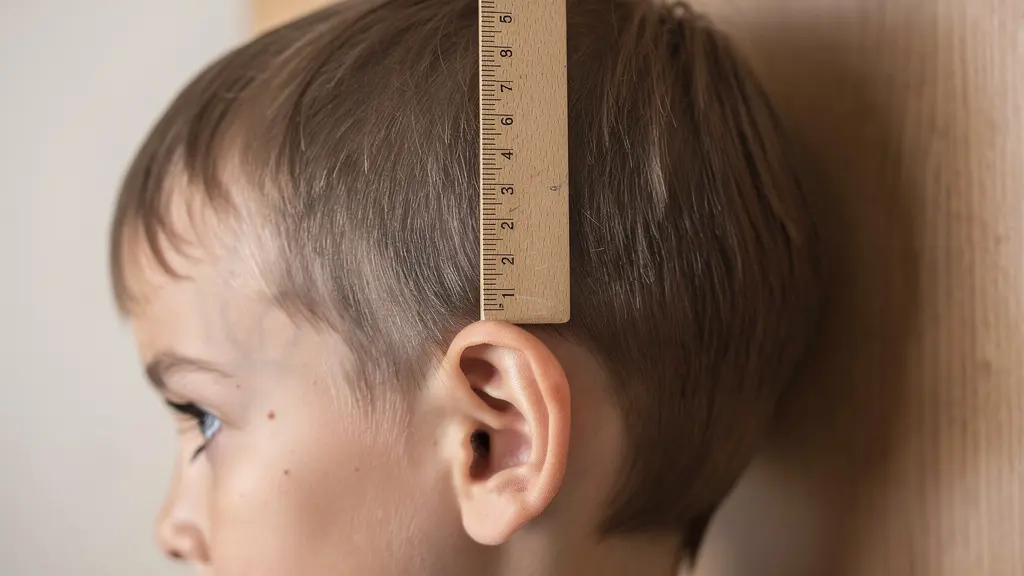
This attention to detail helps control for known discrepancies. For instance, children are measured lying down (recumbent length) until age two, and standing thereafter. It’s important to know that standing height measures about 0.8 cm less than recumbent length, which can create an artificial percentile drop at the two-year mark if not accounted for. By using a consistent method at home, you generate cleaner data, allowing the true growth trend to emerge. As the American Academy of Pediatrics states, what truly matters is the rate of growth, not a single number.
Curve Consistency or Height Value: Which Indicates True Health?
Parents often fixate on the percentile number itself, believing a higher number is “better.” However, in pediatrics, the absolute number is far less important than the pattern of the curve. True health is indicated by curve consistency. A child who has always tracked along the 25th percentile and continues to do so is demonstrating a perfectly healthy and predictable growth pattern for their genetic makeup. Their body is following its unique, pre-programmed trajectory.
Conversely, a sharp deviation from a previously established curve is a “statistical signal” that warrants attention. A drop that crosses two or more major percentile lines (e.g., from the 75th to below the 25th) over a period of time is a clinical red flag. This pattern suggests that something is interfering with the child’s ability to follow their genetic potential. This is far more concerning than a child who is consistently on a lower percentile. Disproportionate growth, where height and weight percentiles are widely separated (e.g., 40th percentile for height but 85th for weight), is another pattern that requires evaluation.
The table below, based on clinical guidelines, helps distinguish between a healthy pattern and one that may signal a concern, as outlined by pediatric health experts.
| Growth Pattern | Potential Concern | Example |
|---|---|---|
| Consistent percentile tracking | No concern – healthy pattern | Child stays on 25th percentile from age 2-10 |
| Crossing 2+ major percentile lines | May indicate growth problem | Drop from 60th to 30th percentile |
| Height-weight mismatch | Disproportionate growth | 40th percentile height, 85th percentile weight |
To move beyond simple observation, you can calculate your child’s “height velocity”—their rate of growth in centimeters per year. This is the metric specialists use to assess growth quality.
Your Action Plan: How to Calculate Height Velocity
- Measure precisely: Measure your child’s height at the same time of day (morning is best), using a consistent technique as described earlier. Record the exact date and measurement.
- Wait and repeat: Wait at least 6 months (12 is better for accuracy) and measure again using the identical technique.
- Calculate the rate: Use the formula: (Height 2 in cm – Height 1 in cm) ÷ (Time between measurements in years) = cm/year.
- Compare to norms: A healthy school-age child typically grows 5-7 cm per year. Growth velocity is a key indicator of underlying health.
- Identify potential flags: A growth velocity that drops below 4 cm per year for a sustained period outside of the normal fluctuations of puberty is a reason to consult your pediatrician.
The Comparison Mistake: Why Siblings Can Have Totally Different Curves?
It’s natural for parents to use their first child as a benchmark for the second. If the older sibling was always at the 75th percentile and the younger one is at the 20th, it’s easy to assume something is wrong. This is a common but profound misconception rooted in a misunderstanding of genetics. While siblings share about 50% of their DNA, they receive a unique and random combination of genes from each parent, including the hundreds of genes that influence height.
As Medicover Genetics notes, “Different combinations of variants can cause siblings to be of different heights.” One child might inherit the specific combination of “tall” genes from both parents, while the other inherits the “shorter” combination. Both are perfectly healthy and normal expressions of the family’s genetic potential. Comparing them is like comparing two different lottery tickets drawn from the same pool of numbers—the outcomes can be wildly different.
Scientific research quantifies this genetic influence. For example, a landmark population-based study published in Nature found that height heritability values are extremely high, confirming that the genetic shuffle during conception is the primary driver of these differences. Each child establishes their own unique growth curve based on their specific genetic inheritance. The only valid comparison is of a child to their *own* previous measurements, not to a sibling, a cousin, or a classmate. Each child’s chart tells its own story.
What Do Bathroom Habits Tell You About Growth Stalling?
When a child’s growth curve flattens or drops unexpectedly, clinicians often look beyond simple nutrition and toward the digestive system. A child can be eating a perfectly healthy diet, but if their body cannot properly absorb the nutrients, growth will falter. Therefore, changes in bathroom habits can be a critical, albeit subtle, clue to an underlying issue of malabsorption.
Chronic diarrhea, foul-smelling or pale stools, bloating, and abdominal pain are not just signs of a temporary stomach bug; they can indicate a more significant problem. These symptoms suggest that food is passing through the digestive tract without its vital nutrients—proteins, fats, vitamins, and minerals—being effectively transferred into the bloodstream to fuel growth. The engine is getting fuel, but the fuel lines are clogged.

For example, a noticeable stall in growth is one of the classic, and sometimes only, signs of Celiac disease in children. As experts at Medicover Genetics point out, a mismatch between a child’s height and their genetic prediction could be a clue to test for hidden conditions like Celiac disease or hormone deficiencies. Other conditions, such as Crohn’s disease or even severe food intolerances, can also manifest as poor growth long before more obvious symptoms appear. Paying attention to these digestive signals provides invaluable information, connecting what happens in the bathroom to what appears on the growth chart.
Why She Is Suddenly Eating More Than Her Father?
A sudden, voracious appetite in a pre-teen girl can be startling for parents. She might be out-eating everyone else at the dinner table, leading to concerns about overeating. However, this is often a completely normal and necessary biological event: the onset of the pubertal growth spurt. This period is the second-fastest phase of growth in a person’s life, surpassed only by infancy. Her body is working overtime, building bone, muscle, and tissue at an accelerated rate, and it requires a massive amount of energy and raw materials to do so.
This intense metabolic demand translates directly into a ravenous hunger. Her body is sending powerful signals to the brain demanding more fuel. To support this crucial developmental stage, the focus should be on providing nutrient-dense foods rather than restricting quantities. This is a time for lean proteins, complex carbohydrates, and calcium-rich foods, not for commenting on portion sizes or comparing her intake to others, which can inadvertently lay the groundwork for unhealthy relationships with food.
Here are key strategies to support a healthy appetite during this phase:
- Normalize the increased appetite as a positive sign of healthy development.
- Provide nutrient-dense meals with adequate protein, calcium, and iron.
- Ensure she is getting 9-11 hours of sleep per night to optimize growth hormone release.
- Avoid commenting on portion sizes or comparing her eating habits to anyone else’s.
- Focus family conversations on the energy and strength food provides, not on weight or appearance.
- Continue to monitor for consistent progression along her established growth curve as the primary indicator of health.
Percentile or Curve: Which Matters More for Tracking Health?
If there is one concept to take away from this guide, it is this: the percentile is a ranking, but the curve is a narrative. A percentile simply tells you where your child’s size ranks compared to a reference population of the same age and sex. A 40th percentile ranking means that 40% of children are smaller and 60% are larger. It is not a grade or a measure of health. The shape of the growth curve over time is infinitely more meaningful.
As Dr. Khan of OSF HealthCare explains, this is the most critical point for parents to understand:
There is no ideal percentile. Healthy children come in all shapes and sizes, and a baby who is in the 5th percentile can be just as healthy as a baby who is in the 95th percentile.
– Dr. Khan, OSF HealthCare
The choice of which chart to use also matters, as different charts are designed for different age groups based on distinct reference populations. This distinction is crucial for accurate interpretation and is a key part of a specialist’s toolkit.
The CDC provides clear guidelines for pediatricians on which charts to use at which age to ensure the data is being interpreted against the correct reference standard. The table below summarizes these recommendations.
| Age Range | Recommended Chart | Key Difference |
|---|---|---|
| Birth to 24 months | WHO Growth Standards | Based on optimal growth patterns of breastfed infants |
| 2 to 20 years | CDC Growth Charts | Reference data from diverse US population |
| Transition at age 2 | Switch from WHO to CDC | May cause artificial percentile shift due to methodology |
Ultimately, the goal is to confirm that a child is following their own unique, genetically determined curve. Whether that curve is the 10th, 50th, or 95th percentile is irrelevant, as long as the trajectory is consistent and the growth velocity is within a healthy range for their age.
Key Takeaways
- Genetics Define Potential: A child’s height is primarily determined by their genetic blueprint; nutrition helps them achieve this potential but cannot change it.
- The Curve is King: The shape and consistency of the growth curve over time is a far more reliable indicator of health than any single percentile number.
- Velocity is the Vital Sign: Tracking the rate of growth (height velocity) is the most accurate way to assess whether a child’s development is on a healthy track.
Understanding Metabolic Needs During Early Puberty Signs in Girls
The onset of puberty is not an event but a process, driven by a complex symphony of hormones. For girls, early signs like breast bud development signal a profound shift in their body’s metabolic state. This phase is characterized by an acceleration in growth velocity, orchestrated by a cascade of hormonal signals. Understanding these underlying mechanisms is key to supporting her through this transformative period.
Hormones are the essential regulators. Thyroid hormones, human growth hormone (HGH), and sex hormones like estrogen all surge to orchestrate this rapid development. Any abnormality in these hormone levels could alter growth, and as such, puberty is a critical window for observation. It is during this time that the body’s demand for energy and nutrients is at a peak, second only to infancy. This is why sleep becomes extraordinarily important.
The connection between sleep and growth is not a myth; it is a core principle of endocrinology. As endocrinology research confirms, most HGH is released during the deep stages of sleep. Inadequate or poor-quality sleep can directly suppress HGH release, effectively throttling the growth engine just when it needs to be running at full capacity. Therefore, ensuring a consistent sleep schedule of 9-11 hours per night is one of the most effective non-nutritional interventions parents can make to support healthy pubertal growth.
Use this framework of focusing on trends, not numbers, to partner with your pediatrician. By tracking growth velocity and understanding the signs of healthy development, you can transform anxiety into informed confidence and become the most effective advocate for your child’s well-being.