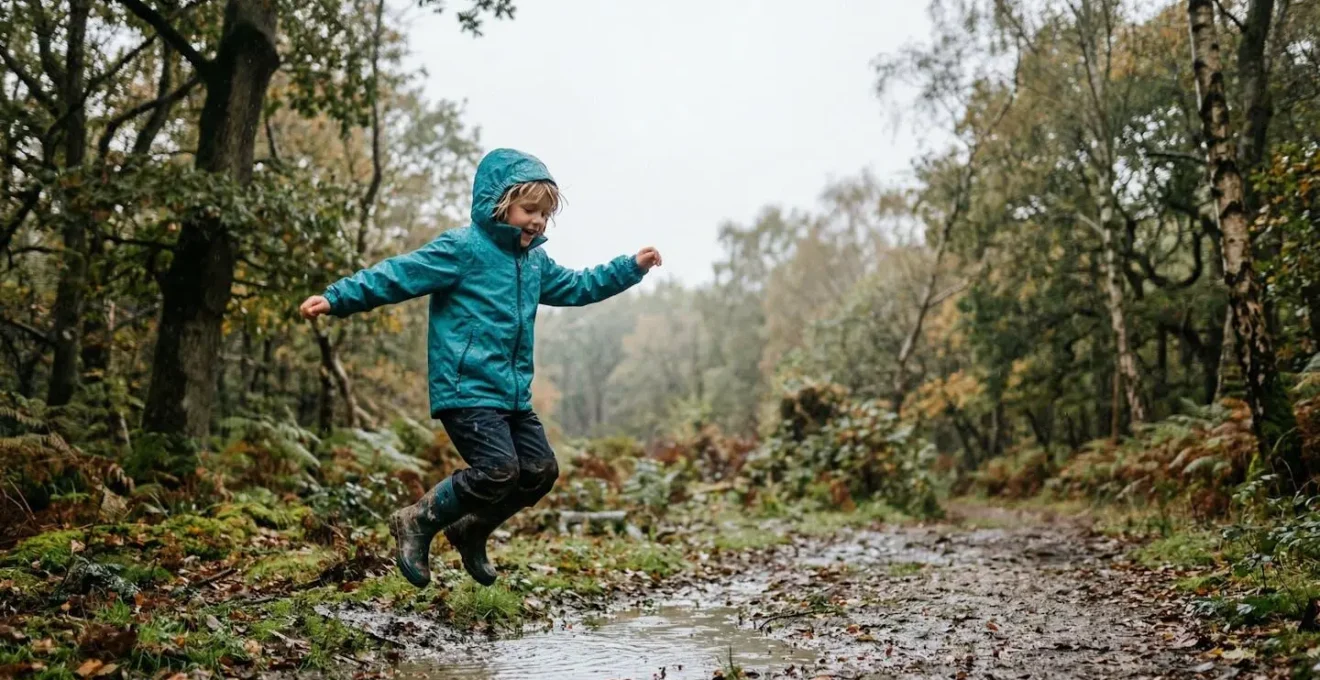
The secret to keeping kids dry and comfortable isn’t just a waterproof jacket, but a complete thermal regulation system that balances protection with breathability.
- A non-breathable jacket traps sweat, making a child cold and clammy even if rain doesn’t get in.
- The right mid-layer (like wool or fleece) manages moisture from the inside, while the outer shell blocks it from the outside.
- Proper maintenance of the DWR coating is non-negotiable for long-term performance.
Recommendation: Shift your focus from buying a single product to building a complete gear system that includes the right layers, a care routine, and habits your child can follow.
The scene is all too familiar for parents: you send your child to school in a brand-new raincoat, only for them to return from recess either soaked from a leak or, worse, clammy and cold from their own sweat. The promise of “100% waterproof” often fails in the dynamic reality of a playground. We’re told to look for taped seams and good hoods, and while those features are important, they are only a small part of a much larger equation. The common approach of simply buying a better, more expensive jacket often leads to the same frustrating result.
This cycle of disappointment happens because we’re focused on the wrong problem. The challenge isn’t just blocking external water; it’s about managing internal moisture and heat. The most effective strategy isn’t a single piece of gear, but a complete technical system. This system involves understanding the physics of fabric breathability, mastering the science of layering, implementing a non-negotiable maintenance routine, and even building the behavioral habits that ensure the gear is used correctly. It’s a shift from thinking like a consumer to thinking like an expedition leader for your child’s daily adventures.
But what if the key wasn’t the jacket itself, but the synergy between the jacket, what’s worn underneath, and how it’s cared for? This guide moves beyond the marketing claims to give you a technical and practical framework. We will deconstruct the science of why cheap raincoats fail, engineer the perfect layering system for warmth without overheating, and establish the simple habits that guarantee your child’s gear is always ready for the next downpour. It’s time to equip your child not just with a jacket, but with true outdoor resilience.
This article breaks down the essential components for building a reliable waterproof system for your child. By understanding each element, from the fabric’s science to daily habits, you can create a strategy that truly works.
Summary: The Ultimate Guide to Kids’ Waterproof Jackets
- Why plastic raincoats make kids sweat and freeze?
- Fleece or Wool: What goes under the raincoat for warmth?
- at what age does a one-piece suit become impractical for school?
- The laundry mistake that destroys water repellency immediately
- How to teach your child to hang it up so it’s dry for the next recess?
- How to get them to wear a coat without ruining their “look”?
- Sun or Supplements: How to maintain Vitamin D levels in January?
- Outdoor Adventures: Safe Risk-Taking in Nature for Confidence
Why Plastic Raincoats Make Kids Sweat and Freeze?
The fundamental flaw of a basic plastic or PVC raincoat lies in a paradox of protection: it’s too good at being waterproof. These materials form an impenetrable barrier, effectively blocking rain from getting in. However, they also create a perfect seal that traps everything inside. An active child running around at recess generates a significant amount of heat and water vapor (sweat). In a non-breathable jacket, that vapor has nowhere to go. It condenses on the inside of the fabric, soaking the child’s inner layers. This leads to the “sweat and freeze” cycle—the child is wet, their body’s insulation is compromised, and they quickly become cold, even if not a single drop of rain touched them.
This is where the engineering of technical fabrics comes into play. High-performance waterproof jackets use a membrane with microscopic pores. These pores are too small for external liquid water droplets to pass through, but large enough for internal water vapor molecules to escape. This process is called moisture-vapor transmission, or “breathability.” It’s the critical feature that allows a child to stay dry from both the outside and the inside. As gear testing experts often note, the more waterproof a jacket is, the less breathable it tends to be, so finding the right balance for an active child is key.
As you can see in the detailed view of technical fabric, the goal is to repel liquid while allowing vapor to pass through. This sophisticated material science is what separates a functional piece of outdoor gear from a simple plastic sheet. The Treeline Review testing team puts it bluntly when describing non-breathable options:
It’s like wrapping your kid in a plastic bag (but it’s great for cold climates or heavy rain where breathability matters less than staying bone dry).
– Treeline Review testing team, Best Rain Gear for Kids of 2026 (Tested)
For the dynamic environment of a school playground, where a child is running one minute and standing still the next, a breathable jacket is not a luxury—it is the core of an effective thermal regulation system. Without it, you are simply trading one source of moisture for another.
Fleece or Wool: What Goes Under the Raincoat for Warmth?
A breathable shell jacket is only half the battle. The layers underneath—the mid-layer and base layer—are the engine of the thermal regulation system. Their mission is to manage the moisture your child produces, moving it away from the skin and towards the outer shell where it can escape. The material choice here is critical, and two primary contenders emerge for the mid-layer: fleece and wool.
Fleece (typically polyester) is a workhorse. It is hydrophobic, meaning it repels and does not absorb water. It provides excellent warmth for its weight, dries quickly, and is highly durable and affordable. It’s a fantastic, reliable choice for active use. Merino wool, on the other hand, is a natural performance fiber with almost magical properties. It can absorb up to 30% of its weight in moisture without feeling wet to the touch, actively pulling vapor away from the skin. Crucially, Merino Wool is insulating when it is cold and cooling when it is hot, making it an incredible temperature regulator for the stop-and-go activity of recess.
The most important rule, however, is not what to choose, but what to avoid at all costs: cotton. Cotton is hydrophilic; it loves water. It absorbs sweat like a sponge and loses all of its insulating properties when wet, actively pulling heat away from the body. A child wearing a cotton hoodie under a raincoat is set up for failure. As the gear experts at Run Wild My Child state:
Cotton is a poor insulator of body heat and performs horribly if it gets wet (from snow or sweat), so it likely didn’t keep you all that warm for long.
– Run Wild My Child gear experts, The Best Merino Wool Base Layers for Kids and Toddlers
Whether you choose the quick-drying reliability of fleece or the superior moisture management of merino wool, the principle remains the same. The mid-layer must be a synthetic or wool-based fiber designed to work in concert with the breathable outer shell. This synergy is what creates a dry, warm, and comfortable microclimate for your child, no matter how hard they play.
At What Age Does a One-Piece Suit Become Impractical for School?
One-piece rain or snow suits are a brilliant invention for toddlers and preschoolers. They offer gap-free, total-body protection that is unmatched for keeping the youngest adventurers warm and dry. There are no jackets riding up or pants slipping down, creating a weatherproof cocoon perfect for stumbling through puddles or sitting in damp sandboxes. However, the moment a child enters the more structured environment of elementary school, typically around ages 5 or 6, the practicality of the one-piece suit plummets.
The primary driver of this shift is the need for autonomy, especially concerning bathroom breaks. A teacher managing a classroom of 20+ children cannot spend several minutes helping each one in and out of a full-body suit. Children need to be able to manage their own clothing quickly and efficiently. A one-piece suit, with its complex zippers and the need to pull it down to the ankles, presents a significant and often stressful challenge in a timed bathroom break. This can lead to accidents or a child avoiding using the restroom altogether.
Furthermore, school life involves constant transitions between indoor and outdoor environments. A two-piece system (jacket and pants) offers far more versatility. A child can easily remove their jacket upon entering the classroom while keeping their rain pants on if their bottom layers are still slightly damp, ensuring they remain comfortable at their desk. A one-piece suit is an all-or-nothing proposition; it’s either fully on and too hot for indoors, or fully off. This lack of adaptability makes it an impractical choice for the dynamic school day. As children grow, they also develop a stronger sense of personal style and may begin to feel self-conscious in a “babyish” one-piece suit, making the transition to a two-piece system a social as well as a practical necessity.
The Laundry Mistake That Destroys Water Repellency Immediately
You’ve invested in a high-quality, breathable, waterproof jacket. For the first few weeks, it’s perfect—water beads up and rolls right off. Then, after the first wash, it starts to “wet out.” The fabric becomes saturated, darkens with moisture, and feels cold and heavy, even if no water is leaking through. The breathability is gone. This common failure is almost always due to a simple, catastrophic laundry mistake: using conventional detergents and, especially, fabric softener.
The magic that makes water bead up is a chemical treatment called Durable Water Repellent (DWR). This is a coating applied to the exterior of the fabric. It’s the jacket’s first line of defense. Regular laundry detergents contain surfactants and wetting agents designed to help water penetrate fabric to clean it—the exact opposite of what you want for a rain jacket. Worse still, fabric softeners leave behind a hydrophilic (water-attracting) residue that completely clogs the DWR coating and the microscopic pores of the breathable membrane. As technical fabric care experts warn, you should “Never use regular laundry detergent, fabric softener, or bleach. These destroy DWR coating permanently”.
Maintaining the DWR integrity is a non-negotiable part of owning technical gear. This means washing the jacket only when necessary (when it’s visibly dirty or losing performance) and using a specialized detergent formulated for technical outerwear. After washing, the DWR often needs to be “reactivated” with heat, typically by tumbling in a dryer on a low or medium setting for about 20 minutes (always check the garment’s care label first). Over time, the factory DWR will wear off from abrasion and washing. At this point, you must restore it using a spray-on or wash-in DWR treatment product.
This maintenance isn’t a chore; it’s part of the engineering of the system. A clean jacket with a functioning DWR treatment will breathe better and keep your child drier and more comfortable. Neglecting it is like not changing the oil in a high-performance engine—eventually, the system will fail.
Your Action Plan: Restoring a Waterproof Jacket
- Clean the Machine: Run an empty wash cycle with hot water to clear out any residual conventional detergent or fabric softener from your washing machine.
- Prepare the Garment: Empty all pockets and close all zippers, flaps, and Velcro tabs to prevent snagging during the wash cycle.
- Wash with a Tech Wash: Use a specialized cleaner designed for technical waterproof fabrics. Follow the dosage instructions on both the garment’s care label and the tech wash bottle.
- Reactivate with Heat: Tumble dry the jacket on a low to medium heat setting for 20 minutes. This heat helps to reactivate the existing DWR coating. If the care label prohibits drying, hang to dry and use an iron on a low, no-steam setting with a towel between the iron and jacket.
- Test and Reapply: Sprinkle a few drops of water on the jacket. If they bead up and roll off, you’re done. If the fabric darkens and absorbs the water, it’s time to reapply a DWR treatment (spray-on or wash-in) following the product’s instructions.
How to Teach Your Child to Hang It Up So It’s Dry for the Next Recess?
The most advanced waterproof-breathable jacket in the world is useless if it’s still damp from morning recess when the bell rings for the afternoon. A jacket crumpled in a ball on the floor of a cubby or stuffed into a backpack will not dry. Teaching a child to properly hang up their gear isn’t just about tidiness; it’s a critical step in ensuring the entire performance system functions correctly. The key to building this habit isn’t nagging, but deliberate environmental design, a concept often referred to as behavioral architecture.
You must make the correct action the easiest action. If a child has to struggle to reach a high hook or if there’s no designated spot at all, the jacket will inevitably end up on the floor. The solution is simple but profound, rooted in principles of child development that prioritize independence. As described by parenting experts applying Montessori principles to daily life:
Install a dedicated hook at the child’s height. If they can’t reach it, you can’t build the habit.
– Montessori principles applied to outdoor gear, Environmental preparation for child independence
This single change transforms the dynamic. By providing a low, accessible, and clearly designated hook for their rain gear—both at home and by advocating for it in the classroom—you empower the child. It becomes *their* hook and *their* responsibility. You can frame it as part of their “expedition gear” protocol: “Adventurers always take care of their equipment so it’s ready for the next mission.” Explain *why* it needs to hang: “We hang it up so the air can help it breathe and be dry for later.” This gives them a sense of purpose and ownership over the process. Making the jacket easy to hang, and making the reason for doing so clear and compelling, is how you build a habit that lasts a lifetime.
How to Get Them to Wear a Coat Without Ruining Their “Look”?
For many school-aged children, social acceptance and personal identity are paramount. A jacket, no matter how technically superior, can be rejected outright if it clashes with their carefully curated “look” or makes them stand out in a way they dislike. This isn’t defiance; it’s a legitimate expression of their developing sense of self. Winning this battle requires shifting from a top-down mandate (“You will wear this coat!”) to a strategy of psychological buy-in and collaborative negotiation.
The most effective tactic is to provide choice within approved parameters. Instead of buying a single jacket you think is best, pre-select two or three options that all meet your technical requirements (breathable, waterproof, appropriate layers). Then, let your child make the final decision. This simple act of giving them agency transforms the jacket from something forced upon them into something they chose. They are now invested in it because it reflects their taste.
Another powerful strategy is to de-emphasize the jacket and focus on the accessories. Allow them to express their style through a cool hat, unique gloves, or a patterned neck gaiter. These items are often less expensive and can be swapped out easily, but they can be enough to make the entire “expedition kit” feel like their own. Finally, reframe the conversation. Instead of calling it a “coat,” use more adventurous language. It’s “expedition gear,” a “protective shell,” or their “adventure armor.” This connects the technical gear to the fun of playing outside, making it a tool for empowerment rather than a restriction on their style. By respecting their need for identity and involving them in the process, you turn a potential power struggle into a shared mission.
Sun or Supplements: How to Maintain Vitamin D Levels in January?
An effective rain gear system does more than just keep a child dry; it enables them to get outside and play, even on cold, grey winter days. This outdoor time is crucial not only for physical activity and mental well-being but also for a vital biological process: the production of Vitamin D. Known as the “sunshine vitamin,” Vitamin D is synthesized by our skin in response to sunlight and is essential for bone health and immune function. During the shorter, darker days of winter, many children’s levels can dip.
The solution, however, may be simpler than you think. While supplements are an option and should be discussed with a pediatrician, the power of even brief sun exposure should not be underestimated. The goal isn’t to spend hours outside on a frigid day, but to take advantage of the brightest moments. A properly dressed child who is warm and dry is far more likely to want to spend that crucial time outdoors during recess or after school. According to Dr. Courtney Smith, a pediatrician with Christus Children’s, it doesn’t take much:
Really it only takes about 10 to 15 minutes of direct sunlight in peak hours to get the vitamin D that your body needs each day.
– Dr. Courtney Smith, Pediatrician with Christus Children’s
This underscores the true value of your investment in a proper gear system. A warm, dry child is a child who plays outside. A child who plays outside gets the sun exposure needed for healthy development. The technical jacket and layers are, therefore, a direct enabler of your child’s physiological health during the winter months. By ensuring they are comfortable, you are giving them the opportunity to thrive in an environment where others might be stuck indoors.
Key Takeaways
- Breathability is Paramount: A jacket that traps sweat is a failed system. Prioritize a breathable membrane over absolute waterproofness for active kids.
- No Cotton, Ever: The layering system under the shell must be made of wool or synthetic fibers (like fleece) to effectively manage moisture. Cotton is the enemy of warmth.
- Maintenance is Mandatory: The DWR coating is the jacket’s first line of defense. Protect it by using specialized tech washes and avoiding fabric softener at all costs.
Outdoor Adventures: Safe Risk-Taking in Nature for Confidence
Ultimately, the purpose of a technical gear system extends far beyond the simple goal of staying dry. Its true value lies in what it enables: freedom, exploration, and the development of confidence through safe, manageable risks. Nature is the world’s best laboratory for learning, but a child who is cold, wet, and miserable cannot engage with it. They will be focused on their own discomfort, hesitant to explore, and eager to go back inside.
A child who is confident in their gear, however, is a child unleashed. They are free to operate without fear of the physical consequences of their curiosity. This psychological security is the foundation for healthy risk-taking. As the philosophy of outdoor education suggests, a well-equipped child is an empowered child:
A child who knows they won’t get cold and soaked is more willing to take the safe risk of splashing in a big puddle, sliding down a muddy slope, or sitting on a damp log to investigate a bug.
– Outdoor education philosophy, Best Rain Gear for Kids of 2026
This is the ultimate payoff for your investment of time and resources into building a proper system. The breathable jacket, the wicking mid-layer, the well-maintained DWR, and the habit of hanging it to dry—all these technical details culminate in a single, powerful outcome: a resilient, confident child who sees a rainy day not as an obstacle, but as an invitation to adventure.
By shifting your perspective from buying a product to engineering a system, you give your child the tools they need to explore their world with courage and joy, no matter the weather. Your mission is to build that system now, ensuring every recess is an opportunity for growth.