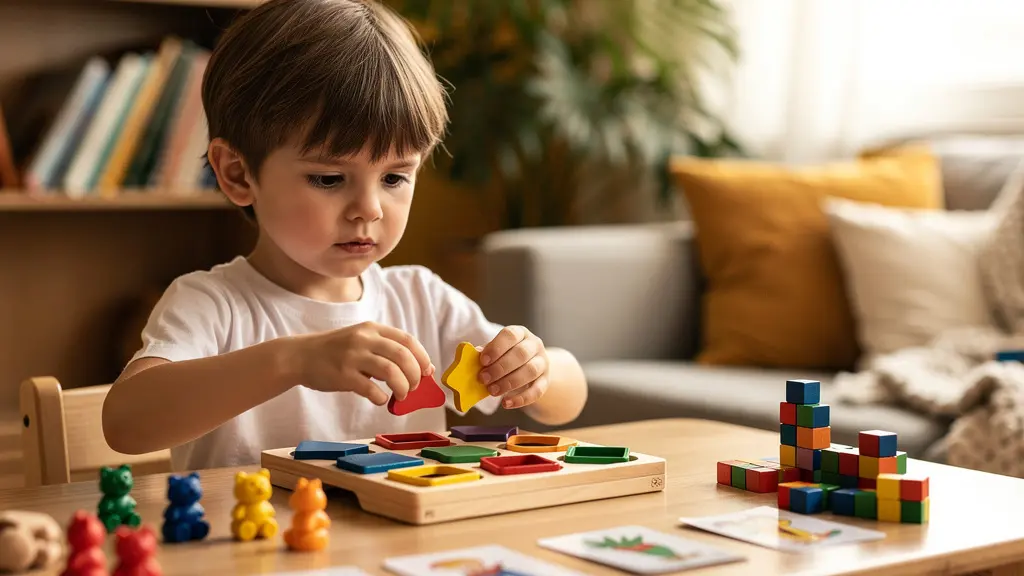
The most reliable indicator of kindergarten readiness isn’t a child’s ability to count to 20, but the strength of their underlying ‘cognitive engine’—the core skills of memory, attention, and flexible thinking.
- Everyday routines like sorting laundry or cooking are powerful opportunities to build these foundational skills without pressure.
- Active, physical play is scientifically proven to build stronger neural pathways for learning than passive screen time.
Recommendation: Shift your focus from rote memorization to nurturing your child’s natural curiosity and problem-solving abilities through intentional, playful interactions.
As a parent of a preschooler, the term “kindergarten readiness” can feel like a high-stakes exam. You see checklists everywhere focused on academic benchmarks: Can they recite the alphabet? Can they count to 20? Can they write their name? While these are certainly useful skills, this narrow focus often creates unnecessary anxiety and misses the bigger picture of what truly prepares a child for a lifetime of learning. The pressure to drill letters and numbers can overshadow the development of something far more critical: the cognitive engine that powers all future learning.
This engine is comprised of core executive functions, primarily working memory (holding and using information), attention control (focusing and shifting attention), and cognitive flexibility (thinking about things in new ways). A child with a strong cognitive engine can follow multi-step directions, adapt when a game changes, and figure out how to build a taller tower after it falls. These are the skills that matter most. An influential path analysis on pre-kindergarten skills found that these general cognitive abilities were unique predictors of later reading and math achievement, even more so than early mastery of specific academic content.
So, what if we reframed our goal? Instead of asking, “Does my child know enough?” we could ask, “How can I help build their brain’s capacity to learn?” This guide is designed to do just that. As a school readiness assessor, I want to reassure you that preparing your child is not about flashcards and drills. It’s about transforming everyday moments into powerful, brain-building opportunities. We will explore what’s normal for your child’s development, how to use simple household items to boost memory, and why active play is non-negotiable for building those crucial neural pathways.
This article provides a comprehensive look into the cognitive skills that truly form the foundation for school success. We will break down each key area, offering practical advice and reassuring insights to help you guide your child’s development with confidence and joy, leaving the stress of benchmarks behind.
Summary: A Parent’s Guide to the Foundational Cognitive Skills for School Success
- Memory and Attention: What is normal for a 4-year-old boy?
- How to boost memory retention using only household items?
- Passive TV vs. Active Play: Which truly builds neural pathways?
- The error of prioritizing counting over problem-solving skills
- How to adapt cognitive games for kids with 5-minute attention spans?
- Fact or Opinion: How to explain the difference to a 6-year-old?
- Why running around aids memory retention more than sitting still?
- Why Group Learning Is Essential for Only Children Before School Starts?
Memory and Attention: What Is Normal for a 4-Year-Old Boy?
One of the most common worries I hear from parents is, “My child can’t sit still! Is his attention span normal?” It’s crucial to understand that a 4-year-old’s brain is not designed for long, seated tasks. Their attention is naturally energetic and fleeting, which is a feature, not a bug. At this age, a child can typically sustain focus on a preferred activity for about 5 to 10 minutes. It’s also normal for their attention to be captured by a new sound or sight, causing them to flit from one thing to the next. This is how they explore and learn about their vast, new world.
Similarly, their working memory is still developing. A 4-year-old can usually follow two-step, related instructions, like “Please take off your shoes and put them in the basket.” However, asking them to perform two unrelated tasks with a delay in between might be too much. Remembering and retelling a simple story with two or three key events is a huge accomplishment and a strong indicator of developing memory skills. The key is to have realistic expectations and to see their cognitive development as a gradual process, not a race.
Instead of worrying, you can become a curious observer of your child’s developing skills. By understanding the typical milestones, you can better support their growth in a way that feels natural and encouraging. The following checklist provides a simple framework for you to audit and understand your child’s current attention abilities in a positive, constructive way.
Your Action Plan: Auditing Your Child’s Attention Skills
- Identify focus moments: List all daily activities where your child shows natural concentration (e.g., building with blocks, listening to a story, drawing).
- Gather observations: For one week, gently note the duration of sustained attention for these activities (e.g., “focused on LEGOs for 7 minutes today”).
- Check against milestones: Compare your observations to typical benchmarks, like the ability to sustain attention for 5-10 minutes on a self-chosen, enjoyable task.
- Assess engagement vs. distraction: Note what specifically holds their attention (e.g., hands-on elements, colorful parts) versus what tends to break it (e.g., background TV noise, interruptions).
- Plan for practice: Identify one activity where you can try to gently extend focus time by just one minute, perhaps by using a fun visual timer or adding a new, exciting element.
How to Boost Memory Retention Using Only Household Items?
Building your child’s cognitive engine doesn’t require expensive “educational” toys or complicated programs. Your home is already a rich learning environment. The secret is to approach everyday routines with a sense of play and intention. By reframing chores and daily activities as games, you can seamlessly integrate memory-building practice into your child’s day without adding any pressure.
Think about meal preparation. As you make lunch, you can use cookie cutters to create sandwiches in different shapes. This isn’t just fun; it’s a powerful lesson in shape recognition and spatial awareness. Ask your child, “Can you find the star-shaped piece?” or “Let’s put the circle on the plate first.” This simple act engages their working memory as they hold the shape’s name in their mind while visually scanning for it. Sorting laundry becomes a game of color and pattern recognition, and setting the table is a lesson in one-to-one correspondence and sequencing.
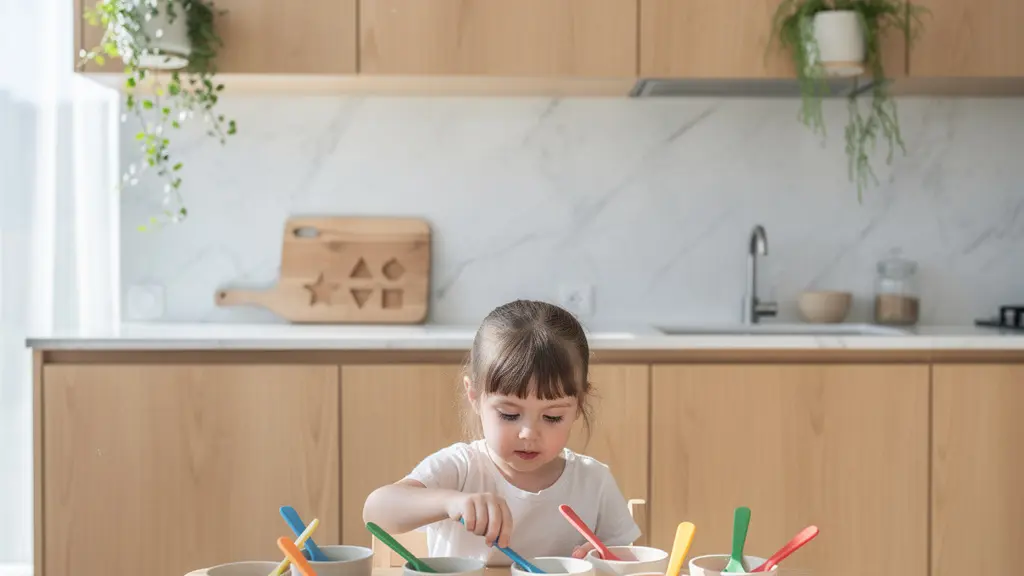
As the image above illustrates, the kitchen can be a fantastic laboratory for learning. These interactions are effective because they are contextual and hands-on. The learning is tied to a real-world activity, which makes it more meaningful and memorable than abstract flashcards. Here are a few simple ideas to get you started:
- Laundry Sorting: Turn sorting clothes into a game. Ask your child to make a pile of all the red items or to match up pairs of socks, which strengthens visual discrimination and categorization skills.
- Cooking Together: While cooking, have them count the carrots you’re adding to a stew or sort the plastic utensils by type (forks, spoons, knives). This builds number sense and classification abilities.
- ‘I Spy’ at Bedtime: Play a simple game of ‘I Spy’ using objects in their room. “I spy with my little eye, something that is blue.” This helps with color recognition and attention.
Passive TV vs. Active Play: Which Truly Builds Neural Pathways?
In our digital world, it’s tempting to rely on screens to entertain or “educate” our children. While some interactive apps have their place, it’s crucial to understand the profound difference between passive screen time and active, physical play. When a child is watching a show, their brain is mostly receiving information. The experience is linear and requires little cognitive effort. In contrast, active play is a full-body, full-brain workout that forges critical neural pathways.
During active play, a child is not just moving their body; they are a scientist in a lab. When they build a tower of blocks, they are testing hypotheses about gravity and balance. When they figure out how to get the ball that rolled under the sofa, they are engaging in complex problem-solving and spatial reasoning. This type of self-directed, goal-oriented activity strengthens executive functions in a way that passive viewing simply cannot. It requires sustained attention, working memory to hold the goal in mind, and cognitive flexibility to adapt when things don’t go as planned.
A comparative analysis from education experts highlights the stark differences in cognitive impact. An overview of cognitive development from Eastern Connecticut State University provides a clear framework for understanding these distinctions, which can be summarized in the table below.
| Activity Type | Working Memory Impact | Attention Control | Problem Solving Skills |
|---|---|---|---|
| Active Physical Play | High improvement | Sustained focus development | Creative solution finding |
| Interactive Educational Apps | Moderate improvement | Task-specific focus | Guided problem solving |
| Passive TV Viewing | Minimal improvement | Fragmented attention | Limited engagement |
This isn’t about eliminating screens entirely but about understanding their role and prioritizing what truly builds a robust cognitive engine. Active play is the essential work of childhood, constructing the brain architecture needed for all future learning.
The Error of Prioritizing Counting Over Problem-Solving Skills
Many well-intentioned parents believe the primary goal of preschool education is to master rote skills like counting to 100 or reciting the alphabet. While these are useful data points for a child to know, they are merely the “paint job” on the cognitive engine. The real power lies in the engine itself: the ability to think, reason, and solve problems. An overemphasis on memorization can inadvertently teach children that there is only one right answer and that learning is a passive process of receiving facts.
True cognitive readiness is about flexible thinking. It’s the ability to see that four can be represented as 2+2, 3+1, or four individual objects. It’s about predicting what might happen next in a story, not just memorizing the character names. Problem-solving skills require a child to use their working memory, control their attention, and think flexibly to test solutions. These are the domain-general skills that transfer to every academic subject and social situation they will encounter in school and life. Long-term data confirms this; kindergarten readiness is a significant predictor of later academic success in both reading and math, and this readiness is defined by a broad set of cognitive and social-emotional skills, not just rote knowledge.
Research consistently highlights the predictive power of these core executive functions. A landmark study published in the journal Mind, Brain, and Education demonstrated that a child’s working memory and attention control skills before school entry were unique predictors of their kindergarten math and reading achievement. This highlights how crucial it is to nurture a child’s ability to think critically rather than just regurgitate information. Encouraging them to ask “why,” to experiment with different solutions, and to learn from their mistakes is far more valuable than drilling them on facts.
How to Adapt Cognitive Games for Kids with 5-Minute Attention Spans?
Knowing that a 4-year-old’s attention span is short is one thing; working with it is another. The key is not to force longer periods of focus but to design activities in “micro-doses.” Instead of setting up a complex, 30-minute craft, think in terms of linked 5-minute “game segments.” This approach respects their natural rhythm and keeps them engaged and successful, which in turn builds their confidence and willingness to try new things.
One of the most effective strategies is to focus on a single skill at a time. A game of sorting blocks by color is manageable. A game of sorting blocks by color AND size at the same time can be overwhelming and lead to frustration. Start simple. Another powerful tool is to provide an immediate and satisfying conclusion. A game that ends with a clear “Tada!” moment—like placing the last piece in a simple puzzle or dropping the last pom-pom into a container—gives a sense of accomplishment that fuels their desire to play again.
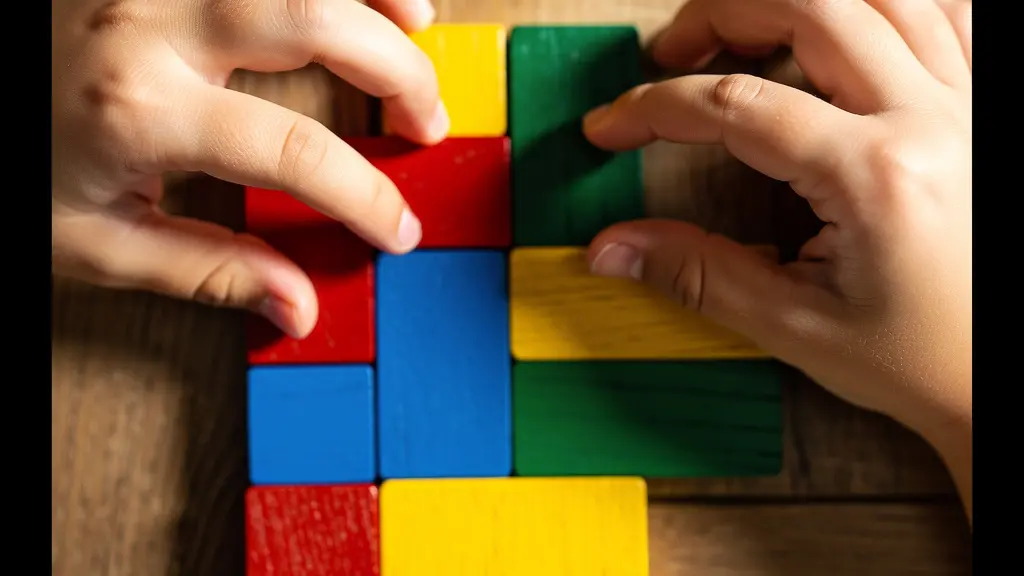
Using visual aids can also be incredibly helpful. A simple sand timer or a visual countdown on a phone can externalize the concept of time and turn a task into a fun, low-stakes challenge. “Let’s see if we can finish sorting these shapes before the sand runs out!” Below are some concrete strategies for designing these micro-games:
- Focus on Single Skills: Structure activities around one concept at a time, such as sorting only by color or only by size, never both at once.
- Create Themed Sequences: Link several short, 2-minute games together. For example, a “dinosaur sequence” could involve sorting dinosaur toys by color, then lining them up by size, then stomping them across the room.
- Use Visual Timers: Incorporate timer-based challenges with visual aids to make the duration of the activity clear and finite.
- Alternate Activities: Rotate between seated, focused activities and physical movement games every 5-10 minutes to cater to their need for motion.
Fact or Opinion: How to Explain the Difference to a 6-Year-Old?
As children approach school age, we can begin to introduce more sophisticated cognitive skills, like the ability to differentiate between a fact and an opinion. This skill is a cornerstone of critical thinking and media literacy, and its foundation can be laid in early childhood through simple, everyday conversations. As the experts at Education Corner note, this is a vital life skill. In their guide, they state:
The ability to identify what is a fact is a critical skill that everyone needs throughout their lifetimes. Well into adulthood, it’s important to be able to distinguish between fact and fiction.
– Education Corner, 5 Cognitive Skills That Are Important for Kindergarten
You don’t need formal lessons to teach this concept. The best way is to use concrete, relatable examples from your child’s daily life. A fact is something you can prove to be true or false. An opinion is what someone feels or thinks. The dinner table is a perfect place to start. “This is broccoli” is a fact; we can see and touch it. “Broccoli is yummy” is an opinion; someone else might think it’s yucky.
This simple distinction helps build cognitive flexibility, encouraging children to understand that people can have different feelings and thoughts about the same thing. It’s the first step toward developing empathy and perspective-taking. Use story time, walks in the park, and even cartoon characters to practice. Here are some easy ways to integrate this concept into your day:
- Use Food Preferences: “This is an apple” (fact) vs. “Apples are the best fruit” (opinion).
- Practice with Observable Traits: “The dog is brown” (fact) vs. “Brown dogs are the cutest” (opinion).
- Apply to Stories: “The story has a dragon in it” (fact) vs. “The dragon was scary” (opinion).
- Talk About Weather: “It is raining outside” (fact) vs. “I love rainy days” (opinion).
- Discuss Classroom Items: “There are 10 crayons in this box” (fact) vs. “Drawing is the most fun activity” (opinion).
Why Running Around Aids Memory Retention More Than Sitting Still?
It might seem counterintuitive, but the physical act of running, jumping, and climbing is deeply connected to a child’s ability to learn and remember. For decades, we’ve operated under the assumption that learning happens when we are sitting still and being quiet. However, modern neuroscience and developmental psychology show us that movement is a powerful catalyst for cognitive development. When a child is physically active, their brain gets a powerful boost.
Physical activity increases blood flow to the brain, delivering more oxygen and nutrients that are essential for optimal function. It also stimulates the release of key proteins like Brain-Derived Neurotrophic Factor (BDNF), which is sometimes called “Miracle-Gro” for the brain because it supports the survival of existing neurons and encourages the growth of new ones. This process is fundamental for learning and memory. This isn’t just theory; multiple literature reviews have found that regular physical activity is associated with improved cognitive function, better test scores, and more positive classroom behavior in children.
So, when your child is running around the yard or climbing at the playground, they aren’t just burning off energy. They are actively building a better brain. This is why recess and outdoor play are not optional extras in early childhood education; they are essential components. You can even combine movement with learning. For example, write letters or numbers with chalk on the driveway and have your child run to the “A” or jump on the “3.” This creates a multi-sensory learning experience that is far more effective and memorable than a worksheet because it engages their body and their brain simultaneously.
Key Takeaways
- Kindergarten readiness is built on a foundation of core cognitive skills (the ‘cognitive engine’), not just academic knowledge.
- Everyday activities and active, physical play are the most effective tools for strengthening a child’s working memory, attention, and problem-solving abilities.
- Supporting your child’s development should be a joyful, pressure-free process that focuses on nurturing their natural curiosity.
Why Group Learning Is Essential for Only Children Before School Starts?
While we’ve focused heavily on individual cognitive skills, it’s vital to remember that learning does not happen in a vacuum. The social context of a classroom is where these skills are truly put to the test. For all children, but especially for only children who may have less daily practice with peers, group learning experiences are essential for developing a different, but equally critical, set of readiness skills.
Group settings—whether in a preschool, a playgroup, or a library story time—are cognitive boot camps. In these environments, children have to negotiate, take turns, and see problems from another’s perspective. When two children want the same toy, they must engage in complex problem-solving and communication. When building a block tower together, they learn collaboration and shared goal-setting. These social interactions place heavy demands on their executive functions. They have to use their attention control to listen to a peer, their working memory to hold the rules of a game in mind, and their cognitive flexibility to adapt when a friend has a different idea.
This social component of readiness is not a “soft skill”—it is directly and powerfully linked to cognitive outcomes. In fact, one major study on behavioral school readiness found that a child’s prosocial behavior and classroom participation accounted for an 82% correlation with their cognitive readiness scores. This shows that the ability to function effectively in a group is a massive predictor of school success. These experiences help children learn through observation and practice crucial conflict-resolution skills in a low-stakes environment, preparing them for the dynamic social world of kindergarten. Here are some of the key benefits:
- Practice negotiation skills through shared toy scenarios.
- Develop perspective-taking by observing how peers attempt to solve problems.
- Build collaborative problem-solving skills through group building activities like constructing a fort.
- Learn vicariously by watching other children succeed and fail at tasks.
- Practice conflict resolution in safe, low-stakes play situations.
Ultimately, preparing your child for kindergarten is about trusting their natural development and providing a rich, supportive environment where their cognitive engine can thrive. Start today by looking at your daily routines not as a to-do list, but as a series of invitations to play, explore, and connect. That is the true path to readiness.