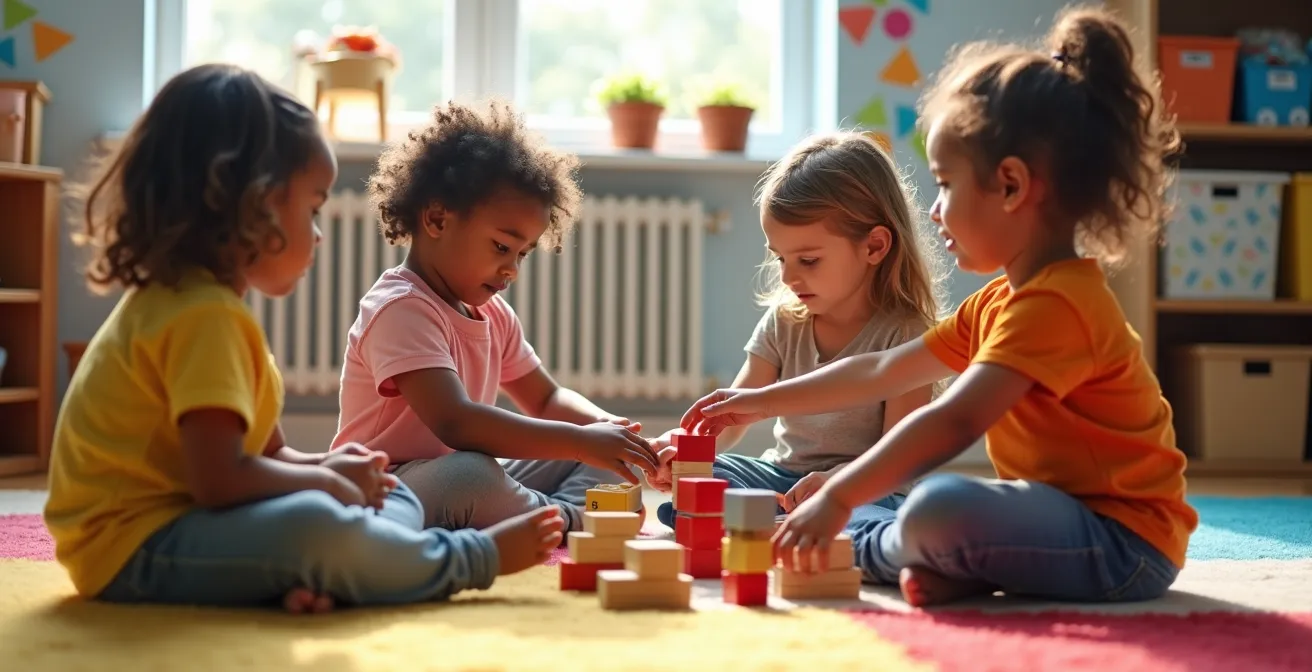
Contrary to popular belief, preparing an only child for school isn’t about random exposure to other kids; it’s about strategically building a ‘social toolkit’ that a quiet home environment simply cannot provide.
- Peer correction is a faster and more effective teacher of social norms than parental guidance.
- Specific activities develop distinct skills, like the difference between listening to a teacher versus a friend in a noisy park.
Recommendation: Shift your focus from simply arranging playdates to choosing structured group experiences that intentionally rehearse specific social skills like conflict resolution and sensory regulation.
As a parent of an only child, you’ve likely given them your undivided attention, creating a world of love, security, and rich conversation. Yet, as kindergarten looms, a quiet worry may start to surface. Will they be ready for the chaotic, bustling, and socially complex world of a classroom? The common advice is to simply “socialize them more” through playdates or by enrolling them in preschool. This advice, while well-intentioned, misses a crucial point. It treats socialization as a matter of exposure, like a vaccine, when it’s actually a matter of skill acquisition.
The true preparation for school isn’t just about being *around* other children. It’s about learning the intricate dance of group dynamics: how to navigate a disagreement over a toy without an adult instantly intervening, how to listen to a friend’s story amid the clamor of a playground, and how to recover from the sensory overwhelm of 20 other children talking at once. These are skills that are rarely practiced in the calm, adult-mediated environment of home. The key, therefore, is not just more social time, but more *strategic* social time.
But what if the very idea of group settings feels daunting for your child, who is accustomed to quiet and order? This guide moves beyond the platitudes. We will explore how to build your child’s social toolkit, piece by piece, by understanding the powerful mechanisms of peer learning. We’ll delve into how a peer’s feedback can be more potent than a parent’s, how to choose environments that empower rather than overwhelm, and what your role as a parent should be—and, more importantly, what it shouldn’t be. This is your strategic manual for transforming social anxiety into social competence, ensuring your child doesn’t just survive school, but thrives in it.
This article provides a detailed roadmap for navigating this journey. Below is a summary of the key strategies we will cover to help you build your child’s confidence and social skills before they take that big step into the classroom.
Summary: A Strategic Approach to Pre-School Socialization for an Only Child
- Why a peer’s correction teaches social norms faster than a parent’s?
- How to choose a playgroup that won’t overwhelm a sensitive child?
- Music Class or Park Meetup: Which builds better listening skills?
- The intervention mistake that prevents conflict resolution skills
- How to desensitize a quiet-home child to group noise levels?
- Stick it Out or Quit: What to do mid-season if they hate it?
- Cycling or Soccer: Which suits the introverted child better?
- Helping Siblings Learn Cooperation Through Structured Play Conflicts
Why a Peer’s Correction Teaches Social Norms Faster Than a Parent’s?
One of the most persistent myths about only children is that they are inherently less socially adept. However, the opposite can be true; without sibling competition, they often develop strong relational skills with adults. In fact, contrary to stereotypes, research from rural China shows that only children tend to show more prosocial tendencies in certain contexts. The challenge isn’t a lack of social desire, but a lack of practice with the unique, unwritten rules of peer culture. A parent saying “We need to share” is an abstract rule from an authority figure. A peer saying “Hey, it’s my turn now!” is an immediate, concrete consequence delivered by an equal. This process is what we can call peer calibration.
Children are wired to seek acceptance from their peers. When a friend gets upset because a toy was snatched, the feedback is direct and emotionally charged. The only child learns, in real-time, that their action has a social cost. This is a powerful learning loop that a parent’s gentle correction cannot replicate. The stakes are real: the continuation of play. This direct cause-and-effect teaches negotiation, turn-taking, and empathy far more effectively than a lecture at home.
This image captures the essence of that critical moment of peer-to-peer learning, where social rules are negotiated without adult intervention.
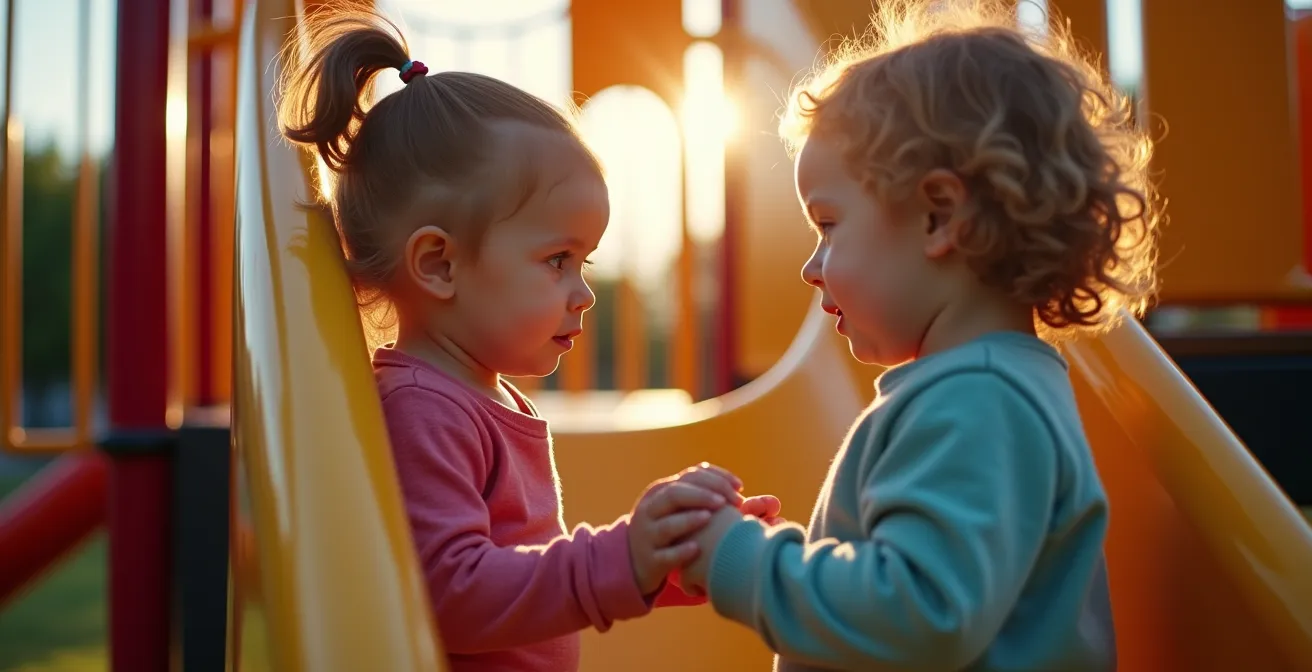
As you can see, the body language and interaction between the children themselves become the lesson. Your role is not to prevent these small frictions, but to provide the safe space for them to happen. The goal is for your child to build a mental library of social cause-and-effect based on hundreds of these tiny, low-stakes interactions. This is the foundational work that prepares them for the complex social landscape of a classroom, where you won’t be there to translate the rules.
How to Choose a Playgroup That Won’t Overwhelm a Sensitive Child?
For a child accustomed to the predictable calm of home, a chaotic playgroup can be a sensory nightmare, leading to shutdown rather than social growth. The solution isn’t to avoid groups, but to choose them with the care of a strategist. The key is finding an environment that offers “structured freedom”—a predictable framework within which social interaction can happen organically. An unstructured free-for-all with 20 children is overwhelming; a structured craft activity with 4 other children at a designated table is manageable.
Look for predictability in three key areas: the environment, the routine, and the activities. Is there a quiet corner where a child can retreat if they feel overwhelmed? Is there a visual schedule posted on the wall, so they know what’s coming next (e.g., circle time, then snack, then free play)? Are the activities rule-based, like a board game or a group song, which have clear expectations? These elements reduce cognitive load, freeing up your child’s mental energy to focus on the social part of the experience. This approach is validated by early learning programs, as shown in one successful program that prepares resources in advance using baskets or caddies, which helps sensitive children predict what’s coming and reduces anxiety.
Case Study: The Power of Predictable Spaces
The Experience Early Learning approach demonstrates a powerful principle: sensitive children thrive when group activities happen in designated, predictable spaces. By using a specific table for small group instruction where children all face the teacher, distractions are minimized. Furthermore, by preparing all necessary materials in advance in clearly visible baskets, the children can anticipate the activity’s components. This simple act of making the materials and space predictable dramatically reduces the anxiety that comes from unexpected transitions, allowing the child to engage more confidently with the group.
When you visit a potential playgroup, don’t just watch the children; observe the structure. A well-managed, predictable environment is the single most important factor in ensuring a positive first group experience for a sensitive child. It provides the psychological safety net they need to dare to engage.
Music Class or Park Meetup: Which Builds Better Listening Skills?
A common parental goal is to “improve listening skills.” But not all listening is the same. It’s crucial to differentiate between instructional listening (following a teacher’s clear directions) and social listening (tuning into a peer’s quiet voice amidst chaos). An only child is often an expert at the first, thanks to years of clear, one-on-one communication with adults. It’s the second type that requires dedicated practice in a group setting. A music class and a park meetup are not interchangeable; they are training grounds for two different, equally vital skills.
A music class offers a high signal-to-noise ratio. Instructions are clear, turn-taking is explicit (“Now it’s your turn to shake the maraca”), and the focus is on responding to a central leader. This is an excellent environment for building foundational instructional listening and the ability to function within a structured group. Conversely, a park meetup is a masterclass in social listening. The signal-to-noise ratio is low. Your child must learn to filter out the sounds of other games and distant traffic to hear what a friend is whispering. They must read subtle social cues and interpret tone, practicing the complex auditory filtering that is essential for classroom conversations and playground friendships. Both activity types develop different but complementary skills, and a breakdown of group learning environments illustrates this well.
| Aspect | Music Class | Park Meetup |
|---|---|---|
| Type of Listening | Instructional Listening | Social Listening |
| Signal-to-Noise Ratio | High (clear instructions, low distraction) | Low (background noise, multiple conversations) |
| Turn-Taking Practice | Explicit (‘Now it’s your turn to shake the maraca’) | Implicit (natural conversation flow) |
| Skills Developed | Following directions, rhythm, structured response | Auditory filtering, peer cue recognition, tone interpretation |
| Best For | Building foundational listening | Advanced social listening in realistic environments |
The strategic approach is to use both. Start with structured activities like a music or art class to build confidence in a group setting. As your child becomes more comfortable, introduce less structured environments like park meetups to hone their social listening. A comprehensive meta-analysis found that peer interaction across 71 datasets led to improved cognitive outcomes, including verbal memory, showcasing the broad benefits of these interactions. By consciously choosing the right setting for the right skill, you are methodically building their auditory and social toolkit.
The Intervention Mistake That Prevents Conflict Resolution Skills
When a conflict erupts over a toy, a parent’s instinct is to swoop in and solve it: “Be nice, you need to share,” or “You play with it for five minutes, then it’s her turn.” This is the single biggest mistake that short-circuits the learning process. By providing the solution, you rob your child of the opportunity to practice one of the most critical life skills: negotiation. Every squabble over a blue truck is not a problem to be squashed; it’s a vital conflict rehearsal. Your job is not to be the judge, but the “sportscaster.”
The Sportscaster Method involves narrating the facts without judgment, a technique detailed by early childhood education specialists. Instead of solving, you describe what you see, which helps children process the situation and their feelings. This simple shift in your role is transformative.
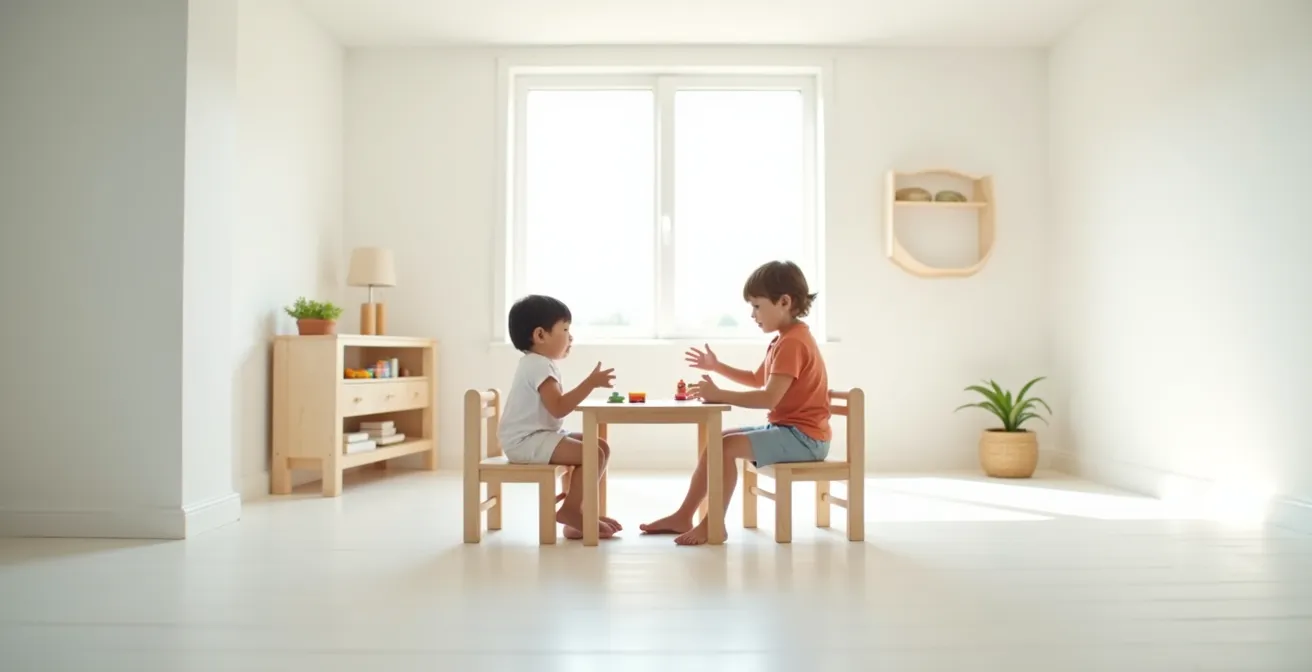
You become a facilitator, not a fixer. By validating their emotions (“You both look frustrated”) and asking open-ended questions (“What could we do so everyone gets a turn?”), you empower them to generate their own solutions. The solutions they come up with might be clunky or inefficient by adult standards, but they are *theirs*. They own the process and the outcome, and the lesson in negotiation, compromise, and problem-solving is deeply ingrained. This is a skill that will serve them every single day in the schoolyard.
I see that Maya has the blue truck, and you want to play with it. Maya, you look unhappy that he took it.
– Example of Sportscaster Method, Small Group Activities for Preschool
Your Action Plan: The Sportscaster Method for Conflict Resolution
- Narrate observable facts without judgment (‘I see two children who both want the same toy’).
- Validate emotions without solving (‘You both look frustrated’).
- Ask open-ended questions (‘What could we do so everyone gets a turn?’).
- Wait for children to generate solutions (count to 10 silently).
- Support child-generated solutions rather than imposing adult solutions.
How to Desensitize a Quiet-Home Child to Group Noise Levels?
For a child whose primary environment is the relative quiet of home, the cacophony of a classroom—bells ringing, chairs scraping, 20 voices talking—can be physically and emotionally overwhelming. This isn’t a behavioral issue; it’s a sensory one. The solution is gradual sensory acclimatization, not sudden immersion. You can build your child’s tolerance to noise at home, turning a potential source of anxiety into a manageable part of their world.
Think of it as building a “sensory diet.” You start with small, controlled doses of noise in a safe, happy context. This could involve short, 5-minute dance parties where you gradually increase the volume, or using noisy kitchen appliances like a blender together. You can even play recordings of happy crowd sounds (like a bustling playground) for short, increasing intervals each week. The key is to associate these sounds with positive experiences and to always give your child a sense of control.
One powerful strategy is to frame noise-management tools as empowerment. As demonstrated at Connection Point Early Learning Center, noise-reducing headphones shouldn’t be presented as a crutch for a weakness, but as a cool tool of control, like “sunglasses for your ears.” Empowering a child to use them when they feel overwhelmed gives them agency. The center found that children with this tool increased their participation in group activities and, over 8-12 weeks, most gradually stopped needing the headphones as their natural tolerance grew. Always ensure a “quiet corner” with soft pillows or books is available, reinforcing the idea that it’s okay to take a break and self-regulate.
Here are some practical steps to build a sensory diet at home:
- Start with 5-minute dance parties with gradually increasing volume.
- Use kitchen appliances together (blender, mixer) to normalize mechanical sounds.
- Play recordings of happy crowd sounds for 2 minutes, increasing by 30 seconds weekly.
- Create ‘noise games’ where making sound is the goal (musical instruments, clapping rhythms).
- Practice in semi-public spaces (library storytime) before full group settings.
- Always provide a ‘quiet corner’ option for self-regulation breaks.
Stick it Out or Quit: What to do Mid-Season if They Hate it?
It’s a scenario many parents face: you’ve invested time, money, and hope into a new activity, and a few weeks in, your child declares, “I hate it!” The immediate dilemma is whether to force them to “stick it out” to teach commitment or to let them quit to honor their feelings. The most strategic response is neither. Instead, it’s time to become a feelings detective. “I hate it” is rarely about the activity itself; it’s a headline for an underlying problem.
Your first job is to investigate the “why” behind the hate. Is it the coach’s loud voice? Is another child being unkind? Is the uniform itchy or uncomfortable? Is the activity too hard, leading to feelings of failure, or too easy, leading to boredom? Often, the problem is small and solvable. By asking specific, neutral questions, you can uncover the root cause. For example, instead of “Why do you hate soccer?” try “I noticed you spent a lot of time near the water cooler today. Were you feeling thirsty or tired?”
If you’ve played detective and can’t find a solvable issue, the conversation shifts from the activity to the experience. Forcing a genuinely miserable child to finish a season can create a long-term aversion to trying new things. Instead, you can negotiate an exit strategy. This might involve agreeing to attend two more classes and then re-evaluating, or finishing the season but with the clear understanding that they won’t sign up again. This approach respects their feelings while still modeling a sense of responsibility. The lesson becomes about navigating difficult situations, not just enduring them.
The goal isn’t loving the activity but learning from the experience. A post-season debrief helps children understand what they learned about trying new things, dealing with frustration, and being part of a team.
– Educational Leadership, Peer Learning Strategies
Cycling or Soccer: Which Suits the Introverted Child Better?
For a more introverted child, the social demands of a team sport can be as draining as the physical exertion. The key to successful group activity is not to force them into a mold but to match the activity’s social structure to their personality. It’s helpful to think in terms of parallel vs. interactive activities. An introverted child often thrives in parallel activities, where they can be part of a group without the pressure of constant interaction.
Soccer is a highly interactive activity. It requires continuous verbal and non-verbal communication, rapid adaptation to changing team dynamics, and a high level of social engagement. For an introverted child who needs time to process, this can be overwhelming. Cycling, swimming, or a martial arts class, on the other hand, are largely parallel activities. A child can ride their bike alongside friends, participating in the group experience while remaining in their own mental space. They can observe social dynamics from a safe distance before choosing to engage.
Research supports this graduated approach. A study on preschoolers found that introverted children who began with parallel activities like cycling showed 50% higher engagement when later introduced to interactive team sports, compared to those who started directly with high-interaction activities. Starting with parallel play builds confidence and social stamina.
| Factor | Cycling | Soccer |
|---|---|---|
| Social Battery Drain | Low (can be done alone or alongside others) | High (constant team communication required) |
| Activity Type | Parallel (doing alongside others) | Interactive (engaging with others) |
| Role Predictability | Clear and unchanging role | Dynamic role requiring constant adaptation |
| Communication Needs | Minimal verbal interaction | Continuous verbal and non-verbal communication |
| Introvert Suitability | High – allows processing time | Lower – requires immediate social responses |
Key Takeaways
- An only child’s social readiness for school depends on a strategically built ‘social toolkit’, not just random exposure to peers.
- Focus on structured group settings that allow for low-stakes practice of specific skills like negotiation, auditory filtering, and sensory regulation.
- Your role as a parent is to be a facilitator and ‘sportscaster’ during conflicts, not a judge who provides immediate solutions.
Simulating Sibling Dynamics: Building Cooperation Without a Built-in Playmate
A common concern is that only children miss out on the constant negotiation and cooperation that sibling life entails. While they don’t have a live-in sparring partner, you can strategically simulate these learning opportunities through structured play. The goal is to create scenarios where success is impossible without teamwork. This shifts the dynamic from competition (“me vs. you”) to cooperation (“us vs. the problem”).
Cooperative games are a perfect tool for this. Unlike traditional board games where there’s one winner, cooperative games require all players to work together to beat the game itself. Games like “Pandemic Junior” or “Outfoxed!” require shared decision-making, communication, and strategic planning. During play, you can model collaborative language by thinking aloud: “Hmm, if I use my special move here, it might help you get to the next space. What do you think?”
Beyond board games, you can set up cooperative challenges. This could be a building project with LEGOs where two people are required (one to hold a piece while the other connects it), or even local co-op video games that demand teamwork. The key is to celebrate joint victories and, just as importantly, analyze joint defeats together without blame. This process teaches your child that pooling resources and ideas leads to better outcomes—a foundational lesson for any group project they will encounter in school and life.
Here are some ways to practice this at home:
- Select cooperative board games where players work together against the game.
- Rotate roles during play – one turn as leader, next as supporter.
- Practice ‘thinking aloud’ to model collaborative problem-solving.
- Celebrate joint victories and analyze joint defeats together.
- Use video games with local co-op modes requiring teamwork.
- Set up building challenges requiring two people (one holds, one connects).
By intentionally creating these moments of shared challenge and success, you are giving your only child the invaluable gift of cooperative practice. Now that you have this toolkit of strategies, the next step is to begin consciously observing and choosing the small, everyday opportunities to put them into action, transforming your role from a caregiver to a strategic social coach.