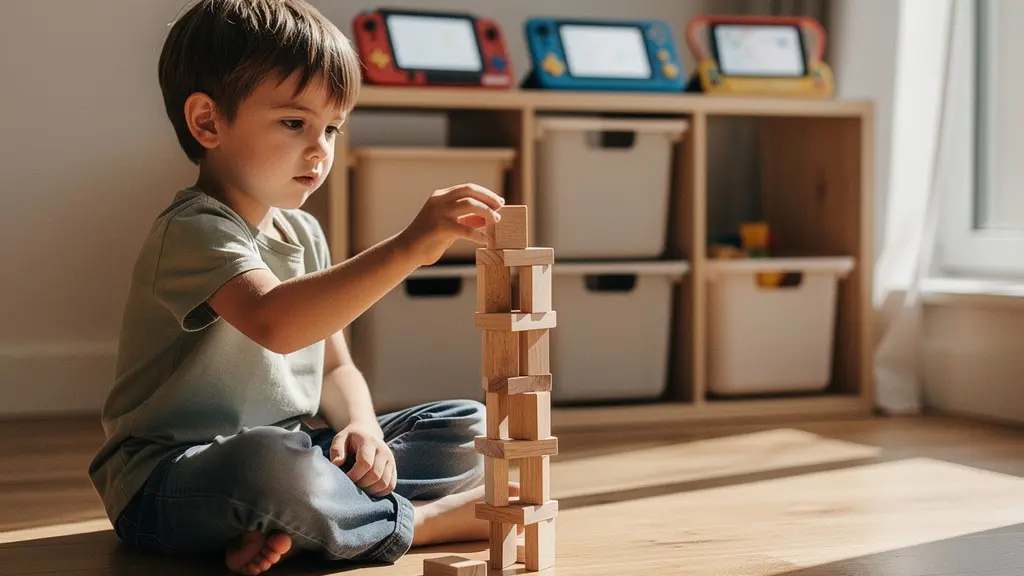
The true value of a toy is not in its material, but in the cognitive work it demands from the child.
- Toys that “do everything” for a child actively reduce their cognitive effort and long-term engagement.
- A superior toy follows the “90/10 Rule”: it provides 10% of the structure, requiring the child to contribute 90% of the play.
Recommendation: Instead of asking “Is it wooden or electronic?”, ask “Does this toy think for my child, or does it make my child think?”
The aisle is a dizzying kaleidoscope of options: rustic, minimalist wooden blocks promise wholesome, imaginative play, while flashing, beeping electronic gadgets boast of accelerated learning and STEM-readiness. For parents overwhelmed by marketing claims, the choice often defaults to a simple binary: natural is good, technology is bad. This leads many to believe that the inherent superiority of a toy lies in its material composition.
The common advice is to opt for “open-ended” wooden toys to foster creativity and avoid the passive stimulation of their electronic counterparts. While well-intentioned, this view oversimplifies the complex mechanics of play and learning. The critical factor isn’t wood versus plastic, or analog versus digital. It’s a question of cognitive science: how does a toy interact with a child’s developing mind?
But what if the key to unlocking a child’s focus and engagement isn’t about banning batteries, but about understanding a concept called cognitive load? This article moves beyond the surface-level debate to provide a researcher’s framework. We will analyze why some toys, regardless of material, end up in a forgotten pile, while others become cherished tools for learning for years. We will equip you with the criteria to assess any toy, not by its features, but by the cognitive investment it demands from your child.
This guide provides an analytical framework to navigate the toy market. By exploring the underlying cognitive principles, you will learn to identify toys that genuinely build neural pathways and foster deep, sustained engagement, moving beyond marketing hype to make choices that truly support your child’s development.
Summary: The Cognitive Science of Choosing a Toy
- Why toys that “do it for you” reduce cognitive effort?
- How to spot a toy that will still be used in 2 years?
- Puzzle or Blocks: Which develops better spatial reasoning?
- The “Advanced Toy” trap: Why buying above age level causes frustration?
- How many toys should be out at once to maximize engagement?
- Loose Parts vs. Craft Kits: Which offers more hours of play?
- Passive TV vs. Active Play: Which truly builds neural pathways?
- How to Encourage Creative Play in Small Apartments Without Mess?
Why Toys That “Do It for You” Reduce Cognitive Effort?
The core issue with many modern toys, particularly electronic ones, is not their material but their design philosophy. They are often engineered to perform for the child, delivering a dazzling display of lights, sounds, and pre-programmed actions at the push of a button. This design minimizes the child’s role to that of a passive observer. From a cognitive science perspective, this is problematic because it significantly lowers the required cognitive investment. When a toy “does the thinking,” it offloads the mental work the child should be doing, such as creating a narrative, solving a problem, or imagining possibilities.
This offloading is directly related to the theory of cognitive load, which examines how working memory is used during learning. As British psychologists Alan Baddeley and Graham Hitch, pioneers in this field, explained in their research:
Children lack general knowledge, and this is what creates increased cognitive load in children.
– Alan Baddeley and Graham Hitch, British psychologists, 2004 research on working memory
A toy that presents too much extraneous information (flashing lights, irrelevant sounds) or solves the problem for the child (a car that follows a pre-set track) overloads their limited working memory with passive inputs, leaving little capacity for the active cognitive processes required for genuine learning. In contrast, simpler, more ambiguous objects demand that the child draw on their own internal resources to give the object meaning and function. Research supports this; a meta-analysis found that children using hands-on Montessori materials, which are simple and purposeful, showed significantly better outcomes. The analysis revealed that on average, children using these materials outperformed peers by 22% on problem-solving tasks.
Ultimately, a toy that does it all teaches one thing: passivity. The child learns to expect entertainment rather than creating it, a mindset that curtails the development of critical skills like problem-solving, creativity, and sustained attention.
How to Spot a Toy That Will Still Be Used in 2 Years?
The longevity of a toy is not determined by its durability but by its “playability” over time. A toy that remains engaging for years is one that can adapt to a child’s evolving cognitive abilities. The key characteristic to look for is its potential for divergent, open-ended play. A fire truck that only makes a siren sound has a single, convergent function. A simple wooden block, however, can be a car, a phone, a piece of a castle, or a stepping stone in a lava-filled landscape. Its function is determined entirely by the child’s imagination, allowing it to remain relevant as the child’s play scenarios become more complex.
This principle is best captured by the “90/10 Rule”: a truly valuable toy is one where the child provides 90% of the play, and the toy provides only 10% of the structure or action. Toys that invert this ratio—where the toy does 90% of the work—are quickly mastered and discarded. A University of Toledo study powerfully illustrates a related concept: quantity overload. The research, involving toddlers, found that children presented with only four toys played more deeply and creatively with each one compared to children given sixteen toys, who became distracted and flitted between them without meaningful engagement. Fewer, more versatile toys are demonstrably better.
Your Action Plan: The 90/10 Toy Longevity Test
- Assess Open-Ended Potential: Can this toy be used in at least five different ways that are not explicitly instructed by its design? (e.g., a stick can be a wand, a sword, a bridge, a horse, a drawing tool).
- Evaluate Integration Capability: Can this toy be easily combined with other simple toys (like blocks, figures, or natural materials) to create more elaborate play scenarios?
- Apply the 90/10 Rule: In a typical play session, who is doing the work? Does the child invent the sounds, movements, and story? Or does the toy dictate the action? The child should be the primary engine of play.
- Check for Growth Potential: Will this toy still be relevant as my child moves from simple sensory exploration to complex symbolic play? (e.g., a set of nesting bowls).
- Gauge Simplicity: Does the toy’s primary value come from its form and material, or from its electronic features? The simpler and more ambiguous the object, the more cognitive work it demands from the child.
By using this framework, parents can move beyond brand names and material biases to identify toys that are not just fleeting novelties, but long-term partners in cognitive development.
Puzzle or Blocks: Which Develops Better Spatial Reasoning?
Both puzzles and blocks are stalwarts of the educational toy world, and both are lauded for developing spatial reasoning. However, as a researcher, it’s critical to understand that they cultivate different *types* of spatial and cognitive skills. The choice between them isn’t about which is “better” overall, but which specific skill you wish to target. This distinction is crucial for providing a balanced cognitive diet for a developing mind.
A puzzle, by its nature, promotes convergent thinking. There is a single, correct solution: the pieces fit together in a predetermined way to form a specific image. This is excellent for developing 2D spatial reasoning, pattern recognition, and problem-solving within a fixed framework. The child learns to analyze shapes, orientations, and how parts relate to a whole. In contrast, blocks foster divergent thinking. With a set of blocks, there is an infinite number of solutions and creations. This type of play develops 3D spatial reasoning, as the child must consider balance, gravity, symmetry, and structural integrity. They are not just fitting pieces, but engineering structures.
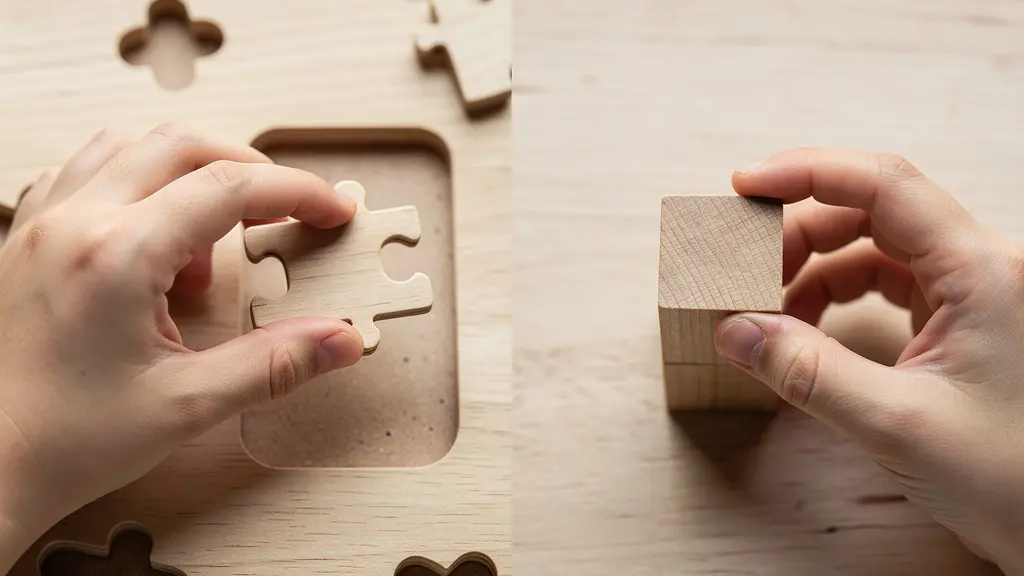
As the image above illustrates, the physical manipulation required for each activity is distinct. Puzzle play involves fine motor skills for fitting and turning, while block play engages gross motor skills for stacking and balancing. The cognitive processes are just as different. One is a process of discovery within limits; the other is a process of invention without them.
The following table breaks down these differences to help guide a more informed choice, directly sourcing its structure from established developmental frameworks.
| Aspect | Puzzles | Blocks |
|---|---|---|
| Spatial Dimension | 2D spatial reasoning | 3D spatial reasoning |
| Problem Type | Convergent (one solution) | Divergent (infinite solutions) |
| Real-world Application | Map reading, data charts | Engineering, architecture |
| Cognitive Focus | Pattern recognition | Balance, gravity, symmetry |
A balanced approach is ideal. Puzzles build the ability to solve defined problems, a crucial skill for logical tasks. Blocks build the ability to create novel solutions, the foundation of innovation. Both are essential, but they are not interchangeable.
The “Advanced Toy” Trap: Why Buying Above Age Level Causes Frustration?
A common parental ambition is to give their child a head start by purchasing toys labeled for an older age group. The logic seems sound: a more complex toy will challenge the child and accelerate their learning. However, this often backfires, leading not to accelerated development but to frustration, disengagement, and a missed learning opportunity. This phenomenon, the “Advanced Toy Trap,” is rooted in a misunderstanding of developmental readiness and cognitive load.
When a toy’s complexity far exceeds a child’s current cognitive or fine motor skills, it creates an insurmountable level of intrinsic cognitive load. The child lacks the foundational knowledge or physical dexterity to even begin to engage with the toy as intended. Instead of a “desirable difficulty” that promotes growth, the toy becomes a source of failure. This can negatively impact a child’s motivation and self-efficacy. As education researcher Roxana Moreno noted, the pure mechanics of cognitive load theory don’t always account for the learner’s emotional state, yet it’s a critical factor. A child who repeatedly fails to operate a toy is likely to internalize a sense of incompetence and avoid similar challenges in the future.
Conversely, providing developmentally appropriate tools leads to a more positive and productive play experience. When tasks are achievable, children are more likely to persist and engage in complex problem-solving. This is backed by observational data from educators, who find that frustration behaviors are reduced by about 40% during complex tasks when children use tools designed for their developmental stage. The goal is not to avoid challenge, but to ensure the challenge is within what psychologist Lev Vygotsky called the “Zone of Proximal Development”—the sweet spot where a child can succeed with a bit of effort and guidance.
Instead of “buying up,” parents should focus on providing toys that offer a high “skill-to-challenge” ratio. A toy that is just slightly beyond a child’s current mastery invites engagement and fosters a sense of accomplishment, building a resilient and motivated learner.
How Many Toys Should Be Out at Once to Maximize Engagement?
In many modern homes, playrooms are overflowing with toys, a testament to good intentions. Yet, from a child development perspective, this abundance is often counterproductive. The concept of “less is more” is not a minimalist aesthetic preference but a scientifically supported strategy for fostering deeper, more meaningful play. An environment saturated with choices overwhelms a child’s attentional system, leading to distracted, superficial interactions with their toys.
Research consistently shows that when faced with too many options, children struggle to focus. They flit from one toy to another, never settling long enough to explore any single object’s full potential. This was the central finding in government-funded research by psychotherapist Claire Lerner, who concluded that an excess of toys leads to children being “overwhelmed and over-stimulated.” A powerful study from the University of Toledo confirmed this with 36 toddlers, demonstrating that those with fewer toys showed higher quality play, including longer durations of engagement and more creative uses for each toy. The paradox is that more toys lead to less play. This is reflected in staggering survey data suggesting the average child owns around 238 toys, yet parents report they consistently play with only about 12 favorites—a mere 5% of their collection.
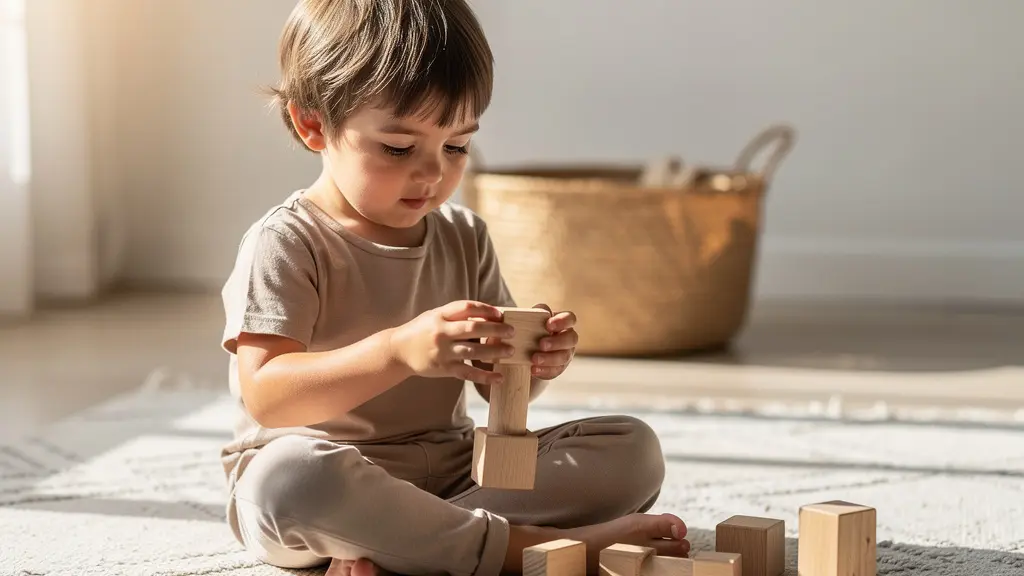
The most effective strategy to combat this is toy rotation. This involves keeping the majority of toys in storage and presenting only a small, curated selection (typically 4-10 toys) at a time. This curated environment reduces extraneous cognitive load, allowing the child to fully engage their attention. By rotating the toys weekly or bi-weekly, novelty is maintained without creating overwhelming chaos. This practice encourages children to delve deeper, discover new ways to use familiar objects, and ultimately, builds a more robust capacity for sustained focus.
The goal is not deprivation, but focus. By curating the play space, parents can transform a distracting environment into a calm, engaging one that nurtures concentration and creativity.
Loose Parts vs. Craft Kits: Which Offers More Hours of Play?
The question of loose parts versus craft kits gets to the heart of process versus product. A craft kit is, by design, product-oriented and convergent. It contains all the necessary components and a set of instructions to create a specific, predetermined outcome—a painted birdhouse, a beaded necklace. While it can teach a child to follow directions and offers the satisfaction of a finished product, its play value is finite. Once the birdhouse is built, the kit’s primary function is complete.
In stark contrast, “loose parts” play is entirely process-oriented and divergent. The theory of loose parts, first proposed by architect Simon Nicholson, posits that the richness of an environment depends on the number of variables and open-ended materials it contains. These parts—shells, twigs, buttons, screws, fabric scraps, cardboard tubes—have no prescribed function. They are raw materials for the imagination. This ambiguity is their strength, as it maximizes the cognitive and creative investment required from the child. A child with a box of loose parts is not a consumer following a blueprint; they are an inventor, an artist, and an engineer.
Because loose parts can be combined and re-imagined in infinite ways, they offer exponentially more hours of play than a single-use kit. Research from institutions like the University of Cambridge has found that children with access to fewer, more open-ended materials demonstrate longer attention spans and greater creativity in their play. They are forced to problem-solve, experiment, and innovate with what is at hand. To begin with this powerful play method:
- Start with curated trays, separating materials by type (e.g., natural, metallic, soft).
- One tray could hold natural items like shells, smooth stones, and twigs.
- Another could offer metallic items like nuts, bolts, and washers for a different sensory and constructive experience.
- Rotate these materials weekly to keep the selection feeling fresh without being overwhelming.
- Focus on validating the process by photographing or displaying their creations, rather than asking “What is it?”
While craft kits have a place for teaching specific skills, a foundation of loose parts play is far more effective for building the enduring, transferable skills of creativity, resourcefulness, and divergent problem-solving.
Passive TV vs. Active Play: Which Truly Builds Neural Pathways?
The contrast between passive screen time and active, hands-on play represents one of the most significant dichotomies in modern childhood. While both can expose a child to new information, their effects on brain development are profoundly different. Active play is a multi-sensory, whole-body experience that is foundational for building robust neural architecture.
When a child engages in active play—stacking blocks, running outside, manipulating clay—they are not just using their hands. They are integrating sensory inputs (touch, sight, sound), practicing motor control, navigating spatial relationships, and often, engaging in social negotiation. This complex, self-directed activity stimulates the brain to form and strengthen new neural pathways across multiple regions, particularly in the prefrontal cortex, which governs executive functions like planning and problem-solving. Passive screen viewing, conversely, primarily stimulates the visual and auditory pathways in a receptive, non-interactive manner. The experience is largely consumed, not created.
Critically, active play is a powerful tool for developing emotional regulation. A groundbreaking 2024 study involving 654 caregiver-child pairs found that play with real toys was a stronger predictor of preventing screen-time-related tantrums than even the child’s own executive function skills. This suggests that the physical, tactile nature of toy play builds a capacity for emotional self-regulation that passive viewing does not. Of course, active play can also be loud and chaotic, a factor that affects the entire family system. A survey of Illinois parents revealed that 72% reported experiencing sensory overload from the noise levels during their children’s play, a valid concern that highlights the intensity of this developmental process.
While screens can be tools for content delivery, they cannot replicate the holistic, brain-building experience of interacting with the physical world. Prioritizing active play is a direct investment in a child’s cognitive, emotional, and physical architecture.
Key Takeaways
- The educational value of a toy is defined by the cognitive effort it requires from the child, not its material.
- Adopt the “90/10 Rule” as a primary filter: the child should do 90% of the work.
- A curated, limited selection of toys (toy rotation) is more effective for deep engagement than an abundance of choice.
How to Encourage Creative Play in Small Apartments Without Mess?
One of the biggest barriers for parents wanting to encourage creative, hands-on play—especially in smaller living spaces—is the inevitable mess. The prospect of paint spills, tiny pieces scattered everywhere, and a living room turned upside down can feel daunting. However, fostering creativity does not have to be synonymous with chaos. With a strategic approach centered on containment, portability, and redefined boundaries, it’s entirely possible to support rich, creative exploration without sacrificing order.
The key is to shift the mindset from “no mess” to “constructive, contained mess.” This involves creating designated, manageable zones and systems for creative activities. Instead of allowing creative supplies to spread across the home, establish clear physical boundaries. This not only keeps the mess manageable but also helps children learn the valuable life skill of respecting spaces and cleaning up. In his work, author Joshua Becker touches upon the underlying benefit of this limitation:
Fewer toys causes children to become resourceful by solving problems with only the materials at hand. And resourcefulness is a gift with unlimited possibilities.
– Joshua Becker, ClutterFree with Kids
This principle of resourcefulness can be applied to space as well as materials. Here are some practical, space-saving solutions:
- Use Vertical Space: Walls are an underutilized resource. Use removable adhesive felt boards for storytelling, or apply a patch of magnetic or chalkboard paint to a designated wall area.
- Define Play Boundaries: A single, dedicated mat or a small rug can become the official “construction zone” or “art studio.” The rule is simple: the creative mess stays on the mat. This makes cleanup faster and teaches containment.
- Create Portable Play Kits: Instead of a large, static art corner, create several small, portable kits in shoeboxes or bins. One might be a drawing kit (paper, crayons, stencils), another a sculpting kit (clay, small tools), and a third a building kit (loose parts).
- Limit to One Kit at a Time: Allow only one kit to be used at a time. This naturally reduces the scale of the mess, encourages focused play on a single activity, and simplifies the cleanup process before a new kit can be brought out.
Ultimately, this approach teaches children that creativity can be both expansive in imagination and respectful of its physical environment, fostering both artistic freedom and personal responsibility.